Giovannoni S J, DeLong E F, Olsen G J, Pace N R
Department of Biology, Indiana University, Bloomington 47405.
J Bacteriol. 1988 Feb;170(2):720-6. doi: 10.1128/jb.170.2.720-726.1988.
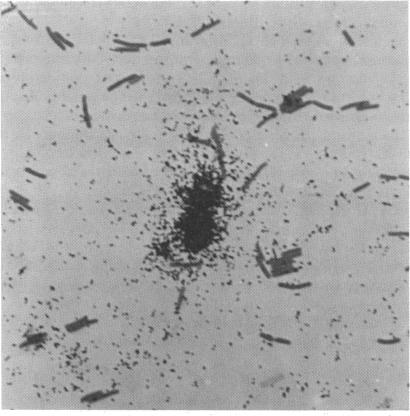
Examination of collections of 16S rRNA sequences revealed sequence domains that were unique to (and invariant within) the three primary lines of cellular descent: the archaebacteria, the eubacteria, and the eucaryotes. Oligodeoxynucleotides complementary to these conserved sequence domains were synthesized and used as hybridization probes. Each of the radiolabeled probes specifically hybridized to nylon membrane-bound 16S rRNA from the targeted kingdom. A probe complementary to a universally conserved sequence in 16S rRNAs was used as a positive control, while its complement provided a negative control for nonspecific binding. The abilities of the probes to bind specifically to whole, fixed cells representing a broad array of phylogenetic diversity were tested in whole-cell dot blot assays. Again, all of the probes specifically bound the targeted groups. By microautoradiography, the method was extended to permit phylogenetic identification of single cells microscopically.
对16S rRNA序列集合的研究揭示了细胞进化三个主要谱系(古细菌、真细菌和真核生物)所特有的(且在谱系内不变的)序列结构域。合成了与这些保守序列结构域互补的寡脱氧核苷酸,并用作杂交探针。每种放射性标记探针都能特异性地与来自目标界的尼龙膜结合的16S rRNA杂交。与16S rRNA中普遍保守序列互补的探针用作阳性对照,而其互补序列则为非特异性结合提供阴性对照。在全细胞斑点印迹分析中测试了这些探针特异性结合代表广泛系统发育多样性的完整固定细胞的能力。同样,所有探针都特异性结合目标群体。通过微放射自显影,该方法得以扩展,从而能够在显微镜下对单个细胞进行系统发育鉴定。