Ranlund Siri, Nottage Judith, Shaikh Madiha, Dutt Anirban, Constante Miguel, Walshe Muriel, Hall Mei-Hua, Friston Karl, Murray Robin, Bramon Elvira
Mental Health Sciences Unit & Institute of Cognitive Neuroscience, University College London, W1W 7EJ, United Kingdom.
NIHR Biomedical Research Centre for Mental Health at the South London and Maudsley NHS Foundation Trust and Institute of Psychiatry, Kings College London, WC2R 2LS, United Kingdom.
Schizophr Res. 2014 Mar;153(1-3):96-102. doi: 10.1016/j.schres.2013.12.017. Epub 2014 Jan 31.
Finding reliable endophenotypes for psychosis could lead to an improved understanding of aetiology, and provide useful alternative phenotypes for genetic association studies. Resting quantitative electroencephalography (QEEG) activity has been shown to be heritable and reliable over time. However, QEEG research in patients with psychosis has shown inconsistent and even contradictory findings, and studies of at-risk populations are scarce. Hence, this study aimed to investigate whether resting QEEG activity represents a candidate endophenotype for psychosis.
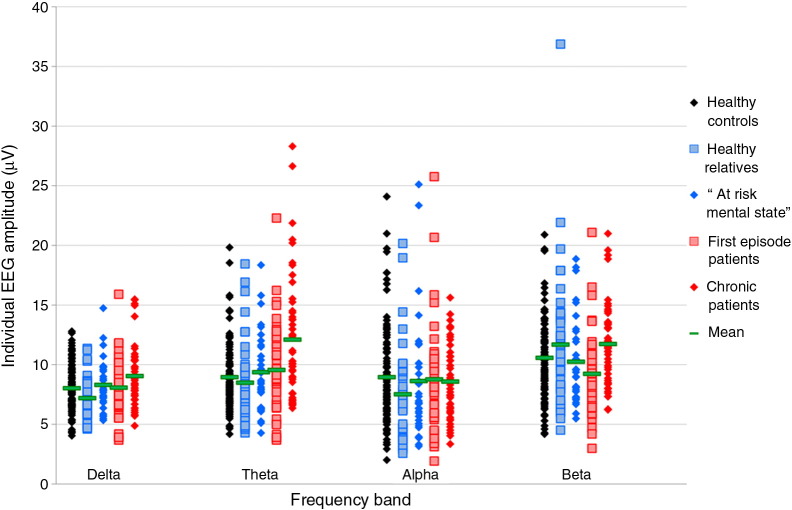
QEEG activity at rest was compared in four frequency bands (delta, theta, alpha, and beta), between chronic patients with psychosis (N=48), first episode patients (N=46), at-risk populations ("at risk mental state", N=33; healthy relatives of patients, N=45), and healthy controls (N=107).
Results showed that chronic patients had significantly increased resting QEEG amplitudes in delta and theta frequencies compared to healthy controls. However, first episode patients and at-risk populations did not differ from controls in these frequency bands. There were no group differences in alpha or beta frequency bands.
Since no abnormalities were found in first episode patients, ARMS, or healthy relatives, resting QEEG activity in the frequency bands examined is unlikely to be related to genetic predisposition to psychosis. Rather than endophenotypes, the low frequency abnormalities observed in chronic patients are probably related to illness progression and/or to the long-term effects of treatments.
找到可靠的精神病内表型有助于增进对病因的理解,并为基因关联研究提供有用的替代表型。静息定量脑电图(QEEG)活动已被证明具有遗传性且随时间推移较为稳定。然而,针对精神病患者的QEEG研究结果并不一致,甚至相互矛盾,且对高危人群的研究较少。因此,本研究旨在探讨静息QEEG活动是否代表精神病的候选内表型。
比较了慢性精神病患者(N = 48)、首发患者(N = 46)、高危人群(“高危精神状态”,N = 33;患者的健康亲属,N = 45)和健康对照(N = 107)在四个频段(δ、θ、α和β)的静息QEEG活动。
结果显示,与健康对照相比,慢性患者在δ和θ频段的静息QEEG振幅显著增加。然而,首发患者和高危人群在这些频段与对照并无差异。在α或β频段没有组间差异。
由于在首发患者、高危精神状态人群或健康亲属中未发现异常,因此在所检查频段的静息QEEG活动不太可能与精神病的遗传易感性相关。慢性患者中观察到的低频异常可能与疾病进展和/或治疗的长期影响有关,而非内表型。