Posnack Nikki Gillum, Jaimes Rafael, Asfour Huda, Swift Luther M, Wengrowski Anastasia M, Sarvazyan Narine, Kay Matthew W
Department of Pharmacology & Physiology, and.
Environ Health Perspect. 2014 Apr;122(4):384-90. doi: 10.1289/ehp.1206157. Epub 2014 Jan 31.
Bisphenol A (BPA) is used to produce polycarbonate plastics and epoxy resins that are widely used in everyday products, such as food and beverage containers, toys, and medical devices. Human biomonitoring studies have suggested that a large proportion of the population may be exposed to BPA. Recent epidemiological studies have reported correlations between increased urinary BPA concentrations and cardiovascular disease, yet the direct effects of BPA on the heart are unknown.
The goal of our study was to measure the effect of BPA (0.1-100 μM) on cardiac impulse propagation ex vivo using excised whole hearts from adult female rats.
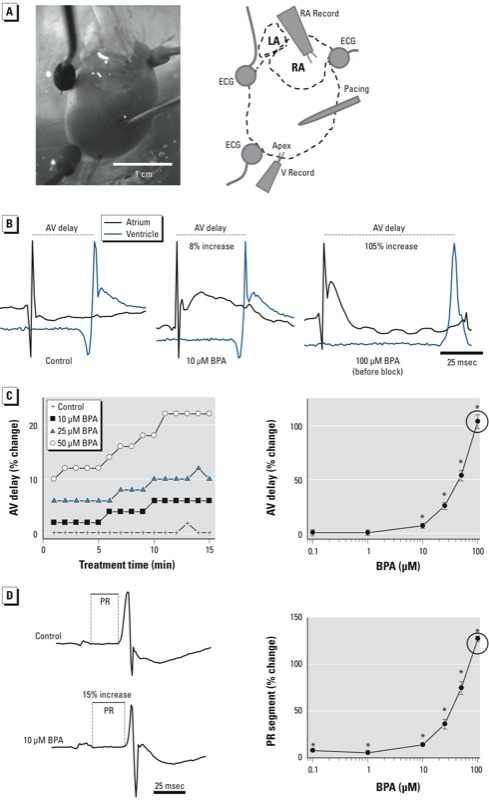
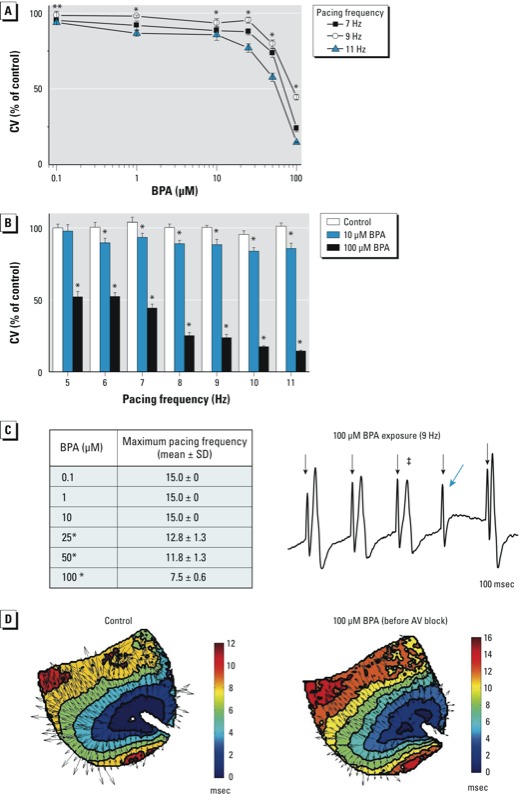
We measured atrial and ventricular activation times during sinus and paced rhythms using epicardial electrodes and optical mapping of transmembrane potential in excised rat hearts exposed to BPA via perfusate media. Atrioventricular activation intervals and epicardial conduction velocities were computed using recorded activation times.
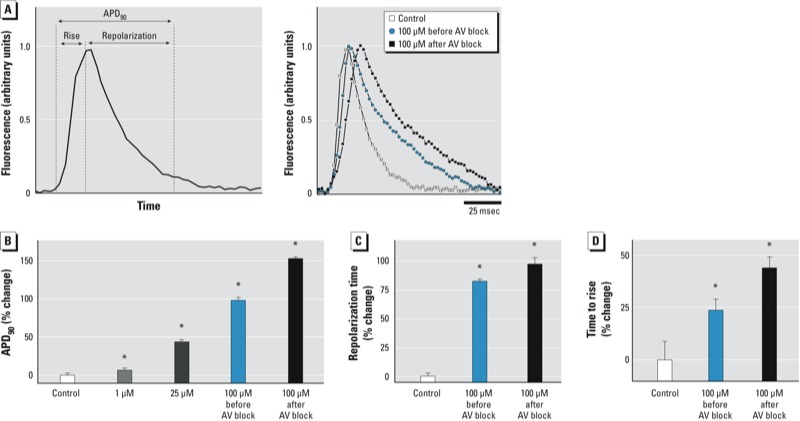
Cardiac BPA exposure resulted in prolonged PR segment and decreased epicardial conduction velocity (0.1-100 μM BPA), prolonged action potential duration (1-100 μM BPA), and delayed atrioventricular conduction (10-100 μM BPA). These effects were observed after acute exposure (≤ 15 min), underscoring the potential detrimental effects of continuous BPA exposure. The highest BPA concentration used (100 μM) resulted in prolonged QRS intervals and dropped ventricular beats, and eventually resulted in complete heart block.
Our results show that acute BPA exposure slowed electrical conduction in excised hearts from female rats. These findings emphasize the importance of examining BPA's effect on heart electrophysiology and determining whether chronic in vivo exposure can cause or exacerbate conduction abnormalities in patients with preexisting heart conditions and in other high-risk populations.
双酚A(BPA)用于生产聚碳酸酯塑料和环氧树脂,这些材料广泛应用于日常用品中,如食品和饮料容器、玩具及医疗设备。人体生物监测研究表明,很大一部分人群可能接触到双酚A。近期的流行病学研究报告了尿中双酚A浓度升高与心血管疾病之间的相关性,但双酚A对心脏的直接影响尚不清楚。
我们研究的目的是使用成年雌性大鼠的离体全心脏,测量双酚A(0.1 - 100 μM)对心脏冲动传导的离体效应。
我们通过灌注液介质使离体大鼠心脏暴露于双酚A,使用心外膜电极和跨膜电位光学映射测量窦性和起搏节律期间的心房和心室激活时间。利用记录的激活时间计算房室激活间期和心外膜传导速度。
心脏暴露于双酚A导致PR段延长和心外膜传导速度降低(0.1 - 100 μM双酚A)、动作电位时程延长(1 - 100 μM双酚A)以及房室传导延迟(10 - 100 μM双酚A)。这些效应在急性暴露(≤15分钟)后即可观察到,突出了持续暴露于双酚A的潜在有害影响。所使用的最高双酚A浓度(100 μM)导致QRS间期延长和心室搏动消失,最终导致完全性心脏传导阻滞。
我们的结果表明,急性暴露于双酚A会使雌性大鼠离体心脏的电传导减慢。这些发现强调了研究双酚A对心脏电生理学影响以及确定慢性体内暴露是否会导致或加重已有心脏疾病患者和其他高危人群传导异常的重要性。