Han Kyungdo, Park Yu-Mi, Kwon Hyuk-Sang, Ko Seung-Hyun, Lee Seung-Hwan, Yim Hyeon Woo, Lee Won-Chul, Park Yong Gyu, Kim Mee Kyoung, Park Yong-Moon
Department of Preventive Medicine, The Catholic University of Korea, Seoul, Korea ; Department of Biostatistics, The Catholic University of Korea, Seoul, Korea.
School of Medicine, The Catholic University of Korea, Seoul, Korea.
PLoS One. 2014 Jan 29;9(1):e86902. doi: 10.1371/journal.pone.0086902. eCollection 2014.
Blood pressure (BP) is directly and causally associated with body size in the general population. Whether muscle mass is an important factor that determines BP remains unclear.
To investigate whether sarcopenia is associated with hypertension in older Koreans.
We surveyed 2,099 males and 2,747 females aged 60 years or older.
Sarcopenia was defined as an appendicular skeletal muscle mass divided by body weight (ASM/Wt) that was <1 SD below the gender-specific mean for young adults. Obesity was defined as a body mass index (BMI) ≥ 25 kg/m(2). Subjects were divided into four groups based on presence or absence of obesity or sarcopenia. Hypertension was defined as a systolic BP (SBP) ≥ 140 mmHg, a diastolic BP (DBP) ≥ 90 mmHg, or a self-reported current use of antihypertensive medications.
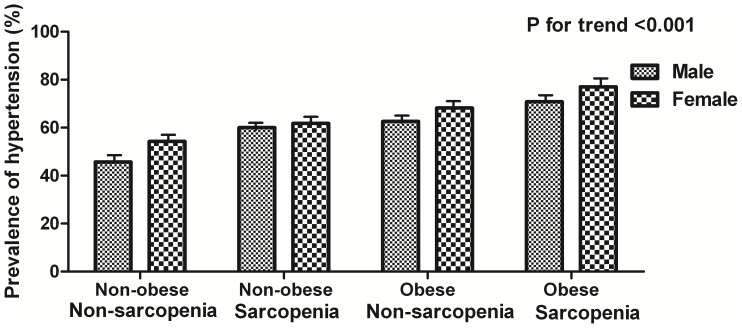
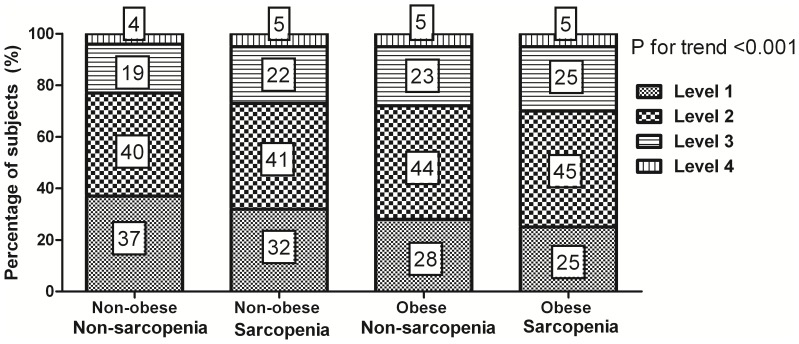
The overall prevalence of hypertension in the four groups was as follows 49.7% for non-obese non-sarcopenia, 60.9% for non-obese sarcopenia, 66.2% for obese non-sarcopenia and 74.7% for obese sarcopenia. After adjustment for age, gender, regular activity, current smoking and alcohol use, the odds ratio (OR) for having hypertension was 1.5 (95% confidence interval (CI) = 1.23-1.84) in subjects in the non-obese sarcopenia group, 2.08 (95% CI = 1.68-2.57) in the obese non-sarcopenia group and 3.0 (95% CI = 2.48-3.63) in the obese sarcopenia group, compared with the non-obese non-sarcopenia group (p for trend <0.001). Controlling further for body weight and waist circumference did not change the association between hypertension and sarcopenia. The association between sarcopenia and hypertension was more robust in the subjects with diabetes mellitus.
Body composition beyond BMI has a considerable impact on hypertension in elderly Koreans. Subjects with sarcopenic obesity appear to have a greater risk of hypertension than simply obese or sarcopenia subjects.
在一般人群中,血压(BP)与体型直接相关且存在因果联系。肌肉量是否是决定血压的重要因素仍不明确。
调查韩国老年人中肌肉减少症是否与高血压相关。
我们对2099名60岁及以上男性和2747名60岁及以上女性进行了调查。
肌肉减少症定义为四肢骨骼肌质量除以体重(ASM/Wt),低于年轻成年人特定性别的均值1个标准差。肥胖定义为体重指数(BMI)≥25kg/m²。根据是否存在肥胖或肌肉减少症,将受试者分为四组。高血压定义为收缩压(SBP)≥140mmHg、舒张压(DBP)≥90mmHg或自我报告目前正在使用降压药物。
四组中高血压的总体患病率如下:非肥胖非肌肉减少症组为49.7%,非肥胖肌肉减少症组为60.9%,肥胖非肌肉减少症组为66.2%,肥胖肌肉减少症组为74.7%。在对年龄、性别、规律活动、当前吸烟和饮酒情况进行调整后,与非肥胖非肌肉减少症组相比,非肥胖肌肉减少症组患高血压的比值比(OR)为1.5(95%置信区间(CI)=1.23 - 1.84),肥胖非肌肉减少症组为2.08(95%CI = 1.68 - 2.57),肥胖肌肉减少症组为3.0(95%CI = 2.48 - 3.63)(趋势p<0.001)。进一步控制体重和腰围后,高血压与肌肉减少症之间的关联并未改变。在糖尿病患者中,肌肉减少症与高血压之间的关联更为显著。
除BMI外的身体组成对韩国老年人的高血压有相当大的影响。肌肉减少性肥胖的受试者似乎比单纯肥胖或肌肉减少症的受试者患高血压的风险更大。