Ullevig Sarah L, Kim Hong Seok, Nguyen Huynh Nga, Hambright William S, Robles Andrew J, Tavakoli Sina, Asmis Reto
Department of Kinesiology, Health, and Nutrition, University of Texas at San Antonio, United States.
Department of Clinical Laboratory Sciences, University of Texas Health Science Center, San Antonio, United States.
Redox Biol. 2014 Jan 11;2:259-66. doi: 10.1016/j.redox.2014.01.003. eCollection 2014.
Dietary supplementation with ursolic acid (UA) prevents monocyte dysfunction in diabetic mice and protects mice against atherosclerosis and loss of renal function. The goal of this study was to determine the molecular mechanism by which UA prevents monocyte dysfunction induced by metabolic stress.
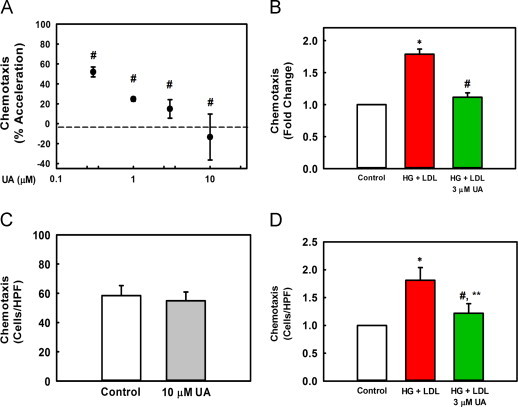
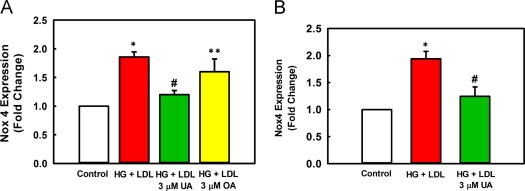
Metabolic stress sensitizes or "primes" human THP-1 monocytes and murine peritoneal macrophages to the chemoattractant MCP-1, converting these cells into a hyper-chemotactic phenotype. UA protected THP-1 monocytes and peritoneal macrophages against metabolic priming and prevented their hyper-reactivity to MCP-1. UA blocked the metabolic stress-induced increase in global protein-S-glutathionylation, a measure of cellular thiol oxidative stress, and normalized actin-S-glutathionylation. UA also restored MAPK phosphatase-1 (MKP1) protein expression and phosphatase activity, decreased by metabolic priming, and normalized p38 MAPK activation. Neither metabolic stress nor UA supplementation altered mRNA or protein levels of glutaredoxin-1, the principal enzyme responsible for the reduction of mixed disulfides between glutathione and protein thiols in these cells. However, the induction of Nox4 by metabolic stress, required for metabolic priming, was inhibited by UA in both THP-1 monocytes and peritoneal macrophages.
UA protects THP-1 monocytes against dysfunction by suppressing metabolic stress-induced Nox4 expression, thereby preventing the Nox4-dependent dysregulation of redox-sensitive processes, including actin turnover and MAPK-signaling, two key processes that control monocyte migration and adhesion. This study provides a novel mechanism for the anti-inflammatory and athero- and renoprotective properties of UA and suggests that dysfunctional blood monocytes may be primary targets of UA and related compounds.
熊果酸(UA)膳食补充可预防糖尿病小鼠的单核细胞功能障碍,并保护小鼠免受动脉粥样硬化和肾功能丧失的影响。本研究的目的是确定UA预防代谢应激诱导的单核细胞功能障碍的分子机制。
代谢应激使人类THP-1单核细胞和小鼠腹腔巨噬细胞对趋化因子MCP-1敏感或“致敏”,将这些细胞转变为高趋化性表型。UA保护THP-1单核细胞和腹腔巨噬细胞免受代谢致敏,并防止它们对MCP-1的高反应性。UA阻断了代谢应激诱导的整体蛋白S-谷胱甘肽化增加(一种细胞硫醇氧化应激的指标),并使肌动蛋白S-谷胱甘肽化正常化。UA还恢复了因代谢致敏而降低的丝裂原活化蛋白激酶磷酸酶-1(MKP1)蛋白表达和磷酸酶活性,并使p38丝裂原活化蛋白激酶激活正常化。代谢应激和UA补充均未改变谷氧还蛋白-1的mRNA或蛋白水平,谷氧还蛋白-1是负责还原这些细胞中谷胱甘肽和蛋白硫醇之间混合二硫键的主要酶。然而,在THP-1单核细胞和腹腔巨噬细胞中,UA均抑制了代谢应激诱导的Nox4表达,而Nox4是代谢致敏所必需的。
UA通过抑制代谢应激诱导的Nox4表达来保护THP-1单核细胞免受功能障碍,从而防止Nox4依赖的氧化还原敏感过程失调,包括肌动蛋白周转和丝裂原活化蛋白激酶信号传导,这两个关键过程控制单核细胞迁移和黏附。本研究为UA的抗炎、抗动脉粥样硬化和肾脏保护特性提供了一种新机制,并表明功能失调的血液单核细胞可能是UA及相关化合物的主要靶点。