Graduate Institute of Life Sciences, National Defense Medical Center, Taipei, Taiwan, ROC.
School of Public Health, National Defense Medical Center, Taipei, Taiwan, ROC.
PLoS One. 2014 Jan 31;9(1):e87604. doi: 10.1371/journal.pone.0087604. eCollection 2014.
Associations between angiotensin-converting enzyme (ACE) gene insertion/deletion (I/D) polymorphisms and chronic kidney disease (CKD) have been extensively studied, with most studies reporting that individuals with the D allele have a higher risk. Although some factors, such as ethnicity, may moderate the association between ACE I/D polymorphisms and CKD risk, gender-dependent effects on the CKD risk remain controversial.
This study investigated the gender-dependent effects of ACE I/D polymorphisms on CKD risk.
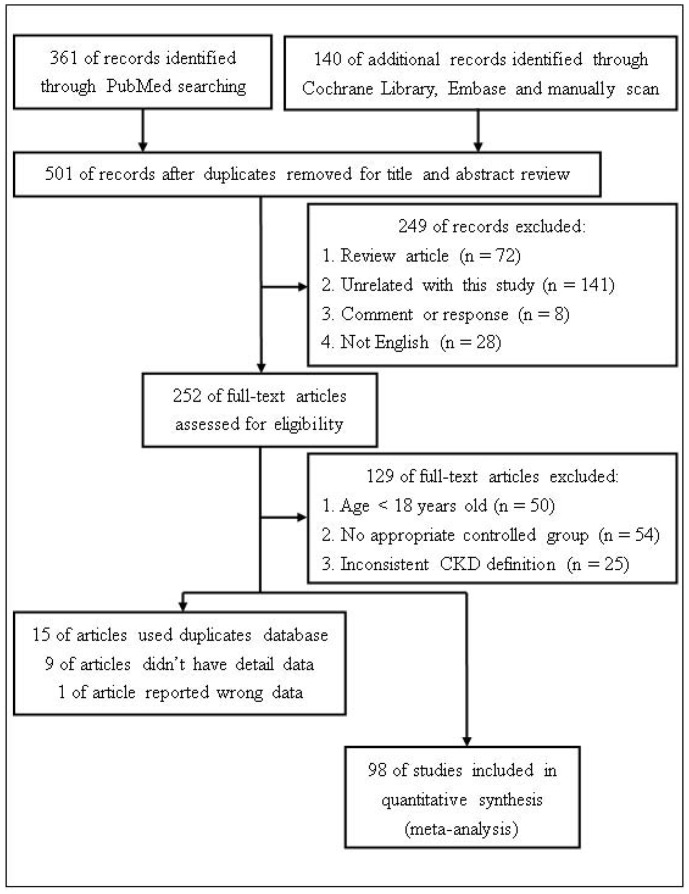
PubMed, the Cochrane library, and EMBASE were searched for studies published before January 2013.
Cross-sectional surveys and case-control studies analyzing ACE I/D polymorphisms and CKD were included. They were required to match the following criteria: age >18 years, absence of rare diseases, and Asian or Caucasian ethnicity.
The effect of carrying the D allele on CKD risk was assessed by meta-analysis and meta-regression using random-effects models.
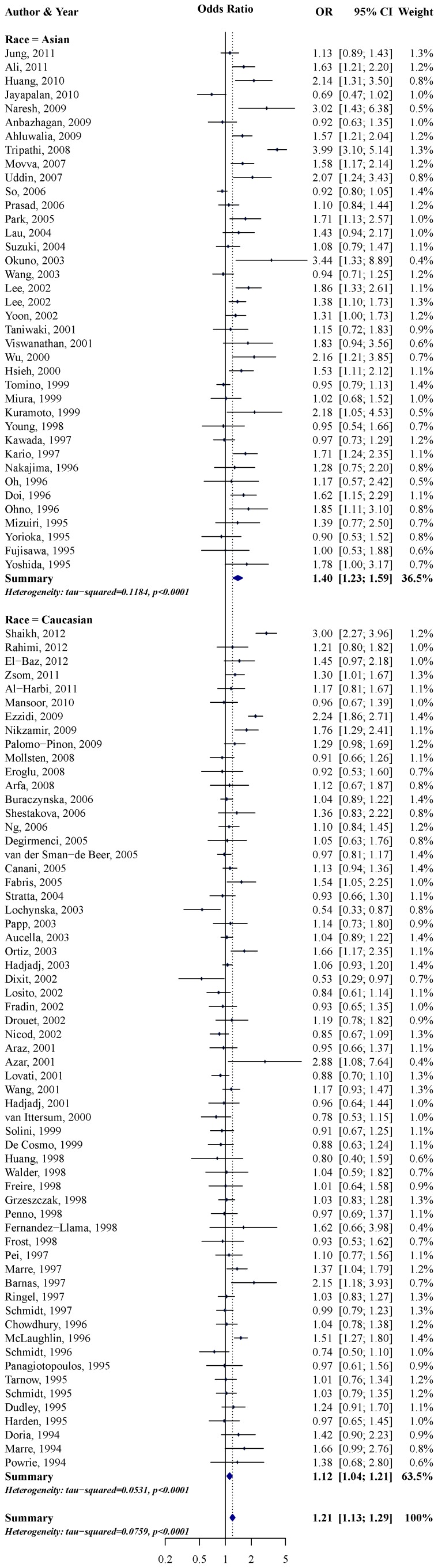
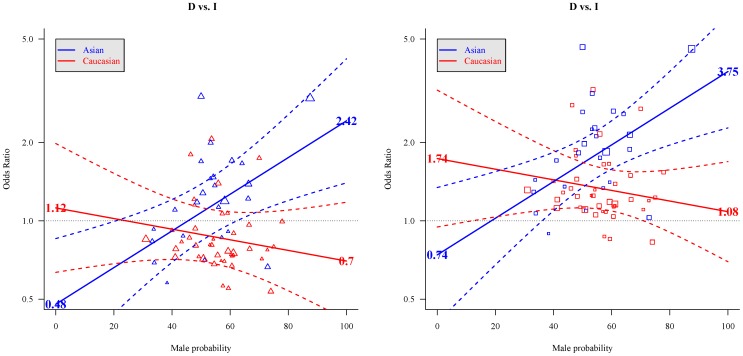
ETHNICITY [ODDS RATIO (OR): 1.24; 95% confidence interval (CI): 1.08-1.42] and hypertension (OR: 1.55; 95% CI: 1.04-2.32) had significant moderate effects on the association between ACE I/D polymorphisms and CKD risk, but they were not significant in the diabetic nephropathy subgroup. Males had higher OR for the association between ACE I/D polymorphisms and CKD risk than females in Asians but not Caucasians, regardless of adjustment for hypertension (p<0.05). In subgroup analyses, this result was significant in the nondiabetic nephropathy group. Compared with the I allele, the D allele had the highest risk (OR: 3.75; 95% CI: 1.84-7.65) for CKD in hypertensive Asian males.
The ACE I/D polymorphisms may incur the highest risk for increasing CKD in hypertensive Asian males.
血管紧张素转换酶(ACE)基因插入/缺失(I/D)多态性与慢性肾脏病(CKD)之间的关联已被广泛研究,大多数研究报告表明,携带 D 等位基因的个体患该病的风险更高。尽管一些因素,如种族,可能会调节 ACE I/D 多态性与 CKD 风险之间的关联,但性别对 CKD 风险的影响仍存在争议。
本研究旨在探讨 ACE I/D 多态性对 CKD 风险的性别依赖性影响。
检索了截至 2013 年 1 月发表的 PubMed、Cochrane 图书馆和 EMBASE 中的研究。
纳入的研究为分析 ACE I/D 多态性与 CKD 的横断面调查和病例对照研究,必须符合以下标准:年龄>18 岁、无罕见疾病、为亚洲或高加索人种。
使用随机效应模型的荟萃分析和荟萃回归来评估携带 D 等位基因对 CKD 风险的影响。
种族[比值比(OR):1.24;95%置信区间(CI):1.08-1.42]和高血压(OR:1.55;95% CI:1.04-2.32)对 ACE I/D 多态性与 CKD 风险之间的关联有显著的中等影响,但在糖尿病肾病亚组中无显著影响。在亚洲人群中,男性 ACE I/D 多态性与 CKD 风险之间的关联的 OR 高于女性,而在高加索人群中则不然,无论是否调整高血压因素(P<0.05)。在亚组分析中,在非糖尿病肾病组中这一结果具有统计学意义。与 I 等位基因相比,D 等位基因使高血压的亚洲男性患 CKD 的风险最高(OR:3.75;95% CI:1.84-7.65)。
ACE I/D 多态性可能会使高血压的亚洲男性患 CKD 的风险最高。