Teh Boon Aun, Choi Sy Bing, Musa Nasihah, Ling Few Ling, Cun See Too Wei, Salleh Abu Bakar, Najimudin Nazalan, Wahab Habibah A, Normi Yahaya M
Enzyme and Microbial Technology Research Center (EMTECH), Faculty of Biotechnology and Biomolecular Sciences, Universiti Putra Malaysia, 43400 Serdang, Selangor, Malaysia.
BMC Struct Biol. 2014 Feb 5;14:7. doi: 10.1186/1472-6807-14-7.
Klebsiella pneumoniae plays a major role in causing nosocomial infection in immunocompromised patients. Medical inflictions by the pathogen can range from respiratory and urinary tract infections, septicemia and primarily, pneumonia. As more K. pneumoniae strains are becoming highly resistant to various antibiotics, treatment of this bacterium has been rendered more difficult. This situation, as a consequence, poses a threat to public health. Hence, identification of possible novel drug targets against this opportunistic pathogen need to be undertaken. In the complete genome sequence of K. pneumoniae MGH 78578, approximately one-fourth of the genome encodes for hypothetical proteins (HPs). Due to their low homology and relatedness to other known proteins, HPs may serve as potential, new drug targets.
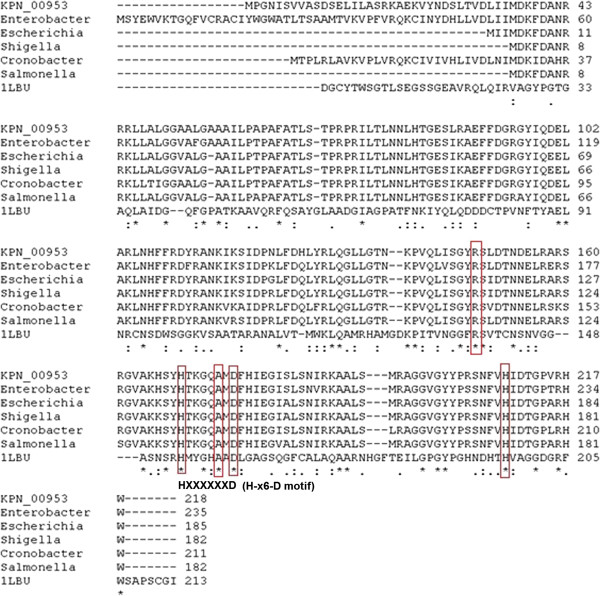
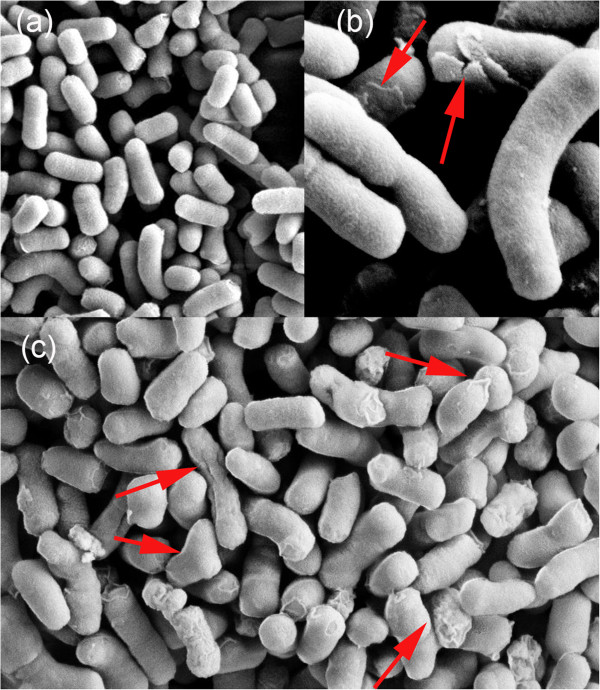
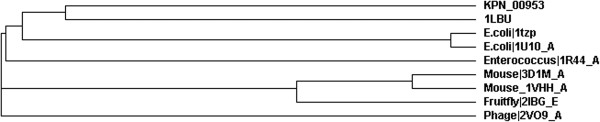
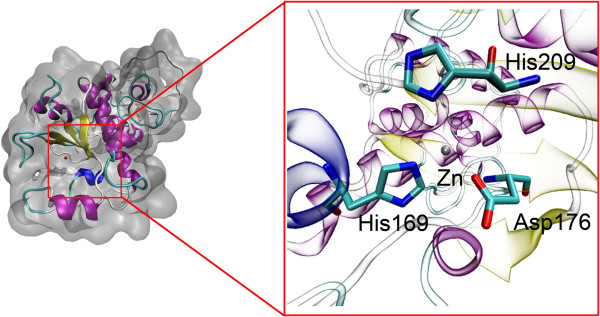
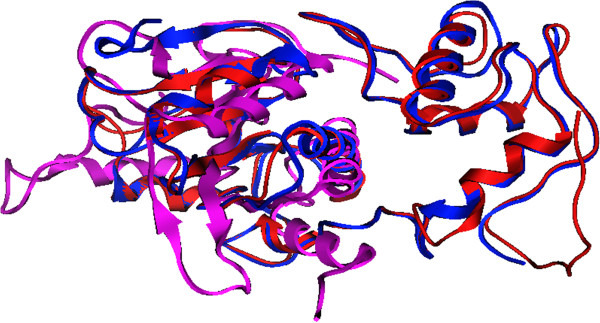
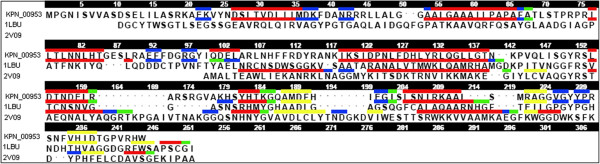
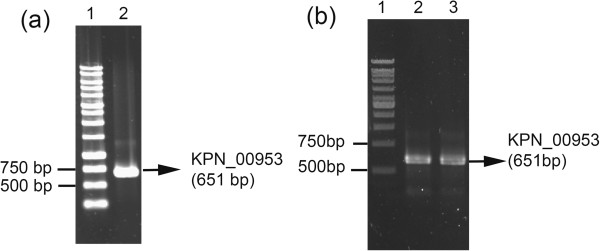
Sequence analysis on the HPs of K. pneumoniae MGH 78578 revealed that a particular HP termed KPN_00953 (YcbK) contains a M15_3 peptidases superfamily conserved domain. Some members of this superfamily are metalloproteases which are involved in cell wall metabolism. BLASTP similarity search on KPN_00953 (YcbK) revealed that majority of the hits were hypothetical proteins although two of the hits suggested that it may be a lipoprotein or related to twin-arginine translocation (Tat) pathway important for transport of proteins to the cell membrane and periplasmic space. As lipoproteins and other components of the cell wall are important pathogenic factors, homology modeling of KPN_00953 was attempted to predict the structure and function of this protein. Three-dimensional model of the protein showed that its secondary structure topology and active site are similar with those found among metalloproteases where two His residues, namely His169 and His209 and an Asp residue, Asp176 in KPN_00953 were found to be Zn-chelating residues. Interestingly, induced expression of the cloned KPN_00953 gene in lipoprotein-deficient E. coli JE5505 resulted in smoother cells with flattened edges. Some cells showed deposits of film-like material under scanning electron microscope.
We postulate that KPN_00953 is a Zn metalloprotease and may play a role in bacterial cell wall metabolism. Structural biology studies to understand its structure, function and mechanism of action pose the possibility of utilizing this protein as a new drug target against K. pneumoniae in the future.
肺炎克雷伯菌在免疫功能低下患者的医院感染中起主要作用。该病原体引起的医学感染范围包括呼吸道和泌尿道感染、败血症,主要是肺炎。随着越来越多的肺炎克雷伯菌菌株对各种抗生素产生高度耐药性,对这种细菌的治疗变得更加困难。因此,这种情况对公众健康构成威胁。因此,需要确定针对这种机会性病原体的可能的新型药物靶点。在肺炎克雷伯菌MGH 78578的完整基因组序列中,大约四分之一的基因组编码假设蛋白(HPs)。由于它们与其他已知蛋白的低同源性和相关性,HPs可能作为潜在的新药物靶点。
对肺炎克雷伯菌MGH 78578的HPs进行序列分析发现,一种名为KPN_00953(YcbK)的特定HP含有M15_3肽酶超家族保守结构域。该超家族的一些成员是参与细胞壁代谢的金属蛋白酶。对KPN_00953(YcbK)进行BLASTP相似性搜索发现,大多数命中结果是假设蛋白,尽管其中两个命中结果表明它可能是一种脂蛋白或与双精氨酸转运(Tat)途径相关,该途径对蛋白质转运到细胞膜和周质空间很重要。由于脂蛋白和细胞壁的其他成分是重要的致病因素,因此尝试对KPN_00953进行同源建模以预测该蛋白的结构和功能。该蛋白的三维模型表明,其二级结构拓扑和活性位点与金属蛋白酶中的相似,在KPN_00953中发现两个组氨酸残基,即His169和His209以及一个天冬氨酸残基Asp176是锌螯合残基。有趣的是,在脂蛋白缺陷型大肠杆菌JE5505中克隆的KPN_00953基因的诱导表达导致细胞更光滑,边缘变平。在扫描电子显微镜下,一些细胞显示出膜状物质的沉积。
我们推测KPN_00953是一种锌金属蛋白酶,可能在细菌细胞壁代谢中起作用。结构生物学研究以了解其结构、功能和作用机制,为未来将该蛋白用作抗肺炎克雷伯菌的新药物靶点提供了可能性。