Li Dehua, Yang Mingxiao, Zhao Ling, Zheng Hui, Li Ying, Chang Xiaorong, Cui Jin, Wang Ruihui, Shi Jing, Lv Junling, Leng Junyan, Li Juan, Liang Fanrong
Chengdu University of Traditional Chinese Medicine, Chengdu, Sichuan, China.
Trials. 2014 Feb 5;15:50. doi: 10.1186/1745-6215-15-50.
Chronic stable angina pectoris (CSAP) is a common cardiovascular condition that endangers a patient's life quality and longevity. As demonstrated in several clinical trials, acupuncture is attested to be effective for CSAP. Current trials are not adequate enough to provide high-quality evidence for clinical decision making, as a result of inadequate methodology design and small sample size. Notably, stark controversy toward acupoint specificity also exists in the clinical acupuncture trials for CSAP. Therefore, we designed the present study as a randomized controlled trial primarily to investigate the effectiveness of acupuncture in addition to routine care among patients with CSAP. Meanwhile, we examined whether acupoint on the disease-affected meridian (DAM) is superior to either acupoint on the non-affected meridian (NAM) or non-acupoint (NA), to further investigate the meridian-based characteristics of acupoint specificity.
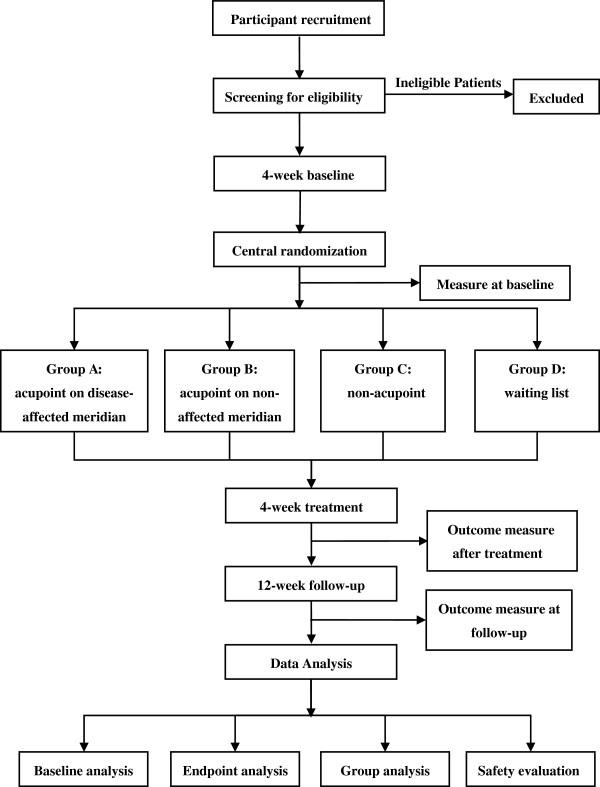
METHODS/DESIGN: This study was a multicenter, assessor and statistician blinded, randomized controlled trial in China. In this study, 404 participants in sum will be randomly assigned to four groups through central randomization in a 1:1:1:1 ratio. The whole study period is 20 weeks including a 4-week baseline period, a 4-week treatment period and a 12-week follow-up. Participants in the DAM group receive acupuncture stimulation at acupoints on the disease-affected meridian, and three different control groups will undergo acupuncture stimulation at the NAM, the non-acupoint and no intervention respectively, in addition to basic treatment. Participants in the acupuncture groups will receive 12 sessions of acupuncture treatment over 4 weeks, while the wait-listed (WL) group would receive free acupuncture treatment after the completion of the study. The outcome measures in this trial include the frequency of angina attack during 4 weeks as the primary outcome and eight other secondary outcomes.
This trial will provide new and relatively high-quality evidence in acupuncture treatment for CSAP. Moreover, this trial may further validate the meridian-based characteristics of acupoint specificity by comparing the strength of acupoints on the disease-affected meridian versus that of the non-affected meridian, to further inspire optimization of acupuncture therapy for CSAP.
Clinical Trials.gov NCT01686230.
慢性稳定性心绞痛(CSAP)是一种常见的心血管疾病,危及患者的生活质量和寿命。多项临床试验表明,针灸对CSAP有效。由于方法设计不当和样本量小,目前的试验不足以提供高质量的证据用于临床决策。值得注意的是,在CSAP的临床针灸试验中,对于穴位特异性也存在激烈的争议。因此,我们将本研究设计为一项随机对照试验,主要目的是研究在常规护理基础上针灸对CSAP患者的有效性。同时,我们研究患病经络(DAM)上的穴位是否优于未患病经络(NAM)上的穴位或非穴位(NA),以进一步研究基于经络的穴位特异性特征。
方法/设计:本研究是一项在中国进行的多中心、评估者和统计学家双盲的随机对照试验。在本研究中,总共404名参与者将通过中央随机化以1:1:1:1的比例随机分配到四组。整个研究期为20周,包括4周的基线期、4周的治疗期和12周的随访期。DAM组的参与者在患病经络上的穴位接受针灸刺激,除基础治疗外,三个不同的对照组将分别在未患病经络、非穴位处接受针灸刺激和不进行干预。针灸组的参与者将在4周内接受12次针灸治疗,而等待列表(WL)组将在研究完成后接受免费针灸治疗。本试验的结局指标包括4周内心绞痛发作频率作为主要结局以及其他八个次要结局。
本试验将为CSAP的针灸治疗提供新的且相对高质量的证据。此外,本试验可能通过比较患病经络上穴位与未患病经络上穴位的强度,进一步验证基于经络的穴位特异性特征,以进一步启发CSAP针灸疗法的优化。
ClinicalTrials.gov NCT0168623。