Department of Parasitology, Faculty of Medical Sciences, Anton de Kom University of Suriname, Kernkampweg 5, Paramaribo, Suriname.
Parasit Vectors. 2013 Nov 4;6(1):318. doi: 10.1186/1756-3305-6-318.
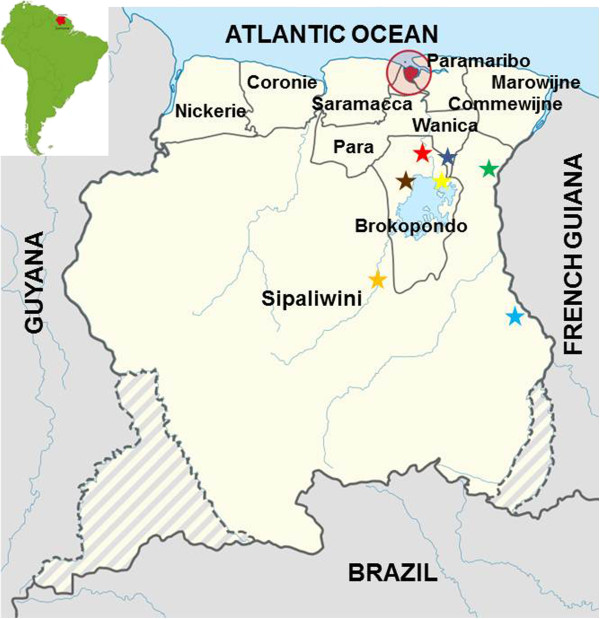
Sand flies (Diptera: Psychodidae) are the vectors of Leishmania parasites, the causative agents of leishmaniasis. Cutaneous leishmaniasis is an increasing public health problem in the Republic of Suriname and is mainly caused by Leishmania (Vianna) guyanensis, but L. (V.) braziliensis, L. (L.) amazonensis, and L. (V.) naiffi also infect humans. Transmission occurs predominantly in the forested hinterland of the country. Information regarding the potential vectors of leishmaniasis in Suriname is limited. This study aims to broaden the knowledge about vectors involved in the transmission of cutaneous leishmaniasis in Suriname. For this purpose, sand flies were characterized in various foci of cutaneous leishmaniasis in the country, the districts of Para, Brokopondo, and Sipaliwini.
Sand flies were collected in areas around mining plots and villages using CDC light traps in the period between February 2011 and March 2013. They were categorized by examination of the spermathecea (females) and the external genitalia (males).
A total of 2,743 sand fly specimens belonging to 34 different species were captured, including four species (Lutzomyia aragaoi, Lu. ayrozai, Lu. damascenoi, and Lu. sordellii) that had never before been described for Suriname. Five percent of the catch comprised Lu. squamiventris sensu lato, one female of which was positive with L. (V.) braziliensis and was captured in a gold mining area in Brokopondo. Other sand fly species found positive for Leishmania parasites were Lu. trichopyga, Lu. ininii, and Lu. umbratilis, comprising 32, 8, and 4%, respectively, of the catch. These were captured at gold mining areas in Brokopondo and Sipaliwini, but the Leishmania parasites they had ingested could not be identified due to insufficient amounts of DNA.
The sand fly fauna in Suriname is highly diverse and comprises Lutzomyia species capable of transmitting Leishmania parasites. Four new Lutzomyia species have been found, and four species - Lu. squamiventris (s.l.), Lu. trichopyga, Lu. ininii, and Lu. umbratilis - have been found to harbor Leishmania parasites. The latter were among the most abundant species captured. These observations may contribute to the understanding of leishmaniasis transmission and the development of control programs in Suriname.
沙蝇(双翅目:长角亚目)是利什曼原虫的传播媒介,而利什曼原虫是导致利什曼病的病原体。在苏里南共和国,皮肤利什曼病是一个日益严重的公共卫生问题,主要由利什曼(Vianna)圭亚那种引起,但也有 L.(V.)braziliensis、L.(L.)amazonensis 和 L.(V.)naiffi 感染人类。传播主要发生在该国森林腹地。关于苏里南皮肤利什曼病潜在传播媒介的信息有限。本研究旨在扩大对苏里南皮肤利什曼病传播中涉及的媒介的了解。为此,在该国的各个皮肤利什曼病焦点地区,即帕拉、布罗科蓬多和西帕利维尼地区,对沙蝇进行了特征描述。
2011 年 2 月至 2013 年 3 月期间,使用 CDC 诱捕器在矿区和村庄周围的地区收集沙蝇。通过检查雌性的受精囊和雄性的外生殖器对沙蝇进行分类。
共捕获了 2743 只属于 34 个不同种的沙蝇标本,其中包括四种(Lutzomyia aragaoi、Lu. ayrozai、Lu. damascenoi 和 Lu. sordellii)此前从未在苏里南描述过。捕获的沙蝇中有 5%为 Lu. squamiventris s.l.,其中一只雌性沙蝇携带 L.(V.)braziliensis,在布罗科蓬多的一个金矿地区捕获。其他被发现携带利什曼原虫的沙蝇物种为 Lu. trichopyga、Lu. ininii 和 Lu. umbratilis,分别占捕获量的 32%、8%和 4%。这些沙蝇在布罗科蓬多和西帕利维尼的金矿地区被捕获,但由于 DNA 量不足,无法确定它们所摄入的利什曼原虫种类。
苏里南的沙蝇区系非常多样化,包括能够传播利什曼原虫的 Lutzomyia 物种。发现了四种新的 Lutzomyia 物种,四种沙蝇物种——Lu. squamiventris(s.l.)、Lu. trichopyga、Lu. ininii 和 Lu. umbratilis——被发现携带利什曼原虫。后者是捕获量最多的物种之一。这些观察结果可能有助于理解利什曼病的传播,并为苏里南制定控制计划做出贡献。