Department of Anthropology, University College London, , London WC1H 0BW, UK, Department of Environmental Health, Faculty of Health Sciences, Jagiellonian University Medical College, , Grzegorzecka 20, Krakow 31-531, Poland, Department of Animal and Plant Sciences, University of Sheffield, , Sheffield S10 2TN, UK.
Proc Biol Sci. 2014 Feb 5;281(1779):20132732. doi: 10.1098/rspb.2013.2732. Print 2014 Mar 22.
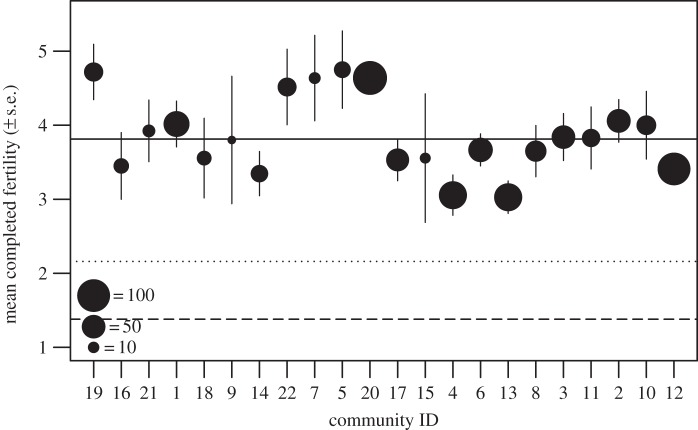
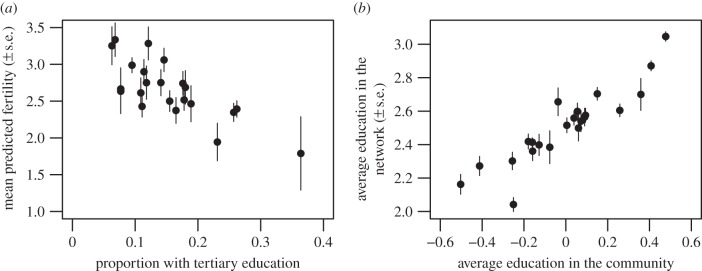
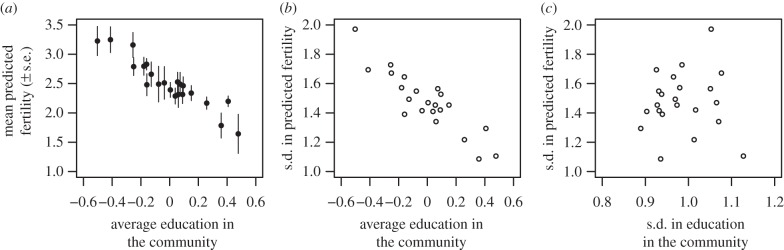
Explaining why fertility declines as populations modernize is a profound theoretical challenge. It remains unclear whether the fundamental drivers are economic or cultural in nature. Cultural evolutionary theory suggests that community-level characteristics, for example average education, can alter how low-fertility preferences are transmitted and adopted. These assumptions have not been empirically tested. Here, we show that community-level education accelerates fertility decline in a way that is neither predicted by individual characteristics, nor by the level of economic modernization in a population. In 22 high-fertility communities in Poland, fertility converged on a smaller family size as average education in the community increased-indeed community-level education had a larger impact on fertility decline than did individual education. This convergence was not driven by educational levels being more homogeneous, but by less educated women having fewer children than expected, and more highly educated social networks, when living among more highly educated neighbours. The average level of education in a community may influence the social partners women interact with, both within and beyond their immediate social environments, altering the reproductive norms they are exposed to. Given a critical mass of highly educated women, less educated neighbours may adopt their reproductive behaviour, accelerating the pace of demographic transition. Individual characteristics alone cannot capture these dynamics and studies relying solely on them may systematically underestimate the importance of cultural transmission in driving fertility declines. Our results are inconsistent with a purely individualistic, rational-actor model of fertility decline and suggest that optimization of reproduction is partly driven by cultural dynamics beyond the individual.
解释为什么随着人口现代化,生育率会下降是一个深刻的理论挑战。目前还不清楚基本驱动力是经济性质还是文化性质。文化进化理论表明,社区层面的特征(例如平均教育水平)可以改变低生育率偏好的传播和采纳方式。这些假设尚未经过实证检验。在这里,我们表明,社区层面的教育以一种既不能由个体特征预测,也不能由人口经济现代化水平预测的方式加速了生育率的下降。在波兰的 22 个人口高度密集的社区中,随着社区平均教育水平的提高,生育率趋同于较小的家庭规模——实际上,社区教育对生育率下降的影响大于个人教育。这种趋同不是因为教育水平更加同质化,而是因为教育程度较低的女性生育的孩子比预期的少,而受教育程度较高的社交网络在与受教育程度较高的邻居生活时生育的孩子也比预期的少。社区的平均教育水平可能会影响女性在其直接社交环境内外与之互动的社会伙伴,改变她们所接触到的生殖规范。在受过高等教育的女性达到一定数量后,教育程度较低的邻居可能会采用她们的生殖行为,从而加速人口转变的步伐。个体特征本身无法捕捉到这些动态,仅依赖于这些特征的研究可能会系统地低估文化传播在推动生育率下降方面的重要性。我们的结果与纯粹的个人主义、理性行为者的生育率下降模型不一致,这表明生殖优化部分是由个体之外的文化动态驱动的。