Votintseva A A, Miller R R, Fung R, Knox K, Godwin H, Peto T E A, Crook D W, Bowden R, Walker A S
Nuffield Department of Clinical Medicine, University of Oxford, John Radcliffe Hospital, Oxford, United Kingdom.
J Clin Microbiol. 2014 Apr;52(4):1192-200. doi: 10.1128/JCM.03254-13. Epub 2014 Feb 5.
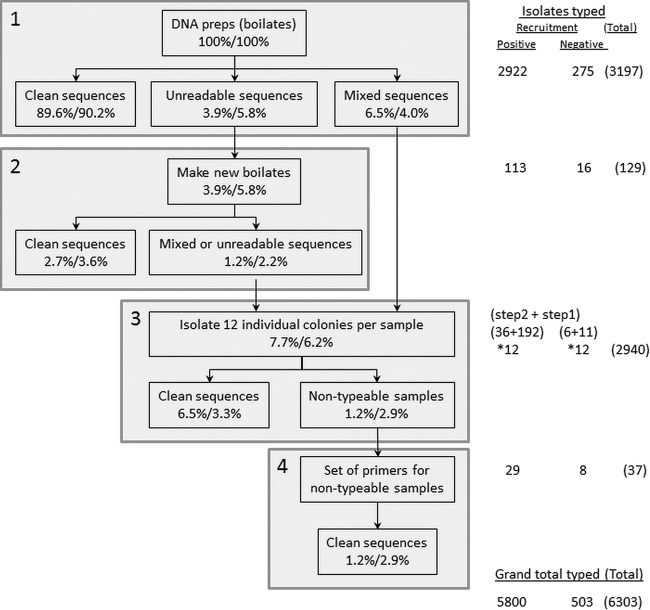
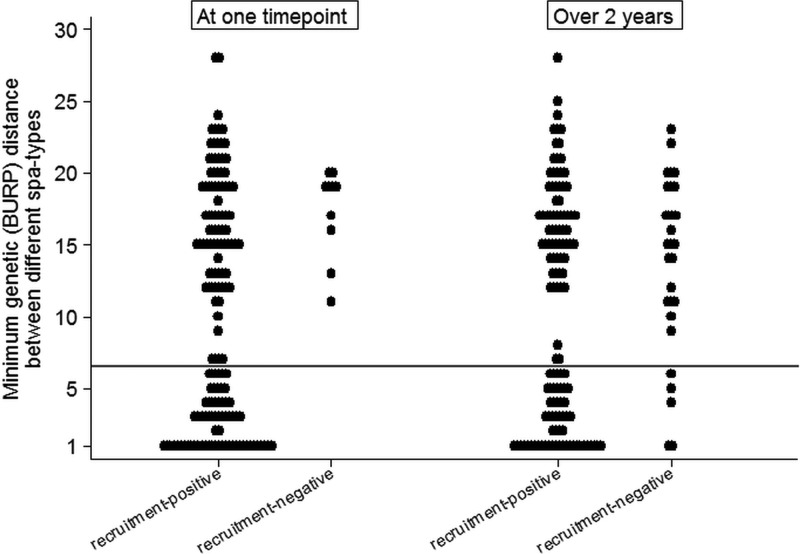
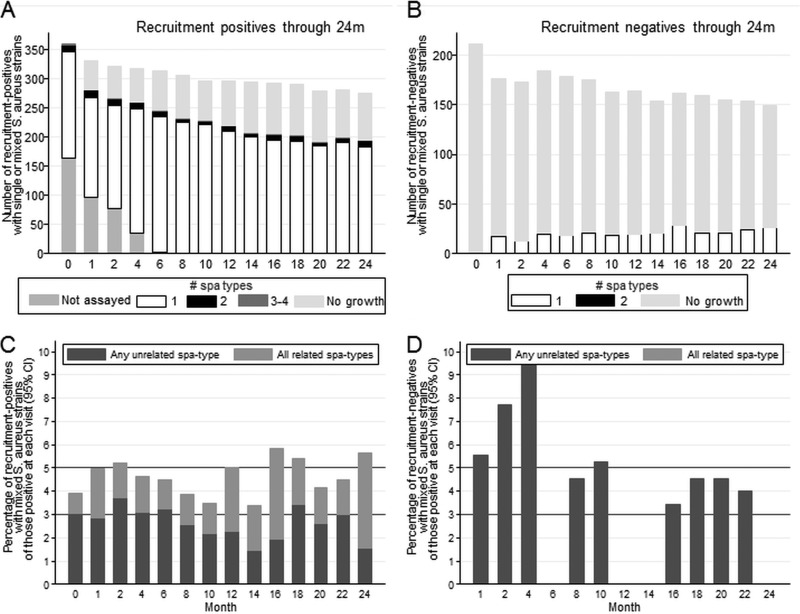
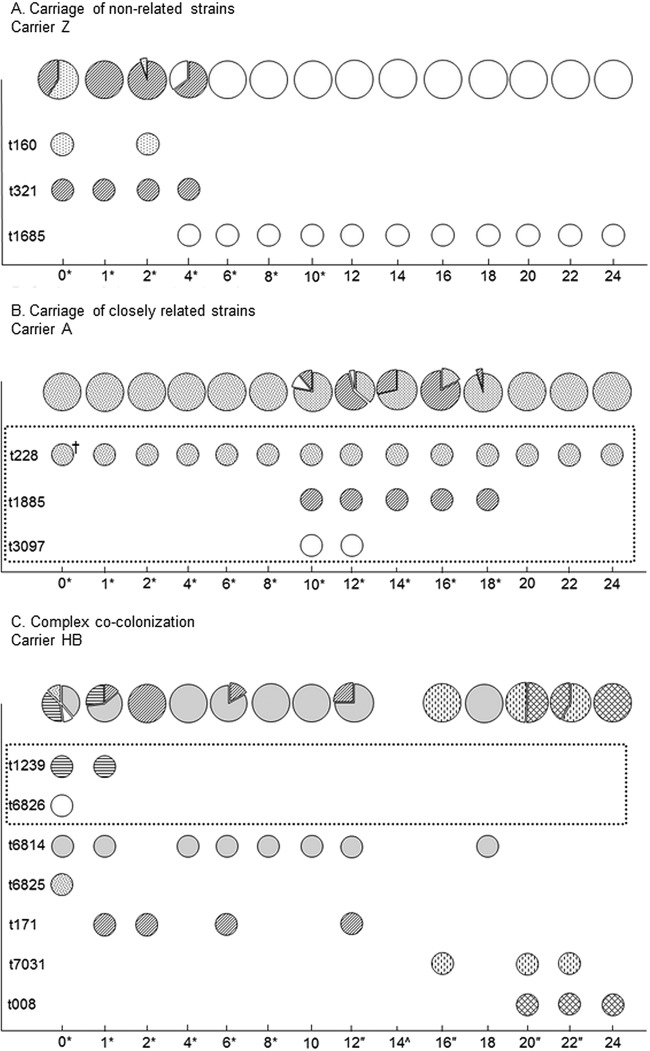
Staphylococcus aureus is a commensal that can also cause invasive infection. Reports suggest that nasal cocolonization occurs rarely, but the resources required to sequence multiple colonies have precluded its large-scale investigation. A staged protocol was developed to maximize detection of mixed-spa-type colonization while minimizing laboratory resources using 3,197 S. aureus-positive samples from a longitudinal study of healthy individuals in Oxfordshire, United Kingdom. Initial typing of pooled material from each sample identified a single unambiguous strain in 89.6% of samples. Twelve single-colony isolates were typed from samples producing ambiguous initial results. All samples could be resolved into one or more spa types using the protocol. Cocolonization point prevalence was 3.4 to 5.8% over 24 months of follow-up in 360 recruitment-positives. However, 18% were cocolonized at least once, most only transiently. Cocolonizing spa types were completely unrelated in 56% of samples. Of 272 recruitment-positives returning ≥12 swabs, 166 (61%) carried S. aureus continuously but only 106 (39%) carried the same single spa type without any cocolonization; 31 (11%) switched spa type and 29 (11%) had transient cocarriage. S. aureus colonization is dynamic even in long-term carriers. New unrelated cocolonizing strains could increase invasive disease risk, and ongoing within-host evolution could increase invasive potential, possibilities that future studies should explore.
金黄色葡萄球菌是一种共生菌,也可引起侵袭性感染。报告表明,鼻腔共定植很少发生,但对多个菌落进行测序所需的资源阻碍了其大规模研究。我们制定了一个分阶段方案,以最大限度地检测混合spa型定植,同时使用来自英国牛津郡一项健康个体纵向研究的3197份金黄色葡萄球菌阳性样本,将实验室资源降至最低。对每个样本的混合材料进行初步分型,在89.6%的样本中鉴定出单一明确的菌株。从产生模糊初步结果的样本中挑选了12个单菌落分离株进行分型。使用该方案,所有样本都可以解析为一种或多种spa型。在360名招募阳性者中,24个月随访期间共定植点患病率为3.4%至5.8%。然而,18%的人至少有一次共定植,大多数只是短暂定植。在56%的样本中,共定植的spa型完全不相关。在272名返回≥12份拭子的招募阳性者中,166人(61%)持续携带金黄色葡萄球菌,但只有106人(39%)携带相同的单一spa型且无共定植;31人(11%)spa型发生转换,29人(11%)有短暂的共同携带。即使在长期携带者中,金黄色葡萄球菌定植也是动态的。新的不相关共定植菌株可能会增加侵袭性疾病风险,而宿主内的持续进化可能会增加侵袭潜力,未来的研究应探索这些可能性。