Griera Mercedes, Martin-Villar Ester, Banon-Rodríguez Inmaculada, Blundell Michael P, Jones Gareth E, Anton Ines M, Thrasher Adrian J, Rodriguez-Puyol Manuel, Calle Yolanda
Department of Physiology, Facultad de Medicina, Universidad de Alcalá, Campus Universitario s/n, Alcalá de Henares, Madrid 28871, Spain.
Cancer Biology Department, Instituto de Investigaciones Biomédicas "Alberto Sols", CSIC-UAM, Madrid 28029, Spain.
Int J Biochem Cell Biol. 2014 May;50(100):47-54. doi: 10.1016/j.biocel.2014.01.021. Epub 2014 Feb 6.
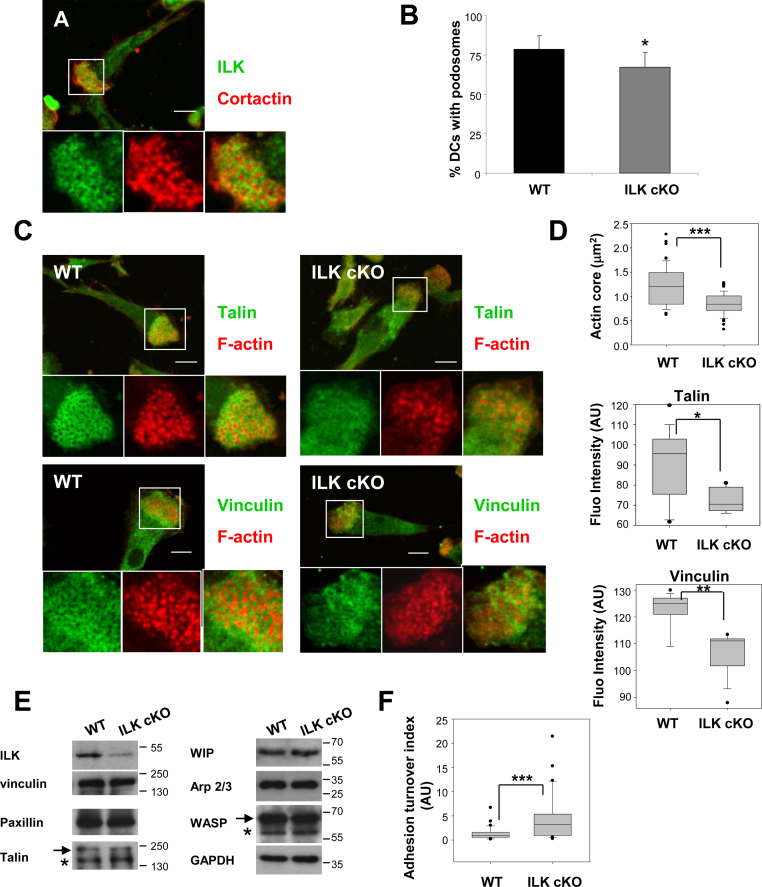
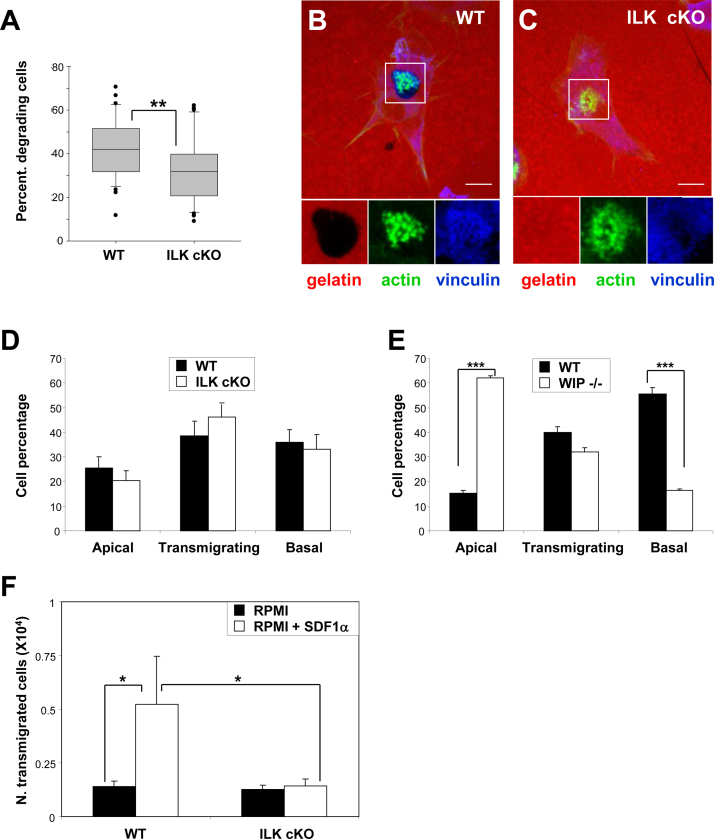
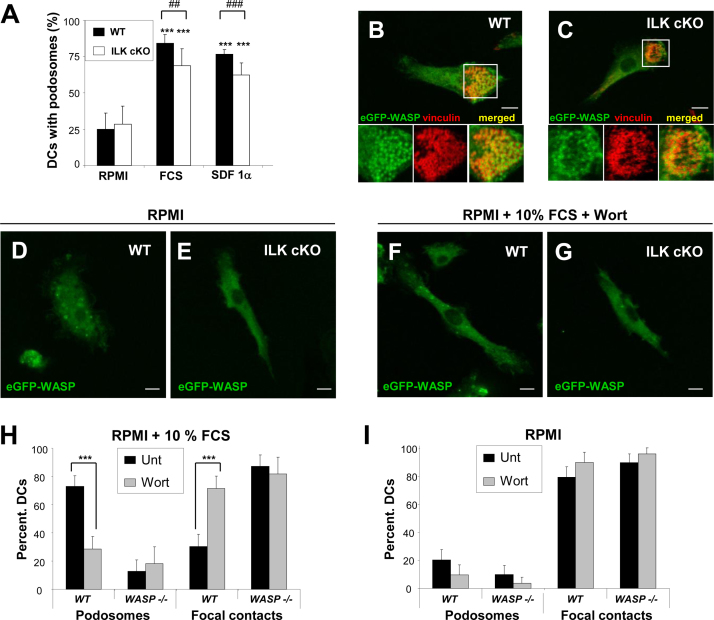
Podosomes are integrin-based adhesions fundamental for stabilisation of the leading lamellae in migrating dendritic cells (DCs) and for extracellular matrix (ECM) degradation. We have previously shown that soluble factors and chemokines such as SDF 1-a trigger podosome initiation whereas integrin ligands promote podosome maturation and stability in DCs. The exact intracellular signalling pathways that regulate the sequential organisation of podosomal components in response to extracellular cues remain largely undetermined. The Wiskott Aldrich Syndrome Protein (WASP) mediates actin polymerisation and the initial recruitment of integrins and associated proteins in a circular configuration surrounding the core of filamentous actin (F-actin) during podosome initiation. We have now identified integrin linked kinase (ILK) surrounding the podosomal actin core. We report that DC polarisation in response to chemokines and the assembly of actin cores during podosome initiation require PI3K-dependent clustering of the Wiskott Aldrich Syndrome Protein (WASP) in puncta independently of ILK. ILK is essential for the clustering of integrins and associated proteins leading to podosome maturation and stability that are required for degradation of the subjacent extracellular matrix and the invasive motility of DCs across connective tissue barriers. We conclude that WASP regulates DCs polarisation for migration and initiation of actin polymerisation downstream of PI3K in nascent podosomes. Subsequently, ILK mediates the accumulation of integrin-associated proteins during podosome maturation and stability for efficient degradation of the subjacent ECM during the invasive migration of DCs.
足体是基于整合素的黏附结构,对于迁移树突状细胞(DCs)前缘板层的稳定以及细胞外基质(ECM)的降解至关重要。我们之前已经表明,可溶性因子和趋化因子如SDF 1-α可触发足体起始,而整合素配体则促进DCs中足体的成熟和稳定。响应细胞外信号调节足体成分顺序组织的确切细胞内信号通路在很大程度上仍未确定。威斯科特-奥尔德里奇综合征蛋白(WASP)在足体起始过程中介导肌动蛋白聚合以及整合素和相关蛋白围绕丝状肌动蛋白(F-肌动蛋白)核心呈环状构型的初始募集。我们现在已经鉴定出围绕足体肌动蛋白核心的整合素连接激酶(ILK)。我们报告称,趋化因子诱导的DC极化以及足体起始过程中肌动蛋白核心的组装需要PI3K依赖的威斯科特-奥尔德里奇综合征蛋白(WASP)在点状结构中的聚集,且不依赖于ILK。ILK对于整合素和相关蛋白的聚集至关重要,而这会导致足体成熟和稳定,这对于下方细胞外基质的降解以及DCs穿过结缔组织屏障的侵袭性运动是必需的。我们得出结论,WASP调节DCs的极化以进行迁移,并在新生足体中PI3K下游启动肌动蛋白聚合。随后,ILK在足体成熟和稳定过程中介导整合素相关蛋白的积累,以在DCs侵袭性迁移过程中有效降解下方的ECM。