Funkey Carolina P, Conley Daniel J, Reuss Nina S, Humborg Christoph, Jilbert Tom, Slomp Caroline P
Department of Geology, Lund University , Sölvegatan 12, SE-22362 Lund, Sweden.
Environ Sci Technol. 2014;48(5):2598-602. doi: 10.1021/es404395a. Epub 2014 Feb 20.
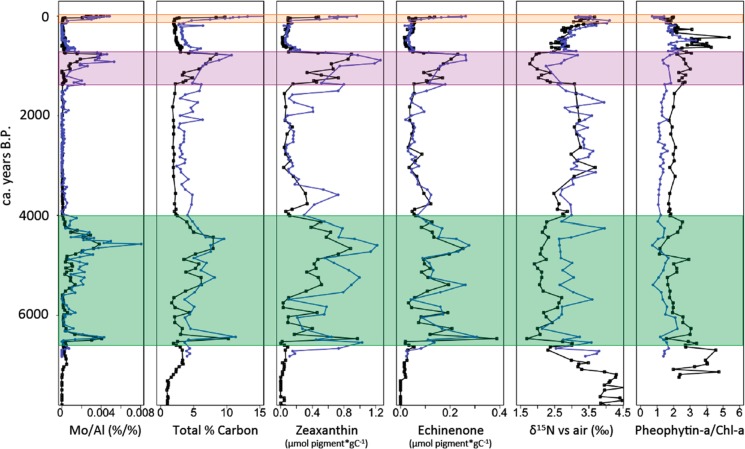
Nutrient over-enrichment is one of the classic triggering mechanisms for the occurrence of cyanobacteria blooms in aquatic ecosystems. In the Baltic Sea, cyanobacteria regularly occur in the late summer months and form nuisance accumulations in surface waters and their abundance has intensified significantly in the past 50 years attributed to human-induced eutrophication. However, the natural occurrence of cyanobacteria during the Holocene is debated. In this study, we present records of cyanobacteria pigments, water column redox proxies, and nitrogen isotopic signatures for the past ca. 8000 years from Baltic Sea sediment cores. Our results demonstrate that cyanobacteria abundance and nitrogen fixation are correlated with hypoxia occurring during three main intervals: (1) ca. 7000-4000 B.P. during the Littorina transgression, (2) ca. 1400-700 B.P. during the Medieval Climate Anomaly, and (3) from ca. 1950 A.D. to the present. Issues of preservation were investigated, and we show that organic matter and pigment profiles are not simply an artifact of preservation. These results suggest that cyanobacteria abundance is sustained during periods of hypoxia, most likely because of enhanced recycling of phosphorus in low oxygen conditions.
营养物质过度富集是水生生态系统中蓝藻水华发生的经典触发机制之一。在波罗的海,蓝藻通常在夏末出现,并在表层水体中形成有害堆积,在过去50年里,由于人为导致的富营养化,其数量显著增加。然而,全新世期间蓝藻的自然出现情况仍存在争议。在本研究中,我们展示了来自波罗的海沉积物岩芯的过去约8000年的蓝藻色素、水柱氧化还原指标和氮同位素特征记录。我们的结果表明,蓝藻丰度和固氮作用与三个主要时期出现的缺氧情况相关:(1)约公元前7000 - 4000年的利托里纳海侵时期,(2)约公元1400 - 700年的中世纪气候异常时期,以及(3)约公元1950年至今。我们研究了保存问题,并表明有机质和色素剖面并非仅仅是保存的假象。这些结果表明,在缺氧时期蓝藻丰度得以维持,最有可能是因为在低氧条件下磷的循环增强。