Selmic L E, Burton J H, Thamm D H, Withrow S J, Lana S E
Flint Animal Cancer Center, Department of Clinical Sciences, College of Veterinary Medicine and Biomedical Sciences, Colorado State University, Fort Collins, CO.
J Vet Intern Med. 2014 Mar-Apr;28(2):554-63. doi: 10.1111/jvim.12313. Epub 2014 Feb 10.
Many chemotherapy protocols have been reported for treatment of canine appendicular osteosarcoma (OSA), but outcome comparisons in a single population are lacking.
To evaluate the effects of protocol and dose intensity (DI) on treatment outcomes for carboplatin and doxorubicin-based chemotherapy protocols.
Four hundred and seventy dogs with appendicular OSA.
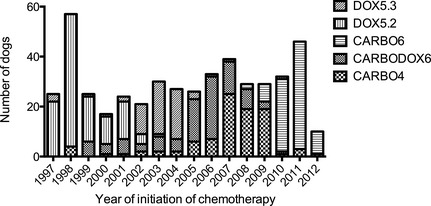
A retrospective cohort study was performed comprising consecutive dogs treated (1997-2012) with amputation followed by 1 of 5 chemotherapy protocols: carboplatin 300 mg/m(2) IV q21d for 4 or 6 cycles (CARBO6), doxorubicin 30 mg/m(2) IV q14d or q21d for 5 cycles, and alternating carboplatin 300 mg/m(2) IV and doxorubicin 30 mg/m(2) IV q21d for 3 cycles. Adverse events (AE) and DI were evaluated. Kaplan-Meier survival curves and Cox proportional hazards regression were used to compare disease-free interval (DFI) and survival time (ST) among protocols.
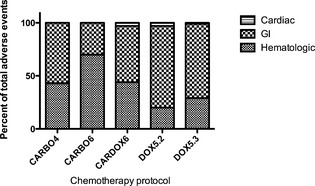
The overall median DFI and ST were 291 days and 284 days, respectively. A lower proportion of dogs prescribed CARBO6 experienced AEs compared to other protocols (48.4% versus 60.8-75.8%; P = .001). DI was not associated with development of metastases or death. After adjustment for baseline characteristics and prognostic factors, none of the protocols provided a significant reduction in risk of development of metastases or death.
Although choice of protocol did not result in significant differences in DFI or ST, the CARBO6 protocol resulted in a lower proportion of dogs experiencing AEs, which could be advantageous in maintaining high quality of life during treatment. DI was not a prognostic indicator in this study.
已有许多化疗方案用于治疗犬附肢骨肉瘤(OSA),但缺乏在单一群体中的疗效比较。
评估方案和剂量强度(DI)对基于卡铂和阿霉素的化疗方案治疗效果的影响。
470只患有附肢OSA的犬。
进行一项回顾性队列研究,纳入连续接受治疗(1997 - 2012年)的犬,截肢后采用5种化疗方案之一:卡铂300mg/m²静脉注射,每21天一次,共4或6个周期(CARBO6);阿霉素30mg/m²静脉注射,每14天或每21天一次,共5个周期;以及卡铂300mg/m²静脉注射和阿霉素30mg/m²静脉注射交替,每21天一次,共3个周期。评估不良事件(AE)和DI。采用Kaplan - Meier生存曲线和Cox比例风险回归比较各方案间的无病间期(DFI)和生存时间(ST)。
总体中位DFI和ST分别为291天和284天。与其他方案相比,采用CARBO6方案的犬发生AE的比例较低(48.4%对60.8 - 75.8%;P = 0.001)。DI与转移或死亡的发生无关。在对基线特征和预后因素进行调整后,各方案均未显著降低转移或死亡风险。
尽管方案的选择在DFI或ST方面未导致显著差异,但CARBO6方案使发生AE的犬比例较低,这在治疗期间维持高质量生活方面可能具有优势。在本研究中,DI不是一个预后指标。