1] Department of Dermatology, The Rudolfstiftung Hospital, Academic Teaching Hospital, Medical University Vienna, Juchgasse 25, 1030 Vienna, Austria [2] Department of Dermatology, Mt Zion Cancer Research Center, University of California, 2340 Sutter Street N461, 94115 San Francisco, CA, USA.
Department of Dermatology, The Rudolfstiftung Hospital, Academic Teaching Hospital, Medical University Vienna, Juchgasse 25, 1030 Vienna, Austria.
Br J Cancer. 2014 Mar 18;110(6):1427-32. doi: 10.1038/bjc.2014.62. Epub 2014 Feb 11.
Interleukin-2 (IL-2) treatment for patients with metastatic melanoma has shown remarkable durable responses. Systemic administration of IL-2 may cause severe side effects, whereas local administration is considered to be a safe alternative. The lungs are common sites of metastases in melanoma patients causing considerable respiratory problems. We sought to evaluate the potential antitumoral effect of a low-dose inhalative IL-2 (lh-IL-2) regimen for patients with melanoma lung metastases. In addition, we explored the prophylactic potential of Ih-IL-2 after surgical removal of lung metastases in a study carried out in an outpatient setting.
Twenty patients with American Joint Committee on Cancer stage-IV (M1b and M1c) melanoma were enrolled in this study and treated with 3 × 3 million IU inhalative IL-2 q.d. together with monthly dacarbazine bolus injections. Five patients received lh-IL-2 after surgical resection of lung metastases to prevent recurrence of the disease (prophylaxis group, N=5). All other patients were enrolled in the treatment group (N=15). Clinical evaluations were carried out monthly and radiological follow-up was performed every third month.
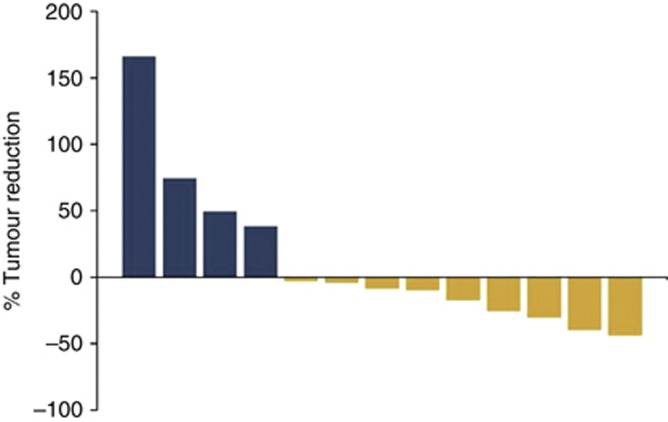
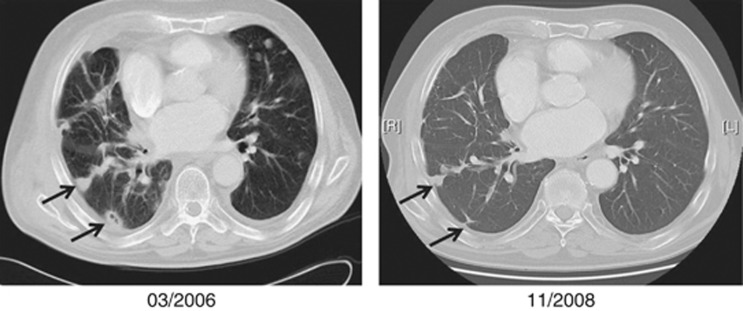
Nine patients in the treatment group had a clinical benefit with partial regression (27%) or stable disease (33%). Four patients had progression of lung metastases (26.7%) and two patients were not evaluable (13.3%). In the prophylaxis group, none of the patients developed new lung metastases during lh-IL-2 therapy. The median follow-up period was 7.8 months in the treatment group and 25.7 months in the prophylaxis group. In the majority of patients, treatment was well tolerated.
Low-dose IL-2 inhalation might offer an effective and safe treatment option for lung metastases in melanoma patients. In addition, lh-IL-2 may have a prophylactic potential to prevent recurrence in the lungs after pulmonary melanoma metastasectomy. Administration can easily be performed in an outpatient setting, thus offering an attractive treatment option.
白细胞介素-2(IL-2)治疗转移性黑色素瘤患者显示出显著持久的反应。全身给予 IL-2 可能会引起严重的副作用,而局部给药被认为是一种安全的替代方法。肺是黑色素瘤患者转移的常见部位,导致严重的呼吸问题。我们试图评估低剂量吸入性白细胞介素-2(lh-IL-2)方案治疗黑色素瘤肺转移患者的潜在抗肿瘤作用。此外,我们在一项门诊环境下进行的研究中,探索了 Ih-IL-2 在肺转移瘤切除术后的预防潜力。
本研究纳入了 20 例美国癌症联合委员会(AJCC)分期-IV 期(M1b 和 M1c)黑色素瘤患者,他们接受了 3×300 万 IU 吸入性 IL-2,qd,同时每月接受达卡巴嗪冲击治疗。5 例患者在肺转移瘤切除术后接受 lh-IL-2 治疗以预防疾病复发(预防组,N=5)。其余所有患者均纳入治疗组(N=15)。每月进行临床评估,每 3 个月进行一次影像学随访。
治疗组有 9 例患者有临床获益,表现为部分缓解(27%)或疾病稳定(33%)。4 例患者出现肺转移进展(26.7%),2 例患者无法评估(13.3%)。在预防组,lh-IL-2 治疗期间无患者出现新的肺转移。治疗组的中位随访时间为 7.8 个月,预防组为 25.7 个月。大多数患者的治疗耐受性良好。
低剂量 IL-2 吸入可能为黑色素瘤肺转移患者提供一种有效且安全的治疗选择。此外,lh-IL-2 可能具有预防肺黑色素瘤转移瘤切除术后肺部复发的潜力。该治疗可在门诊环境中轻松进行,因此是一种有吸引力的治疗选择。