Vanz Ana Letícia, Nimtz Manfred, Rinas Ursula
Leibniz University of Hannover, Technical Chemistry - Life Science, Callinstr, 5, 30167 Hannover, Germany.
Microb Cell Fact. 2014 Feb 13;13(1):23. doi: 10.1186/1475-2859-13-23.
Pichia pastoris is a popular yeast preferably employed for secretory protein production. Secretion is not always efficient and endoplasmic retention of proteins with aberrant folding properties, or when produced at exaggerated rates, can occur. In these cases production usually leads to an unfolded protein response (UPR) and the induction of the endoplasmic reticulum associated degradation (ERAD). P. pastoris is nowadays also an established host for secretory insulin precursor (IP) production, though little is known about the impact of IP production on the host cell physiology, in particular under industrially relevant production conditions. Here, we evaluate the cellular response to aox1 promoter-controlled, secretory IP production in controlled fed-batch processes using a proteome profiling approach.
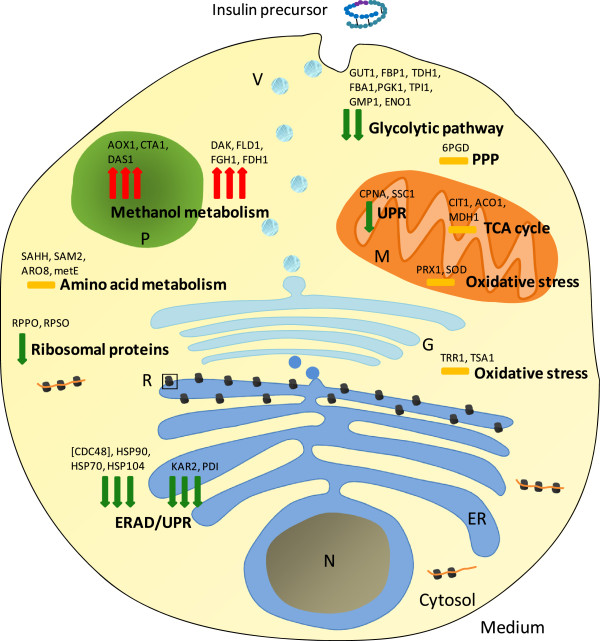
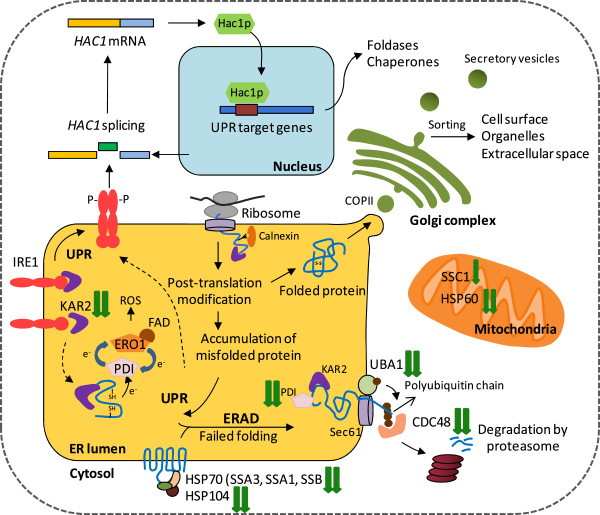
Cells were first grown in a batch procedure using a defined medium with a high glycerol concentration. After glycerol depletion IP production was initiated by methanol addition which was kept constant through continuous methanol feeding. The most prominent changes of the intracellular proteome after the onset of methanol feeding were related to the enzymes of central carbon metabolism. In particular, the enzymes of the methanol dissimilatory pathway - virtually absent in the glycerol batch phase - dominated the proteome during the methanol fed-batch phase. Unexpectedly, a strong decrease of UPR and ERAD related proteins was also observed during methanol-induced IP production. Compared to non-producing control strains grown under identical conditions the UPR down-regulation was less pronounced indicating that IP production elicits a detectable but non prominent UPR response which is repressed by the general culture condition-dependent UPR down-regulation after the shift from glycerol to methanol.
The passage of IP through the secretory pathway using an optimized IP vector and growing the strain at fed-batch conditions with a high initial glycerol concentration does not impose a significant burden on the secretory machinery even under conditions leading to an extracellular accumulation of ~ 3 g L-1 IP. The glycerol batch pre-induction culture conditions are associated with a high constitutive - recombinant protein production independent - induction of the UPR and ERAD pathways probably preconditioning the cells for effective IP secretion in the methanol fed-batch phase.
巴斯德毕赤酵母是一种常用于分泌蛋白生产的酵母。分泌并不总是高效的,具有异常折叠特性的蛋白质,或者当以过高速率产生时,可能会在内质网中滞留。在这些情况下,生产通常会导致未折叠蛋白反应(UPR)和内质网相关降解(ERAD)的诱导。如今,巴斯德毕赤酵母也是分泌型胰岛素前体(IP)生产的成熟宿主,尽管关于IP生产对宿主细胞生理学的影响知之甚少,特别是在工业相关的生产条件下。在此,我们使用蛋白质组分析方法评估在受控补料分批过程中细胞对受aox1启动子控制的分泌型IP生产的反应。
细胞首先在使用高甘油浓度的限定培养基的分批培养过程中生长。甘油耗尽后,通过添加甲醇启动IP生产,并通过连续补加甲醇使其保持恒定。甲醇补料开始后,细胞内蛋白质组最显著的变化与中心碳代谢的酶有关。特别是,甲醇异化途径的酶——在甘油分批阶段几乎不存在——在甲醇补料分批阶段主导了蛋白质组。出乎意料的是,在甲醇诱导的IP生产过程中,还观察到UPR和ERAD相关蛋白的强烈减少。与在相同条件下生长的非生产对照菌株相比,UPR下调不太明显,这表明IP生产引发了可检测但不显著的UPR反应,该反应在从甘油转变为甲醇后被一般的依赖培养条件的UPR下调所抑制。
使用优化的IP载体使IP通过分泌途径,并在高初始甘油浓度的补料分批条件下培养菌株,即使在导致细胞外积累约3 g L-1 IP的条件下,也不会对分泌机制造成显著负担。甘油分批预诱导培养条件与UPR和ERAD途径的高组成型(与重组蛋白生产无关)诱导相关,这可能使细胞为甲醇补料分批阶段的有效IP分泌做好准备。