Kastberg Louise La Barbera, Ard Ryan, Jensen Michael Krogh, Workman Christopher T
Department of Biotechnology and Biomedicine, Technical University of Denmark, Lyngby, Denmark.
Department of Biology, University of British Columbia, Kelowna, BC, Canada.
Front Fungal Biol. 2022 Feb 1;3:827704. doi: 10.3389/ffunb.2022.827704. eCollection 2022.
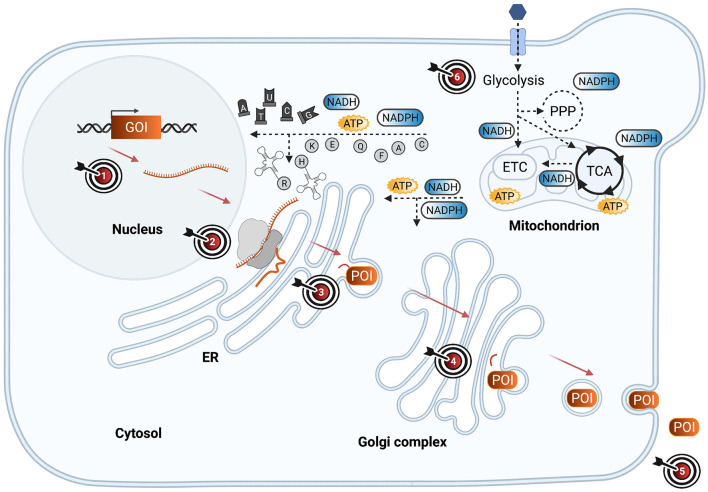
Production of heterologous proteins, especially biopharmaceuticals and industrial enzymes, in living cell factories consumes cellular resources. Such resources are reallocated from normal cellular processes toward production of the heterologous protein that is often of no benefit to the host cell. This competition for resources is a burden to host cells, has a negative impact on cell fitness, and may consequently trigger stress responses. Importantly, this often causes a reduction in final protein titers. Engineering strategies to generate more burden resilient production strains offer sustainable opportunities to increase production and profitability for this growing billion-dollar global industry. We review recently reported impacts of burden derived from resource competition in two commonly used protein-producing yeast cell factories: and (syn. ). We dissect possible sources of burden in these organisms, from aspects related to genetic engineering to protein translation and export of soluble protein. We also summarize advances as well as challenges for cell factory design to mitigate burden and increase overall heterologous protein production from metabolic engineering, systems biology, and synthetic biology perspectives. Lastly, future profiling and engineering strategies are highlighted that may lead to constructing robust burden-resistant cell factories. This includes incorporation of systems-level data into mathematical models for rational design and engineering dynamical regulation circuits in production strains.
在活细胞工厂中生产异源蛋白,尤其是生物制药和工业酶,会消耗细胞资源。这些资源从正常的细胞过程重新分配到异源蛋白的生产中,而异源蛋白通常对宿主细胞没有益处。这种对资源的竞争对宿主细胞来说是一种负担,会对细胞适应性产生负面影响,并可能因此触发应激反应。重要的是,这通常会导致最终蛋白滴度降低。构建更具负担承受能力的生产菌株的工程策略为这个不断发展的全球数十亿美元产业提供了增加产量和盈利能力的可持续机会。我们综述了最近报道的在两种常用的产蛋白酵母细胞工厂:和(同义词)中,资源竞争产生的负担所带来的影响。我们从与基因工程、蛋白质翻译以及可溶性蛋白输出相关的方面剖析了这些生物体中可能的负担来源。我们还从代谢工程、系统生物学和合成生物学的角度总结了细胞工厂设计在减轻负担和提高整体异源蛋白产量方面的进展以及挑战。最后,强调了未来可能导致构建强大的抗负担细胞工厂的分析和工程策略。这包括将系统水平的数据纳入数学模型以进行合理设计,并在生产菌株中构建动态调控回路。