Khan Salman A, Asiri Abdullah M, Al-Amry Khalid, Malik Maqsood Ahmad
Chemistry Department, Faculty of Science, King Abdulaziz University, P.O. Box 80203, Jeddah 21589, Saudi Arabia.
Chemistry Department, Faculty of Science, King Abdulaziz University, P.O. Box 80203, Jeddah 21589, Saudi Arabia ; Center of Excellence for Advanced Materials Research (CEAMR), King Abdulaziz University, P.O. Box 80203, Jeddah 21589, Saudi Arabia.
ScientificWorldJournal. 2014 Jan 9;2014:592375. doi: 10.1155/2014/592375. eCollection 2014.
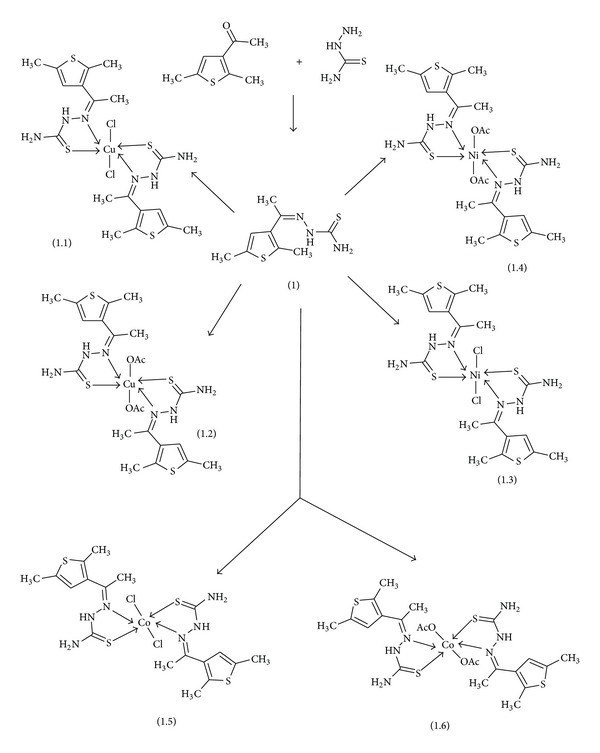
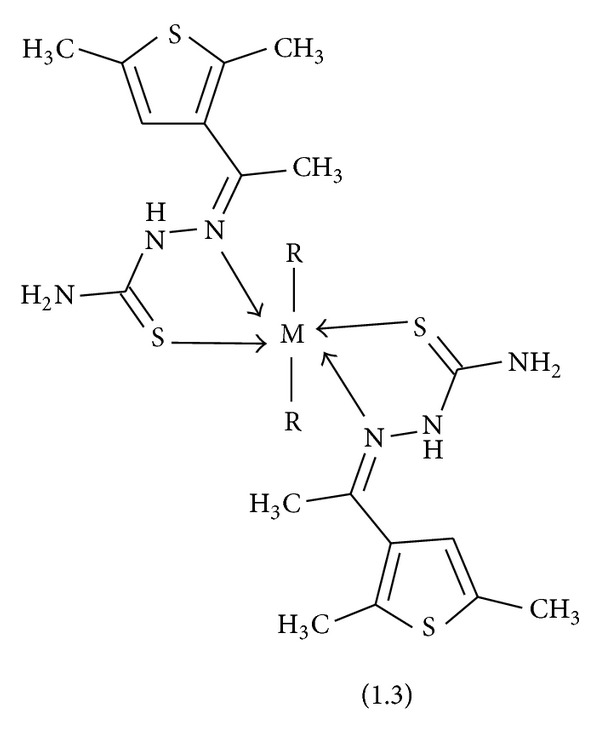
Metal complexes were prepared by the reaction of thiosemicarbazone with CuCl2, NiCl2, CoCl2, Cu(OAc)2, Ni(OAc)2, and Co(OAc)2. The thiosemicarbazone coordinates to metal through the thionic sulfur and the azomethine nitrogen. The thiosemicarbazone was obtained by the thiosemicarbazide with 3-acetyl-2,5-dimethylthiophene. The identities of these compounds were elucidated by IR, (1)H, (13)C-NMR, and GC-MS spectroscopic methods and elemental analyses. The antibacterial activity of these compounds was first tested in vitro by the disc diffusion assay against two Gram-positive and two Gram-negative bacteria, and then the minimum inhibitory concentration (MIC) was determined by using chloramphenicol as reference drug. The results showed that compound 1.1 is better inhibitor of both types of tested bacteria as compared to chloramphenicol.
通过硫代氨基脲与氯化铜、氯化镍、氯化钴、醋酸铜、醋酸镍和醋酸钴反应制备金属配合物。硫代氨基脲通过硫代硫和甲亚胺氮与金属配位。硫代氨基脲由硫代氨基脲与3-乙酰基-2,5-二甲基噻吩反应制得。通过红外光谱、氢谱、碳谱核磁共振以及气相色谱-质谱联用光谱法和元素分析确定了这些化合物的结构。首先通过纸片扩散法对这些化合物针对两种革兰氏阳性菌和两种革兰氏阴性菌进行体外抗菌活性测试,然后以氯霉素为参比药物测定最低抑菌浓度(MIC)。结果表明,与氯霉素相比,化合物1.1对两种受试细菌均为更好的抑制剂。