Mayorga Perez Orlando, Brinkhof Martin W G, Egger Matthias, Frösner Gert, Herzog Christian, Zwahlen Marcel
Department of Microbiology and Parasitology, Faculty of Medical Sciences, National Autonomous University, León, Nicaragua.
Institute of Social & Preventive Medicine (ISPM), University of Berne, Berne, Switzerland.
PLoS One. 2014 Feb 11;9(2):e87643. doi: 10.1371/journal.pone.0087643. eCollection 2014.
Nicaragua is highly endemic for hepatitis A. We aimed to provide an estimate of the change in the age-specific risk of hepatitis A virus (HAV) infection based on serological data from cross-sectional and longitudinal samples collected in León, Nicaragua, in 1995/96 (n = 979) and 2003 (n = 494).
The observed age-specific prevalence of anti-HAV antibodies was correlated to the age-specific risk of infection by calculating the probability of freedom from infection at a specific age.
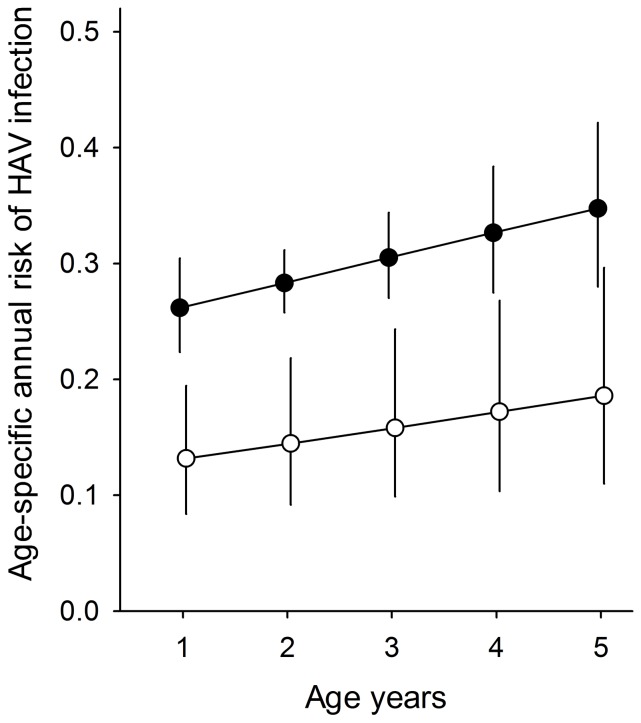
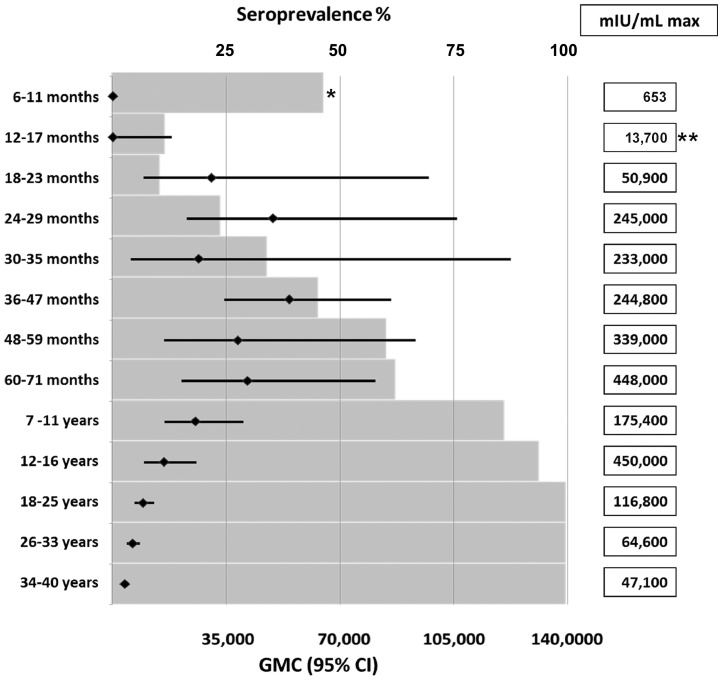
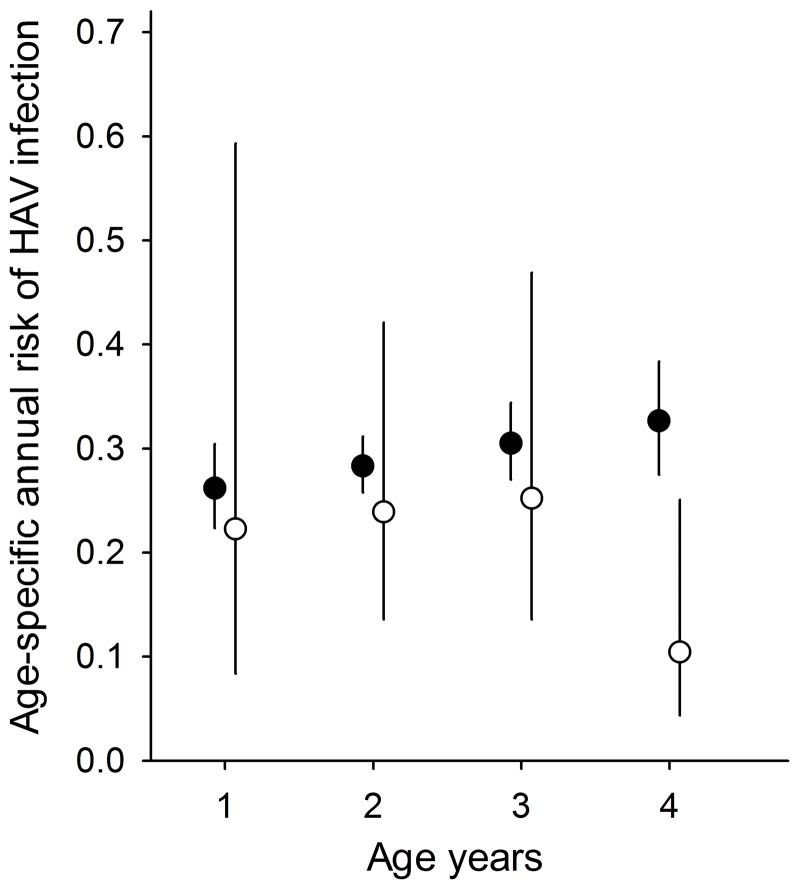
The proportion of seropositive children aged 1.5 to 6 years was 42% in 2003 compared to 67% in 1995/96. Estimated annual risk of infection for a 3-year old child was 30% (95% CI: 27.0%, 33.1%) in 1995 and 15.5% (95% CI: 12.4%, 19.0%) in 2003. There was good agreement between estimates based on cross-sectional and longitudinal data. The age-specific geometric mean of the quantified anti-HAV antibody levels assessed in 2003 was highest at age 4 and decreased steadily up to age 40.
The substantially lower risk of HAV infection in 2003 than in 1995 for young children indicates a beginning transition from high to intermediate endemicity in León, Nicaragua. Consecutive age-stratified serosurveys are useful to assess changes in risk of infection following public health interventions. The decreasing age-specific GMC of anti-HAV antibodies during adulthood in a country with endemic HAV indirectly suggests that ongoing HAV exposure in the community has marginal boosting effect on antibody levels once protective immunity has been established by natural infection.
尼加拉瓜是甲型肝炎的高流行地区。我们旨在根据1995/96年(n = 979)和2003年(n = 494)在尼加拉瓜莱昂收集的横断面和纵向样本的血清学数据,估算甲型肝炎病毒(HAV)感染的年龄特异性风险变化。
通过计算特定年龄无感染的概率,将观察到的抗-HAV抗体年龄特异性患病率与年龄特异性感染风险相关联。
2003年1.5至6岁血清阳性儿童的比例为42%,而1995/96年为67%。1995年3岁儿童的估计年感染风险为30%(95%CI:27.0%,33.1%),2003年为15.5%(95%CI:12.4%,19.0%)。基于横断面和纵向数据的估计之间具有良好的一致性。2003年评估的定量抗-HAV抗体水平的年龄特异性几何平均值在4岁时最高,并在40岁之前稳步下降。
2003年幼儿感染HAV的风险比1995年大幅降低,这表明尼加拉瓜莱昂开始从高流行向中流行转变。连续的年龄分层血清学调查有助于评估公共卫生干预后感染风险的变化。在HAV流行的国家,成年期抗-HAV抗体的年龄特异性几何平均浓度下降间接表明,一旦通过自然感染建立了保护性免疫,社区中持续的HAV暴露对抗体水平的增强作用很小。