Vitral Claudia Lamarca, da Silva-Nunes Mônica, Pinto Marcelo Alves, de Oliveira Jaqueline Mendes, Gaspar Ana Maria Coimbra, Pereira Rebeca Cristina Costa, Ferreira Marcelo Urbano
Laboratory of Technological Development in Virology, Oswaldo Cruz Institute, Oswaldo Cruz Foundation, Rio de Janeiro, RJ, Brazil.
BMC Infect Dis. 2014 Aug 23;14:458. doi: 10.1186/1471-2334-14-458.
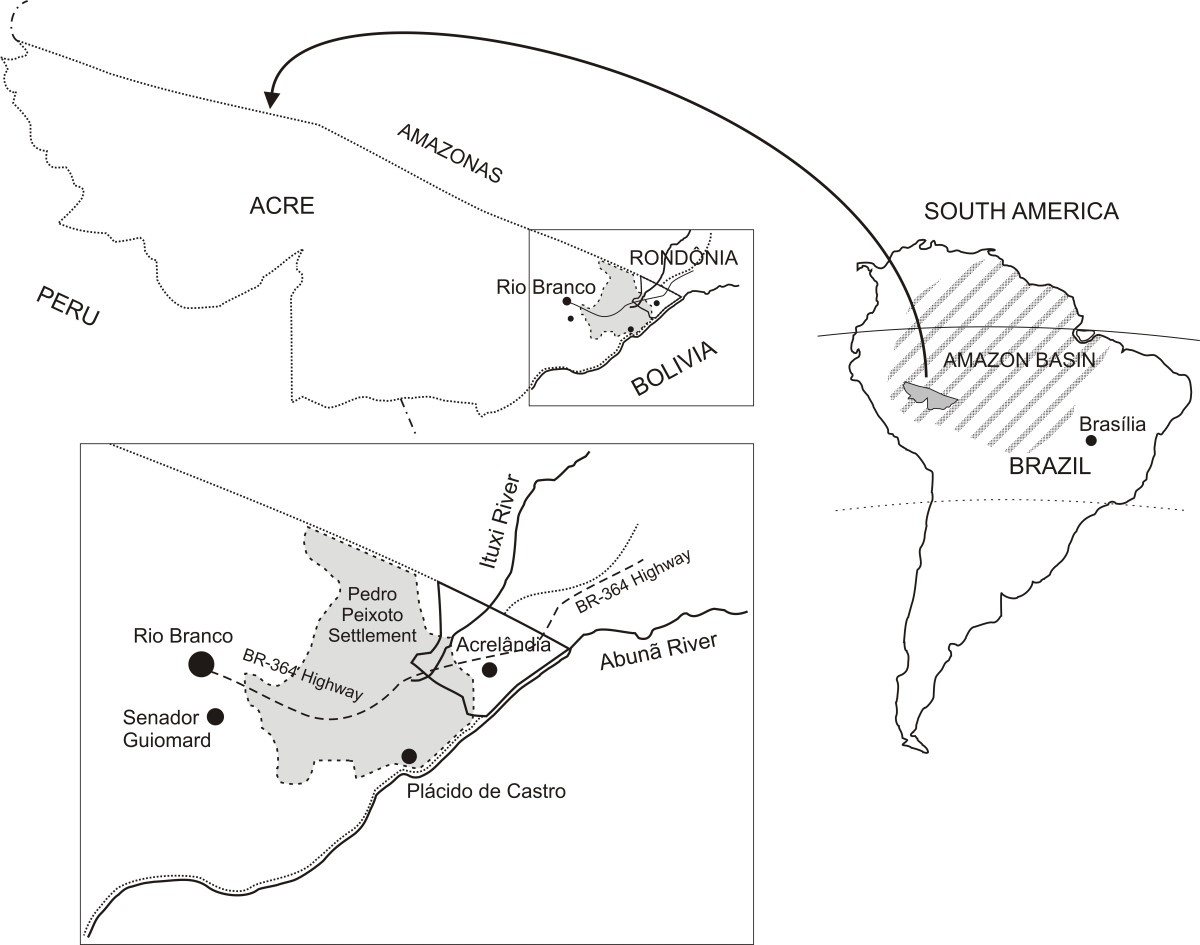
Hepatitis A virus (HAV) and hepatitis E virus (HEV) are both transmitted by the faecal-oral route, and represent common causes of acute hepatitis in developing countries. The endemicity of HAV infection has shifted from high to moderate in Brazil. Human cases of HEV infection seem to be rare, although the virus has been detected in swine livestock and effluents of slaughterhouses. This study was to determine the epidemiology of hepatitis A and E in one of the largest agricultural settlements in the Amazon Basin of Brazil.
Serum samples collected from 397 individuals aged between 5 and 90 years during a population-based cross-sectional survey were tested for anti-HAV and anti-HEV antibodies. Associated risk factors and spatial clustering of HAV and HEV seropositivity were also analyzed.
The overall rate of HAV seropositivity was 82.9% (95% confidence interval (CI), 79.2-86.6%). Multilevel logistic regression analysis identified increasing age (in years; odds ratio (OR), 1.097; 95% CI, 1.050-1.147; P < 0.001) and crowding (OR, 1.603; 95% CI, 1.054-2.440; P = 0.028) as significant risk factors for HAV seropositivity. Anti-HEV IgG was detected in 50/388 settlers (12.9%, 95% CI, 9.5-16.2%). Anti-HEV IgM was detected in 7/43 (16.3%) anti-IgG positive samples, and 4 of them had a confirmed result by immunoblot. Increasing age was the only significant determinant of HEV seropositivity (OR, 1.033; 95% CI, 1.016-1.050; P < 0.001). No significant spatial clustering of HAV and HEV seropositivity was detected in the area.
Both HAV and HEV are endemic, with differing rates of infection in children and adults in this rural setting of the Brazilian Amazon. Anti-HEV prevalence was considerably higher than those previously reported in Brazil. The detection of HEV- specific IgM antibodies in four asymptomatic individuals is highly suggestive of the circulation of HEV in this rural population.
甲型肝炎病毒(HAV)和戊型肝炎病毒(HEV)均通过粪-口途径传播,是发展中国家急性肝炎的常见病因。在巴西,HAV感染的流行程度已从高流行转变为中度流行。尽管已在猪和屠宰场废水中检测到HEV,但人类HEV感染病例似乎很少见。本研究旨在确定巴西亚马逊盆地最大的农业定居点之一的甲型和戊型肝炎流行病学情况。
在一项基于人群的横断面调查中,对397名年龄在5至90岁之间的个体采集的血清样本进行抗HAV和抗HEV抗体检测。还分析了HAV和HEV血清阳性的相关危险因素及空间聚集性。
HAV血清阳性的总体率为82.9%(95%置信区间(CI),79.2 - 86.6%)。多水平逻辑回归分析确定年龄增长(以年计;比值比(OR),1.097;95%CI,1.050 - 1.147;P < 0.001)和拥挤(OR,1.603;95%CI,1.054 - 2.440;P = 0.028)是HAV血清阳性的显著危险因素。在388名定居者中有50人检测到抗HEV IgG(12.9%,95%CI,9.5 - 16.2%)。在4 / 43(16.3%)抗IgG阳性样本中检测到抗HEV IgM,其中4人经免疫印迹法得到确诊结果。年龄增长是HEV血清阳性的唯一显著决定因素(OR,1.033;95%CI,1.016 - 1.050;P < 0.001)。在该地区未检测到HAV和HEV血清阳性的显著空间聚集性。
在巴西亚马逊地区的这个农村环境中,HAV和HEV均为地方性流行,儿童和成人的感染率不同。抗HEV流行率显著高于巴西此前报道的水平。在4名无症状个体中检测到HEV特异性IgM抗体,强烈提示HEV在该农村人群中传播。