Olson Daniel, Lamb Molly M, Lopez Maria Renee, Paniagua-Avila M Alejandra, Zacarias Alma, Samayoa-Reyes Gabriela, Cordon-Rosales Celia, Asturias Edwin J
Departments ofPediatrics and.
Department of Epidemiology, Colorado School of Public Health, Aurora.
Open Forum Infect Dis. 2017 Mar 17;4(2):ofx049. doi: 10.1093/ofid/ofx049. eCollection 2017 Spring.
Rapid, cost-effective tools are needed to estimate the disease burden of acute gastroenteritis (AGE) and norovirus (NoV) in resource-limited settings.
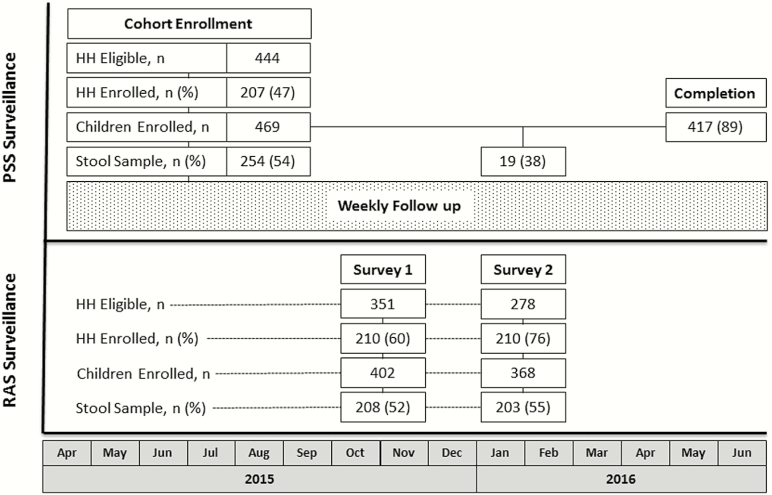
Households with children (6 weeks-17 years) in rural Guatemala were randomly enrolled into 2 parallel AGE surveillance systems: (1) a prospective cohort, which included an enrollment visit followed by 1 year of prospective observation using a smartphone-based weekly symptom diary; and (2) 2 sequential cross-sectional rapid active sampling (RAS) surveys. Norovirus testing was performed during enrollment (all subjects) and for prospective AGE episodes (prospective cohort only).
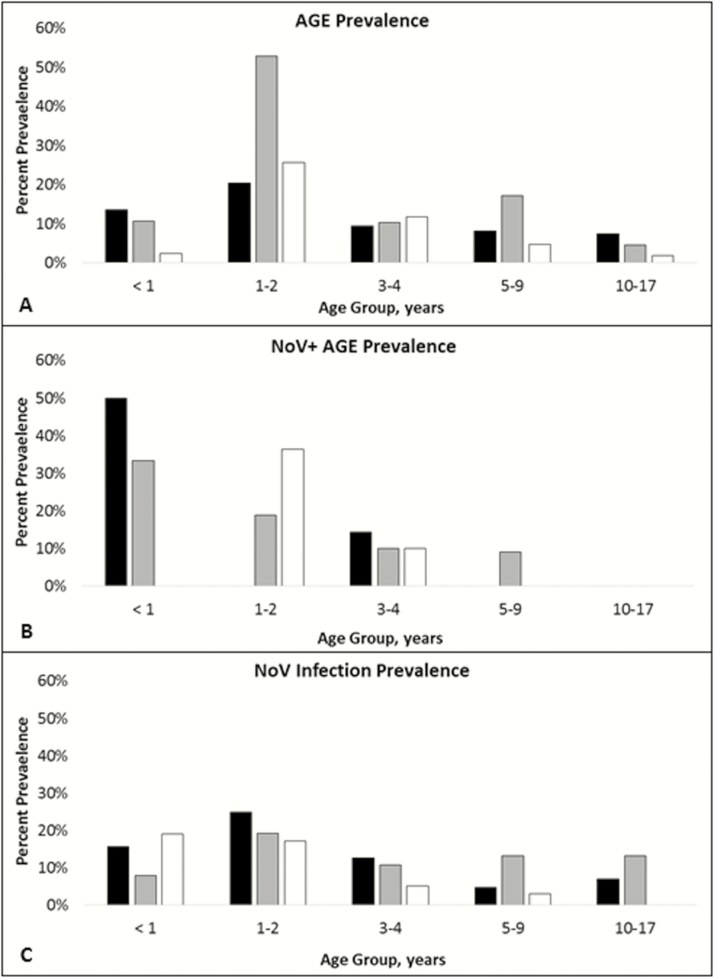
The prospective cohort enrolled 207 households (469 children) from April to September 2015 followed by 471 person-years of observation; RAS survey 1 enrolled 210 households (402 children) during October to November 2015, and RAS survey 2 enrolled 210 separate households (368 children) during January to February 2016. The prospective cohort detected a NoV+ AGE prevalence of 11% and a population-attributable fraction (PAF) of -1.6% at enrollment, followed by an incidence of 1.4 episodes/100 person-years. Rapid active sampling surveys 1 and 2 identified a NoV+ AGE prevalence of 14%-21% and a PAF of 3.2%-12.4%.
Rapid active sampling surveys were practical and identified more cases of NoV infection and disease compared with a parallel prospective cohort in rural Guatemala.
在资源有限的环境中,需要快速且具有成本效益的工具来估计急性胃肠炎(AGE)和诺如病毒(NoV)的疾病负担。
危地马拉农村地区有6周龄至17岁儿童的家庭被随机纳入两个平行的AGE监测系统:(1)一个前瞻性队列,包括一次入组访视,随后使用基于智能手机的每周症状日记进行1年的前瞻性观察;(2)两项连续的横断面快速主动抽样(RAS)调查。在入组时(所有受试者)以及前瞻性AGE发作时(仅前瞻性队列)进行诺如病毒检测。
前瞻性队列在2015年4月至9月纳入了207户家庭(469名儿童),随后进行了471人年的观察;RAS调查1在2015年10月至11月期间纳入了210户家庭(402名儿童),RAS调查2在2016年1月至2月期间纳入了210户不同的家庭(368名儿童)。前瞻性队列在入组时检测到NoV+ AGE患病率为11%,人群归因分数(PAF)为-1.6%,随后发病率为1.4例/100人年。快速主动抽样调查1和2确定NoV+ AGE患病率为14%-21%,PAF为3.2%-12.4%。
与危地马拉农村地区的平行前瞻性队列相比,快速主动抽样调查切实可行,且发现了更多的NoV感染和疾病病例。