Bellavista Elena, Santoro Aurelia, Galimberti Daniela, Comi Cristoforo, Luciani Fabio, Mishto Michele
Interdepartmental Center for Studies on Biophysics, Bioinformatics and Biocomplexity "L. Galvani" (CIG), University of Bologna, 40126 Bologna, Italy ; Department of Experimental, Diagnostic and Specialty Medicine (DIMES), University of Bologna, 40126 Bologna, Italy.
Department of Experimental, Diagnostic and Specialty Medicine (DIMES), University of Bologna, 40126 Bologna, Italy.
Autoimmune Dis. 2014;2014:739705. doi: 10.1155/2014/739705. Epub 2014 Jan 2.
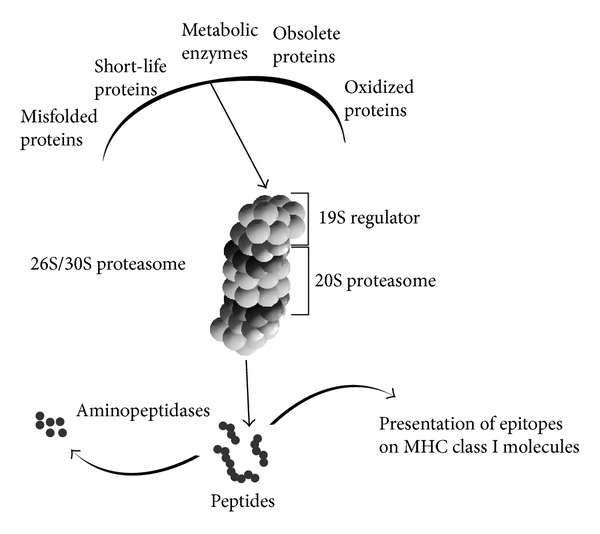
The ubiquitin-proteasome system is the major intracellular molecular machinery for protein degradation and maintenance of protein homeostasis in most human cells. As ubiquitin-proteasome system plays a critical role in the regulation of the immune system, it might also influence the development and progression of multiple sclerosis (MS). Both ex vivo analyses and animal models suggest that activity and composition of ubiquitin-proteasome system are altered in MS. Proteasome isoforms endowed of immunosubunits may affect the functionality of different cell types such as CD8(+) and CD4(+) T cells and B cells as well as neurons during MS development. Furthermore, the study of proteasome-related biomarkers, such as proteasome antibodies and circulating proteasomes, may represent a field of interest in MS. Proteasome inhibitors are already used as treatment for cancer and the recent development of inhibitors selective for immunoproteasome subunits may soon represent novel therapeutic approaches to the different forms of MS. In this review we describe the current knowledge on the potential role of proteasomes in MS and discuss the pro et contra of possible therapies for MS targeting proteasome isoforms.
泛素-蛋白酶体系统是大多数人类细胞中蛋白质降解和维持蛋白质稳态的主要细胞内分子机制。由于泛素-蛋白酶体系统在免疫系统调节中起关键作用,它也可能影响多发性硬化症(MS)的发展和进程。体外分析和动物模型均表明,MS中泛素-蛋白酶体系统的活性和组成会发生改变。具有免疫亚基的蛋白酶体同工型可能会影响MS发病过程中不同细胞类型的功能,如CD8(+)和CD4(+) T细胞、B细胞以及神经元。此外,对蛋白酶体相关生物标志物(如蛋白酶体抗体和循环蛋白酶体)的研究可能成为MS领域的一个研究热点。蛋白酶体抑制剂已被用于癌症治疗,而针对免疫蛋白酶体亚基的抑制剂的最新研发可能很快代表针对不同形式MS的新型治疗方法。在这篇综述中,我们描述了目前关于蛋白酶体在MS中潜在作用的知识,并讨论了针对蛋白酶体同工型的MS可能治疗方法的利弊。