Imam Bita, Jarus Tal
Rehabilitation Sciences Graduate Program, University of British Columbia, Vancouver, BC, Canada V6T 2B5.
Rehabilitation Sciences Graduate Program, University of British Columbia, Vancouver, BC, Canada V6T 2B5 ; Department of Occupational Science & Occupational Therapy, University of British Columbia, Vancouver, BC, Canada V6T 2B5.
Rehabil Res Pract. 2014;2014:594540. doi: 10.1155/2014/594540. Epub 2014 Jan 9.
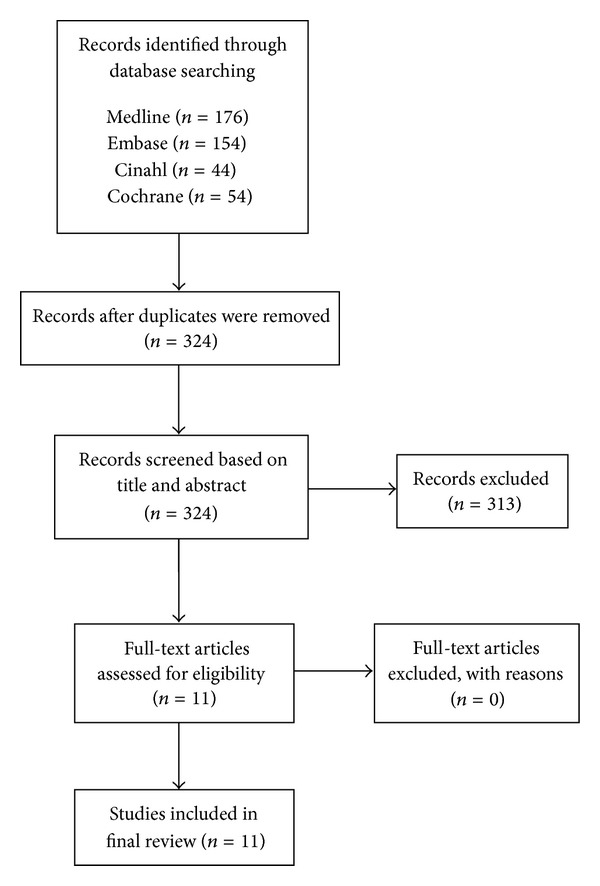
Objectives. To identify the virtual reality (VR) interventions used for the lower extremity rehabilitation in stroke population and to explain their underlying training mechanisms using Social Cognitive (SCT) and Motor Learning (MLT) theoretical frameworks. Methods. Medline, Embase, Cinahl, and Cochrane databases were searched up to July 11, 2013. Randomized controlled trials that included a VR intervention for lower extremity rehabilitation in stroke population were included. The Physiotherapy Evidence Database (PEDro) scale was used to assess the quality of the included studies. The underlying training mechanisms involved in each VR intervention were explained according to the principles of SCT (vicarious learning, performance accomplishment, and verbal persuasion) and MLT (focus of attention, order and predictability of practice, augmented feedback, and feedback fading). Results. Eleven studies were included. PEDro scores varied from 3 to 7/10. All studies but one showed significant improvement in outcomes in favour of the VR group (P < 0.05). Ten VR interventions followed the principle of performance accomplishment. All the eleven VR interventions directed subject's attention externally, whereas nine provided training in an unpredictable and variable fashion. Conclusions. The results of this review suggest that VR applications used for lower extremity rehabilitation in stroke population predominantly mediate learning through providing a task-oriented and graduated learning under a variable and unpredictable practice.
目的。确定用于中风患者下肢康复的虚拟现实(VR)干预措施,并使用社会认知理论(SCT)和运动学习理论(MLT)框架解释其潜在的训练机制。方法。检索截至2013年7月11日的Medline、Embase、Cinahl和Cochrane数据库。纳入包括针对中风患者下肢康复的VR干预的随机对照试验。使用物理治疗证据数据库(PEDro)量表评估纳入研究的质量。根据SCT(替代学习、绩效成就和言语说服)和MLT(注意力焦点、练习的顺序和可预测性、增强反馈和反馈消退)的原则解释每种VR干预所涉及的潜在训练机制。结果。纳入11项研究。PEDro评分从3到7/10不等。除一项研究外,所有研究均显示VR组的结局有显著改善(P<0.05)。10项VR干预遵循绩效成就原则。所有11项VR干预均将受试者的注意力引向外部,而9项以不可预测和可变的方式提供训练。结论。本综述结果表明,用于中风患者下肢康复的VR应用主要通过在可变和不可预测的练习下提供面向任务的分级学习来介导学习。