Ahn Seong Hee, Koh Jung-Min, Gong Eun Jeong, Byun Seongeun, Lee Sun-Young, Kim Beom-Jun, Lee Seung Hun, Chang Jae Suk, Kim Ghi Su
Division of Endocrinology and Metabolism, Asan Medical Center, University of Ulsan College of Medicine, Seoul, Korea.
Division of Orthopedic Surgery, Asan Medical Center, University of Ulsan College of Medicine, Seoul, Korea.
J Bone Metab. 2013 Nov;20(2):61-5. doi: 10.11005/jbm.2013.20.2.61. Epub 2013 Nov 18.
Sphingosine 1-phosphate (S1P) has been discovered to be a critical regulator of bone metabolism. Very recently, we found that higher circulating S1P levels were associated with higher rate of prevalent osteoporotic fracture in human.
This was a cross-sectional study of 16 patients who underwent hip replacement surgeries. Bone marrow fluids were obtained during hip surgeries, and the S1P levels were measured using a competitive enzyme-linked immunosorbent assay (ELISA) assay. Bone mineral densities (BMDs) at various skeletal sites were obtained using dual energy X-ray absorptiometry.
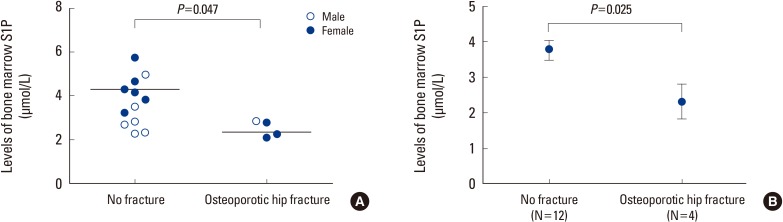
Among 16 patients, 4 patients were undergone operations due to hip fractures, and the others were done by any other causes. Bone marrow S1P levels were significantly lower in patients with hip fractures than in those without, before and after adjusting for confounding factors (P=0.047 and 0.025, respectively). We failed to demonstrate significant associations between bone marrow S1P levels and any BMD values (γ=0.026-0.482, P=0.171-0.944).
In conjunction with our previous findings, these suggest that the effects of gradient between peripheral blood and bone marrow, but not S1P itself, may be the most critical on bone metabolism.
鞘氨醇-1-磷酸(S1P)已被发现是骨代谢的关键调节因子。最近,我们发现循环中较高的S1P水平与人类骨质疏松性骨折的较高发生率相关。
这是一项对16例行髋关节置换手术患者的横断面研究。在髋关节手术期间获取骨髓液,并使用竞争性酶联免疫吸附测定(ELISA)法测量S1P水平。使用双能X线吸收法获取不同骨骼部位的骨密度(BMD)。
16例患者中,4例因髋部骨折接受手术,其他患者因其他原因接受手术。在调整混杂因素之前和之后,髋部骨折患者的骨髓S1P水平均显著低于无骨折患者(分别为P = 0.047和0.025)。我们未能证明骨髓S1P水平与任何BMD值之间存在显著关联(γ = 0.026 - 0.482,P = 0.171 - 0.944)。
结合我们之前的研究结果,这些表明外周血与骨髓之间的梯度效应而非S1P本身可能对骨代谢最为关键。