Zheng Guorong, Xiong Yimin, Xu Weitian, Wang Yan, Chen Fang, Wang Zhigang, Yan Zhi
Department of Digestive Diseases, Wuhan General Hospital of Guangzhou Command, Wuchang, Wuhan 430070, P.R. China.
Department of Medical Laboratory, Wuhan General Hospital of Guangzhou Command, Wuchang, Wuhan 430070, P.R. China.
Oncol Lett. 2014 Mar;7(3):679-684. doi: 10.3892/ol.2014.1797. Epub 2014 Jan 15.
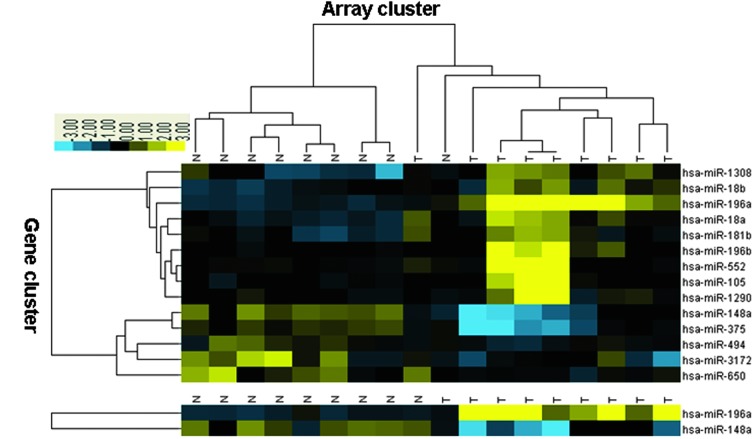
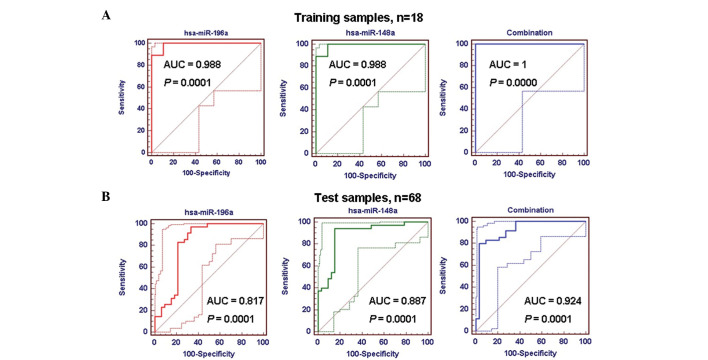
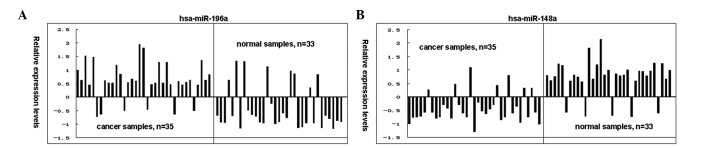
Gastric cancer (GC) is one of the most common malignant tumors worldwide. No fundamental improvements in the five-year survival rates of patients with GC have been reported due to a low early diagnosis rate. Therefore, the identification of novel biomarkers is urgently required for an early diagnosis of GC. A total of 86 patients were selected for the present study, including 44 patients with early stage GC (T1-T2 according to TNM staging criteria) and 42 normal gastric mucosa samples from non-cancer patients as controls. A total of 18 samples were used for the microRNA (miRNA) microarray experiments, including nine early GC and nine normal gastric mucosa samples. Bioinformatics algorithms, significant analysis of microarray (SAM), top scoring pair (TSP) and statistical receiver operating characteristic curves were used to identify the best signatures. Finally, quantitative PCR was used to validate the candidate biomarkers for early gastric cancer in the test samples (35 cancer and 33 normal samples). Using the SAM algorithm, 14 differential miRNAs were selected as candidate biomarkers. Using the TSP algorithm, hsa-miR-196a and hsa-miR-148a were obtained as a signature to differentiate between the early GC and normal samples. A coincidental result was observed in the test samples. hsa-miR-196a was upregulated and hsa-miR-148a was downregulated in the early GC samples. hsa-miR-196a and hsa-miR-148a have the potential to serve as candidate biomarkers for early GC.
胃癌(GC)是全球最常见的恶性肿瘤之一。由于早期诊断率低,胃癌患者的五年生存率未见根本性改善。因此,迫切需要鉴定新的生物标志物用于胃癌的早期诊断。本研究共选取86例患者,包括44例早期胃癌患者(根据TNM分期标准为T1-T2期)和42例来自非癌症患者的正常胃黏膜样本作为对照。共18个样本用于微小RNA(miRNA)微阵列实验,包括9例早期胃癌样本和9例正常胃黏膜样本。采用生物信息学算法、微阵列显著性分析(SAM)、最高得分对(TSP)和统计性受试者工作特征曲线来鉴定最佳特征。最后,采用定量PCR验证测试样本(35例癌症样本和33例正常样本)中早期胃癌的候选生物标志物。使用SAM算法,选择14个差异miRNA作为候选生物标志物。使用TSP算法,获得hsa-miR-196a和hsa-miR-148a作为区分早期胃癌样本和正常样本的特征。在测试样本中观察到了一致的结果。在早期胃癌样本中,hsa-miR-196a上调,hsa-miR-148a下调。hsa-miR-196a和hsa-miR-148a有潜力作为早期胃癌的候选生物标志物。