Shin Aesun, Joo Jungnam, Yang Hye-Ryung, Bak Jeongin, Park Yunjin, Kim Jeongseon, Oh Jae Hwan, Nam Byung-Ho
Molecular Epidemiology Branch, National Cancer Center, Goyang-si, Republic of Korea.
Biometric Research Branch, National Cancer Center, Goyang-si, Republic of Korea.
PLoS One. 2014 Feb 12;9(2):e88079. doi: 10.1371/journal.pone.0088079. eCollection 2014.
Incidence and mortality rates of colorectal cancer have been rapidly increasing in Korea during last few decades. Development of risk prediction models for colorectal cancer in Korean men and women is urgently needed to enhance its prevention and early detection.
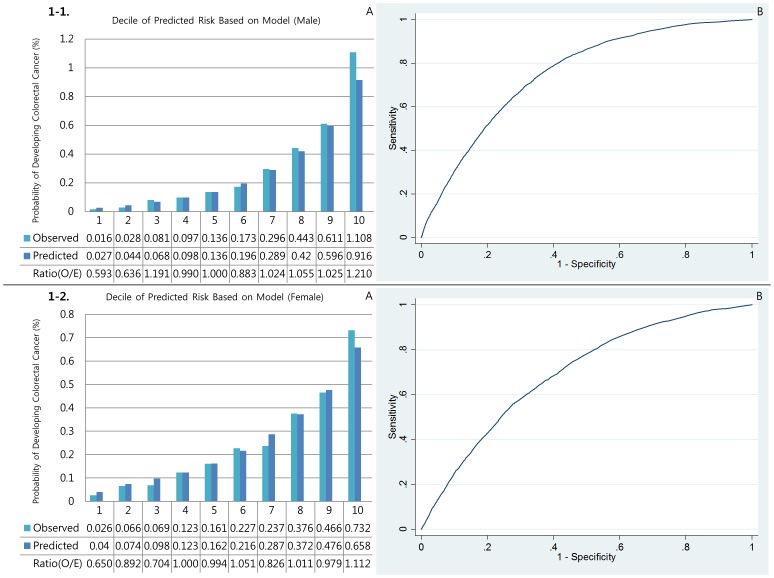
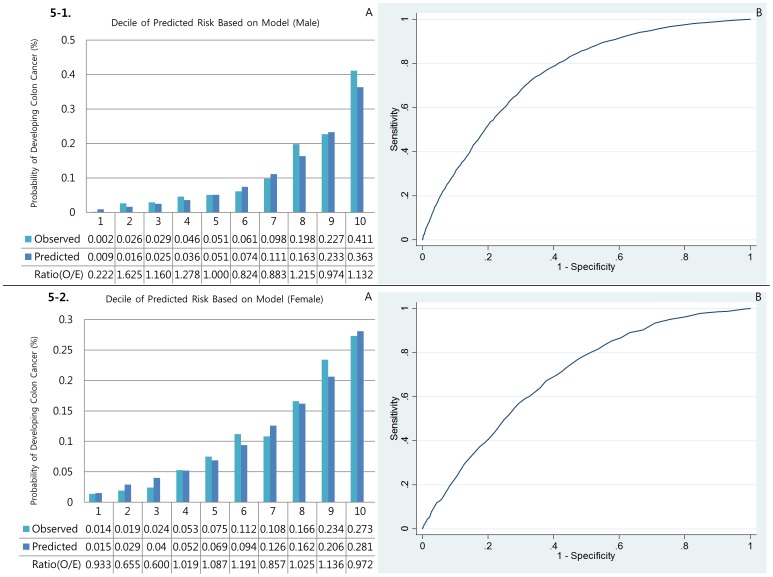
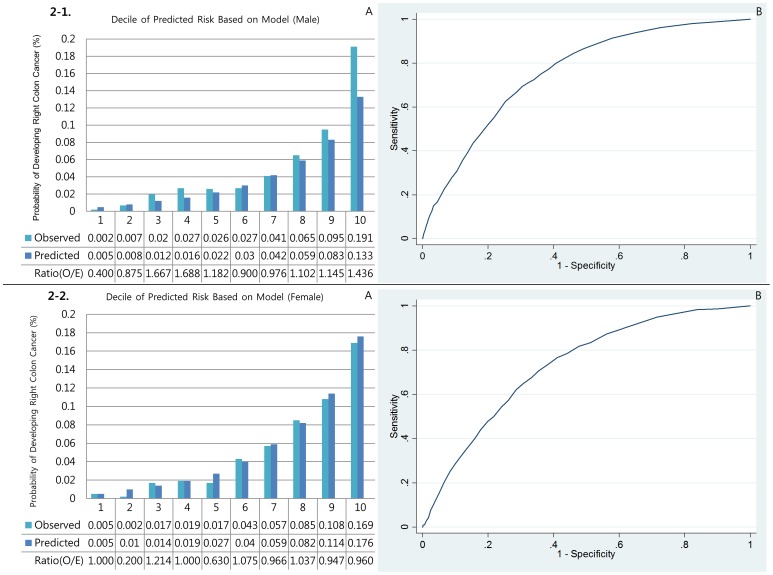
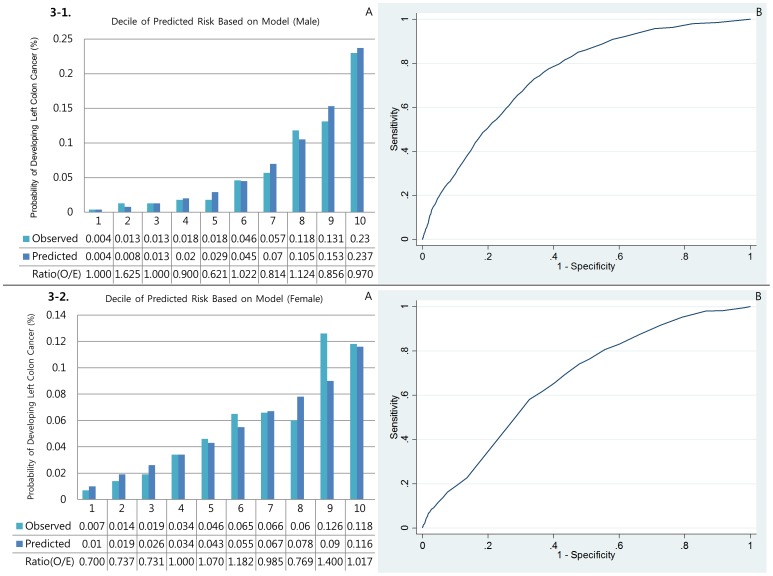
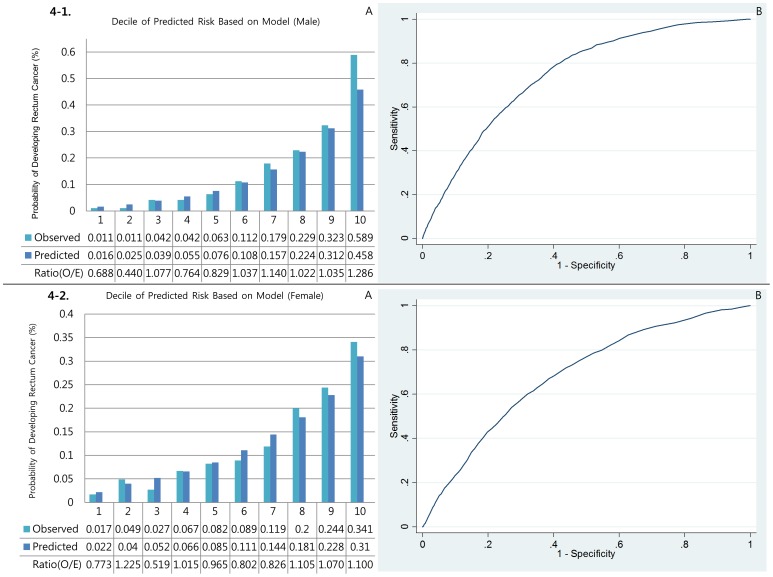
Gender specific five-year risk prediction models were developed for overall colorectal cancer, proximal colon cancer, distal colon cancer, colon cancer and rectal cancer. The model was developed using data from a population of 846,559 men and 479,449 women who participated in health examinations by the National Health Insurance Corporation. Examinees were 30-80 years old and free of cancer in the baseline years of 1996 and 1997. An independent population of 547,874 men and 415,875 women who participated in 1998 and 1999 examinations was used to validate the model. Model validation was done by evaluating its performance in terms of discrimination and calibration ability using the C-statistic and Hosmer-Lemeshow-type chi-square statistics.
Age, body mass index, serum cholesterol, family history of cancer, and alcohol consumption were included in all models for men, whereas age, height, and meat intake frequency were included in all models for women. Models showed moderately good discrimination ability with C-statistics between 0.69 and 0.78. The C-statistics were generally higher in the models for men, whereas the calibration abilities were generally better in the models for women.
Colorectal cancer risk prediction models were developed from large-scale, population-based data. Those models can be used for identifying high risk groups and developing preventive intervention strategies for colorectal cancer.
在过去几十年中,韩国结直肠癌的发病率和死亡率一直在迅速上升。迫切需要开发针对韩国男性和女性的结直肠癌风险预测模型,以加强其预防和早期检测。
针对总体结直肠癌、近端结肠癌、远端结肠癌、结肠癌和直肠癌,开发了按性别划分的五年风险预测模型。该模型是使用韩国国民健康保险公团进行的健康检查中的846,559名男性和479,449名女性的数据开发的。受试者年龄在30至80岁之间,在1996年和1997年的基线年份没有患癌症。使用1998年和1999年参加检查的547,874名男性和415,875名女性的独立人群来验证该模型。通过使用C统计量和Hosmer-Lemeshow型卡方统计量评估模型在区分能力和校准能力方面的表现来进行模型验证。
所有男性模型都纳入了年龄、体重指数、血清胆固醇、癌症家族史和饮酒情况,而所有女性模型都纳入了年龄、身高和肉类摄入频率。模型显示出中等良好的区分能力,C统计量在0.69至0.78之间。男性模型的C统计量通常较高,而女性模型的校准能力通常较好。
结直肠癌风险预测模型是从大规模的基于人群的数据中开发出来的。这些模型可用于识别高危人群,并制定结直肠癌的预防性干预策略。