Miyazawa Hideyuki, Ueda Chiaki, Yahata Kensuke, Su Zhi-Hui
1] Department of Biological Sciences, Graduate School of Science, Osaka University, Osaka 560-0043, Japan [2] JT Biohistory Research Hall, 1-1 Murasaki-cho, Takatsuki, Osaka 569-1125, Japan.
Graduate School of Life and Environmental Sciences, University of Tsukuba, Tsukuba, Ibaraki 305-8572, Japan.
Sci Rep. 2014 Feb 18;4:4127. doi: 10.1038/srep04127.
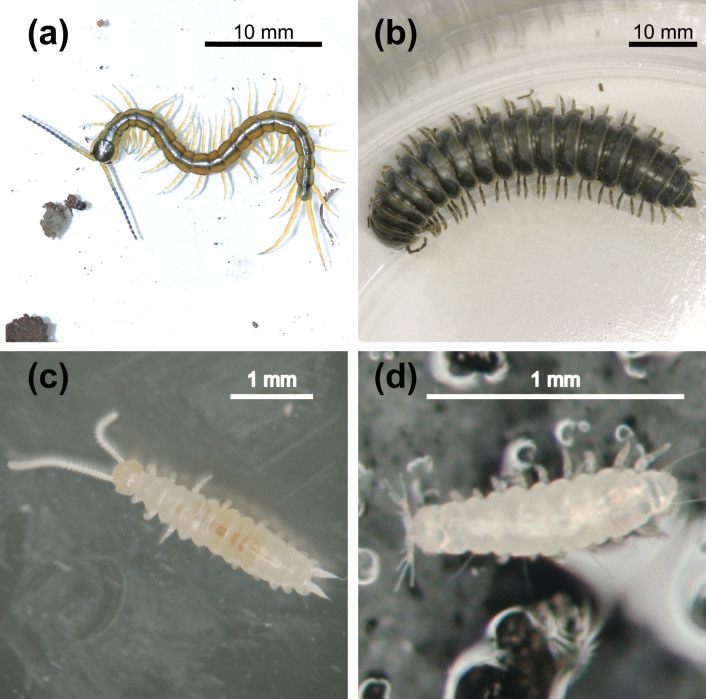
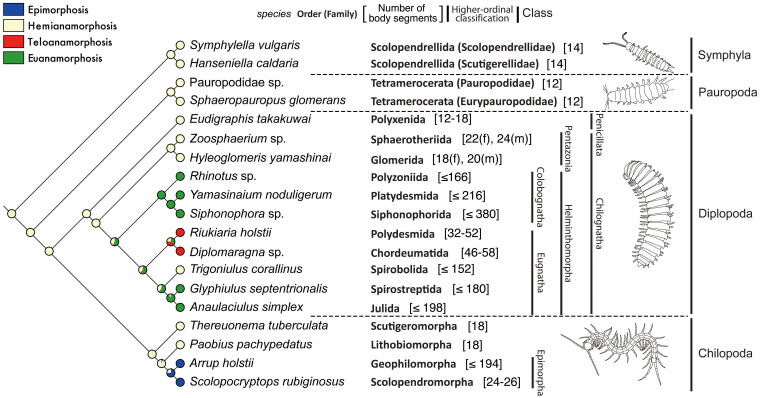
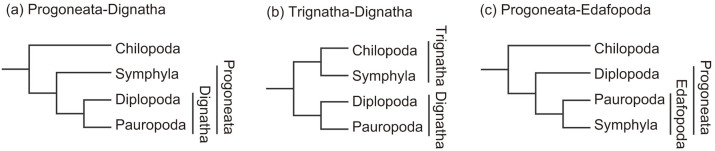
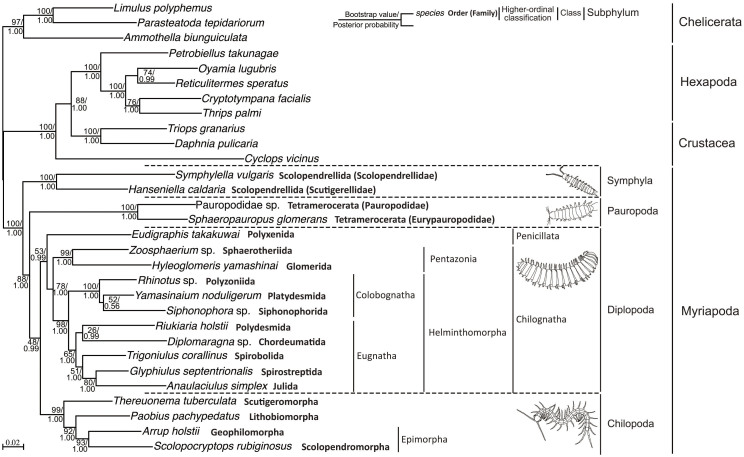
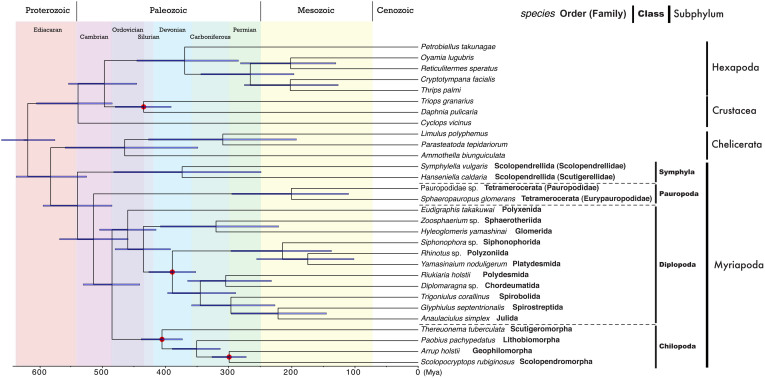
Myriapoda, a subphylum of Arthropoda, comprises four classes, Chilopoda, Diplopoda, Pauropoda, and Symphyla. While recent molecular evidence has shown that Myriapoda is monophyletic, the internal phylogeny, which is pivotal for understanding the evolutionary history of myriapods, remains unresolved. Here we report the results of phylogenetic analyses and estimations of divergence time and ancestral state of myriapods. Phylogenetic analyses were performed based on three nuclear protein-coding genes determined from 19 myriapods representing the four classes (17 orders) and 11 outgroup species. The results revealed that Symphyla whose phylogenetic position has long been debated is the sister lineage to all other myriapods, and that the interordinal relationships within classes were consistent with traditional classifications. Ancestral state estimation based on the tree topology suggests that myriapods evolved from an ancestral state that was characterized by a hemianamorphic mode of post-embryonic development and had a relatively low number of body segments and legs.
多足纲是节肢动物门下的一个亚门,包括四个纲:唇足纲、倍足纲、少足纲和综合纲。虽然最近的分子证据表明多足纲是单系的,但对于理解多足类动物进化历史至关重要的内部系统发育仍然没有得到解决。在这里,我们报告了多足类动物的系统发育分析结果以及分歧时间和祖先状态的估计。系统发育分析是基于从代表四个纲(17个目)的19种多足类动物和11个外类群物种中确定的三个核蛋白编码基因进行的。结果表明,长期以来其系统发育位置一直存在争议的综合纲是所有其他多足类动物的姐妹谱系,并且纲内目的间关系与传统分类一致。基于树拓扑结构的祖先状态估计表明,多足类动物从一个以胚胎后发育的半变态模式为特征、身体节段和腿的数量相对较少的祖先状态进化而来。