aLaboratory of Cellular and Developmental Biology (50/3351), National Institute of Diabetes and Digestive and Kidney Diseases, National Institutes of Health, Bethesda, Maryland bThe Geriatric Research, Education and Clinical Center, Baltimore Veterans Affairs Healthcare Center, Division of Endocrinology, Department of Medicine, School of Medicine, University of Maryland, Baltimore, Maryland, USA.
Curr Opin Lipidol. 2014 Apr;25(2):110-7. doi: 10.1097/MOL.0000000000000057.
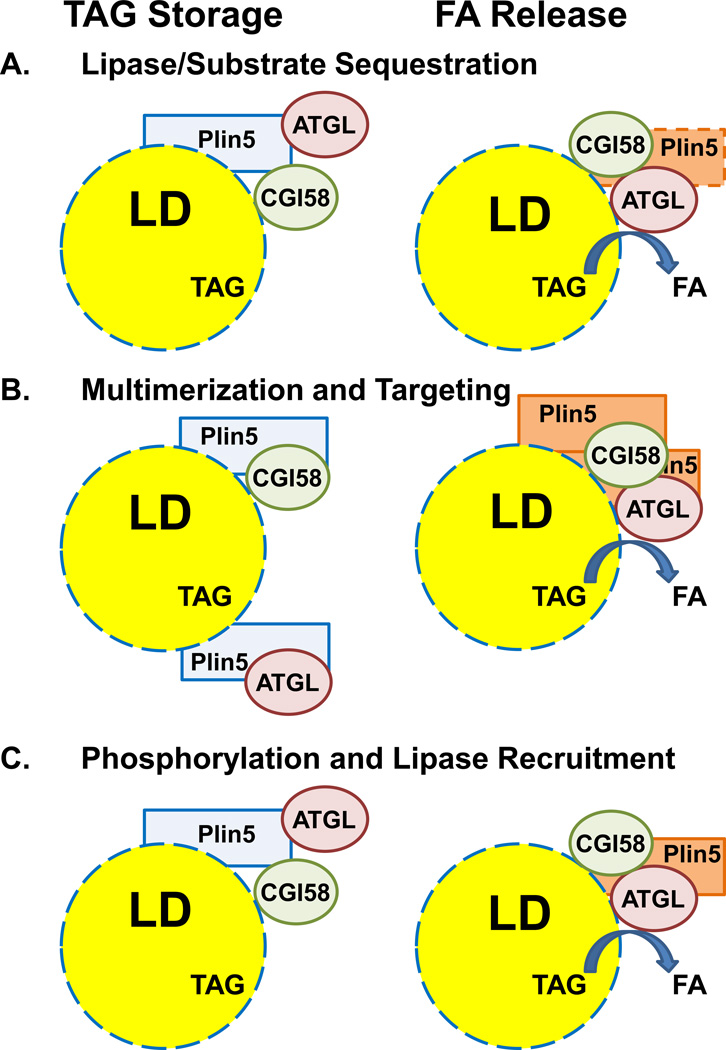
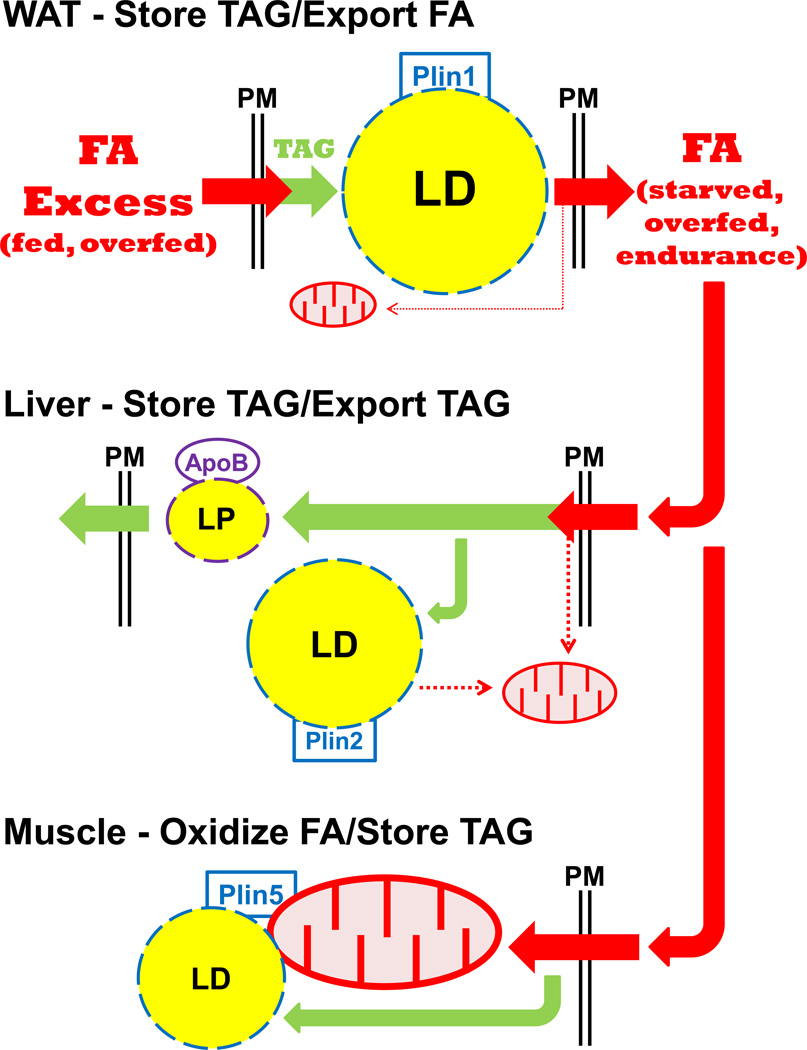
We summarize recent mechanistic and physiological studies related to the role of perilipin 5 (Plin5) in regulating lipid droplet accumulation and protection to fatty acids in tissues with high lipid oxidative metabolism.
Plin5 is a lipid droplet targeting protein that promotes association of lipid droplets with mitochondria and is most highly expressed in oxidative tissues, including cardiac and skeletal muscle. Recent in-vivo and in-vitro data indicate an important role for Plin5 in the regulation of cardiac lipid storage and function. Targeted overexpression of Plin5 in heart causes steatosis, mild mitochondria dysfunction, and hypertrophy in cardiac tissue, but without affecting cardiac function. In contrast, whole body ablation of Plin5 (Plin5 mice) reduces cardiac lipid droplet formation, increases cardiac fatty acid oxidation, and promotes cardiac dysfunction; cardiac defects can be prevented with antioxidative therapy. These data suggest a cytoprotective role for Plin5 to promote lipid storage but to limit fatty acid toxicity, parameters critical for tissues with high lipid oxidative metabolism.
In-vivo and in-vitro data suggest that Plin5 is part of a cell-adaptive response to high lipid oxidative metabolism to protect lipid droplet storage against neutral lipases and, so, limit fatty acid accumulation. Although the specific mechanisms that underlie Plin5 lipid droplet storage protection in oxidative tissues remain to be fully elucidated, Plin5 provides a basis for the novel cytoprotective nature of lipid droplets.
我们总结了近期与脂滴蛋白 5(Plin5)在调节富含脂质的组织中脂肪滴积累和保护脂肪酸方面的作用相关的机制和生理学研究进展。
Plin5 是一种脂滴靶向蛋白,可促进脂肪滴与线粒体的结合,在富含脂质的氧化组织中表达水平最高,包括心脏和骨骼肌。近期的体内和体外数据表明 Plin5 在调节心脏脂质储存和功能方面发挥着重要作用。心脏组织中 Plin5 的靶向过表达可导致脂肪变性、轻度线粒体功能障碍和肥大,但不影响心脏功能。相反,Plin5 全身敲除(Plin5 敲除小鼠)可减少心脏脂滴形成,增加心脏脂肪酸氧化,并促进心脏功能障碍;抗氧化治疗可预防心脏缺陷。这些数据表明 Plin5 具有细胞保护作用,可促进脂质储存,但限制脂肪酸毒性,这对富含脂质的氧化代谢组织至关重要。
体内和体外数据表明,Plin5 是高脂质氧化代谢适应细胞的一部分,可保护脂滴储存免受中性脂肪酶的侵害,从而限制脂肪酸的积累。尽管 Plin5 在氧化组织中保护脂滴储存的具体机制仍有待充分阐明,但 Plin5 为脂滴的新型细胞保护特性提供了依据。