Department of Paediatrics, Faculty of Medicine, Imperial College, Wellcome Trust Centre for Clinical Tropical Medicine, St Mary's Campus Norfolk Place, London W2 1PG, UK.
BMC Med. 2014 Feb 19;12:31. doi: 10.1186/1741-7015-12-31.
Severe malaria remains a major cause of pediatric hospital admission across Africa. Invasive bacterial infection (IBI) is a recognized complication of Plasmodium falciparum malaria, resulting in a substantially worse outcome. Whether a biological relationship exists between malaria infection and IBI susceptibility remains unclear. We, therefore, examined the extent, nature and evidence of this association.
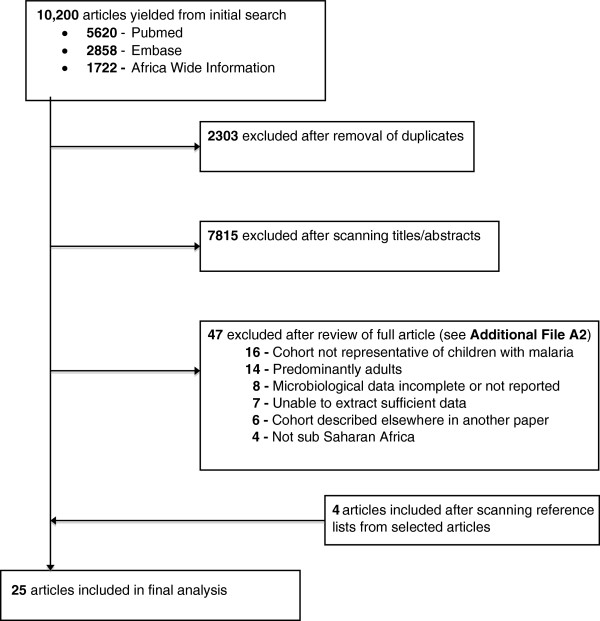
We conducted a systematic search in August 2012 of three major scientific databases, PubMed, Embase and Africa Wide Information, for articles describing bacterial infection among children with P. falciparum malaria using the search string '(malaria OR plasmodium) AND (bacteria OR bacterial OR bacteremia OR bacteraemia OR sepsis OR septicaemia OR septicemia).' Eligiblity criteria also included studies of children hospitalized with malaria or outpatient attendances in sub-Saharan Africa.
A total of 25 studies across 11 African countries fulfilled our criteria. They comprised twenty cohort analyses, two randomized controlled trials and three prospective epidemiological studies. In the meta-analysis of 7,208 children with severe malaria the mean prevalence of IBI was 6.4% (95% confidence interval (CI) 5.81 to 6.98%). In a further meta-analysis of 20,889 children hospitalised with all-severity malaria and 27,641 children with non-malarial febrile illness the mean prevalence of IBI was 5.58 (95% CI 5.5 to 5.66%) in children with malaria and 7.77% (95% CI 7.72 to 7.83%) in non-malaria illness. Ten studies reported mortality stratified by IBI. Case fatality was higher at 81 of 336, 24.1% (95% CI 18.9 to 29.4) in children with malaria/IBI co-infection compared to 585 of 5,760, 10.2% (95% CI 9.3 to 10.98) with malaria alone. Enteric gram-negative organisms were over-represented in malaria cases, non-typhoidal Salmonellae being the most commonest isolate. There was weak evidence indicating IBI was more common in the severe anemia manifestation of severe malaria.
The accumulated evidence suggests that children with recent or acute malaria are at risk of bacterial infection, which results in an increased risk of mortality. Characterising the exact nature of this association is challenging due to the paucity of appropriate severity-matched controls and the heterogeneous data. Further research to define those at greatest risk is necessary to target antimicrobial treatment.
在整个非洲,严重疟疾仍然是导致儿童住院的主要原因。侵袭性细菌感染(IBI)是恶性疟原虫疟疾的一种公认并发症,会导致严重后果。疟疾感染和 IBI 易感性之间是否存在生物学关系尚不清楚。因此,我们研究了这种关联的程度、性质和证据。
我们于 2012 年 8 月在三个主要的科学数据库 PubMed、Embase 和 Africa Wide Information 中进行了系统搜索,使用搜索字符串“(疟疾或疟原虫)和(细菌或细菌性或菌血症或菌血症或败血症或败血病或败血症)”来描述恶性疟原虫感染儿童中的细菌感染。纳入标准还包括在撒哈拉以南非洲住院的疟疾儿童或门诊就诊的研究。
共有 11 个非洲国家的 25 项研究符合我们的标准。其中包括 20 项队列分析、2 项随机对照试验和 3 项前瞻性流行病学研究。在对 7208 例严重疟疾患儿的荟萃分析中,IBI 的平均患病率为 6.4%(95%置信区间[CI]为 5.81%至 6.98%)。在对 20889 例所有严重程度疟疾住院患儿和 27641 例非疟疾发热患儿的进一步荟萃分析中,疟疾患儿的 IBI 平均患病率为 5.58%(95%CI 为 5.5%至 5.66%),而非疟疾患儿的 IBI 患病率为 7.77%(95%CI 为 7.72%至 7.83%)。有 10 项研究报告了按 IBI 分层的死亡率。在疟疾/IBI 合并感染的 336 例中有 81 例(24.1%,95%CI 为 18.9%至 29.4%),在疟疾单独感染的 5760 例中有 585 例(10.2%,95%CI 为 9.3%至 10.98%)发生死亡。肠革兰氏阴性菌在疟疾病例中过度表达,非伤寒沙门氏菌是最常见的分离株。有证据表明,IBI 在严重疟疾的严重贫血表现中更为常见。
累积证据表明,近期或急性疟疾患儿有发生细菌感染的风险,这会增加死亡风险。由于缺乏适当的严重程度匹配对照和数据异质性,准确描述这种关联的性质具有挑战性。需要进一步研究以确定风险最大的人群,从而有针对性地进行抗菌治疗。