
人工耳蜗刺激产生的异常音调感知。
Abnormal pitch perception produced by cochlear implant stimulation.
作者信息
Zeng Fan-Gang, Tang Qing, Lu Thomas
机构信息
Center for Hearing Research, Departments of Anatomy and Neurobiology, Biomedical Engineering, Cognitive Sciences, and Otolaryngology - Head and Neck Surgery, University of California Irvine, Irvine, California, United States of America.
出版信息
PLoS One. 2014 Feb 13;9(2):e88662. doi: 10.1371/journal.pone.0088662. eCollection 2014.
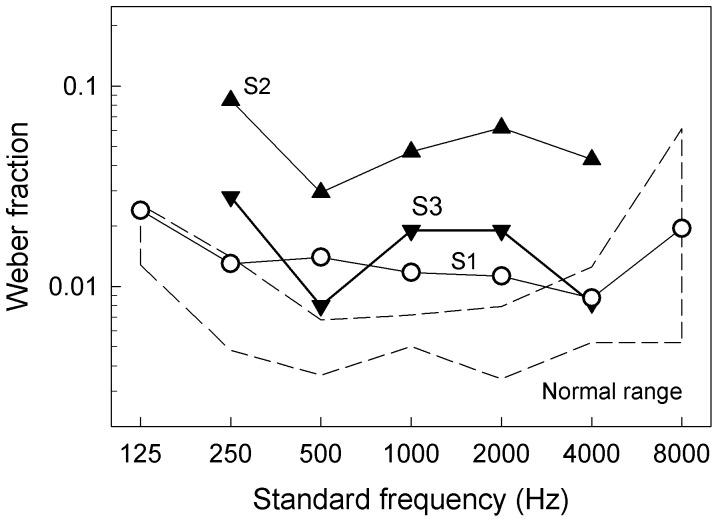
Contemporary cochlear implants with multiple electrode stimulation can produce good speech perception but poor music perception. Hindered by the lack of a gold standard to quantify electric pitch, relatively little is known about the nature and extent of the electric pitch abnormalities and their impact on cochlear implant performance. Here we overcame this obstacle by comparing acoustic and electric pitch perception in 3 unilateral cochlear-implant subjects who had functionally usable acoustic hearing throughout the audiometric frequency range in the non-implant ear. First, to establish a baseline, we measured and found slightly impaired pure tone frequency discrimination and nearly perfect melody recognition in all 3 subjects' acoustic ear. Second, using pure tones in the acoustic ear to match electric pitch induced by an intra-cochlear electrode, we found that the frequency-electrode function was not only 1-2 octaves lower, but also 2 times more compressed in frequency range than the normal cochlear frequency-place function. Third, we derived frequency difference limens in electric pitch and found that the equivalent electric frequency discrimination was 24 times worse than normal-hearing controls. These 3 abnormalities are likely a result of a combination of broad electric field, distant intra-cochlear electrode placement, and non-uniform spiral ganglion cell distribution and survival, all of which are inherent to the electrode-nerve interface in contemporary cochlear implants. Previous studies emphasized on the "mean" shape of the frequency-electrode function, but the present study indicates that the large "variance" of this function, reflecting poor electric pitch discriminability, is the main factor limiting contemporary cochlear implant performance.
当代具有多电极刺激功能的人工耳蜗能产生良好的言语感知,但音乐感知较差。由于缺乏量化电音高的金标准,人们对电音高异常的性质、程度及其对人工耳蜗性能的影响了解相对较少。在此,我们通过比较3名单侧人工耳蜗受试者的声学音高和电音高感知克服了这一障碍,这些受试者在非植入耳的整个听力计频率范围内都具有功能可用的声学听力。首先,为了建立基线,我们测量并发现所有3名受试者的声学耳中纯音频率辨别略有受损,而旋律识别近乎完美。其次,利用声学耳中的纯音来匹配耳蜗内电极诱发的电音高,我们发现频率-电极函数不仅比正常耳蜗频率-位置函数低1-2个八度,而且在频率范围内的压缩程度是其2倍。第三,我们得出了电音高的频率差异阈限,发现等效电频率辨别比正常听力对照组差24倍。这三种异常可能是由宽电场、耳蜗内电极放置距离远以及螺旋神经节细胞分布和存活不均匀共同造成的结果,所有这些都是当代人工耳蜗电极-神经接口所固有的。以往的研究强调频率-电极函数的“平均”形状,但本研究表明,反映电音高辨别能力差的该函数的大“方差”是限制当代人工耳蜗性能的主要因素。




 Zotero 插件