Vieira André Filipe, Ribeiro Ana Sofia, Dionísio Maria Rita, Sousa Bárbara, Nobre Ana Rita, Albergaria André, Santiago-Gómez Angélica, Mendes Nuno, Gerhard Renê, Schmitt Fernando, Clarke Robert B, Paredes Joana
IPATIMUP - Institute of Molecular Pathology and Immunology of the University of Porto, Porto, Portugal.
Oncotarget. 2014 Feb 15;5(3):679-92. doi: 10.18632/oncotarget.1459.
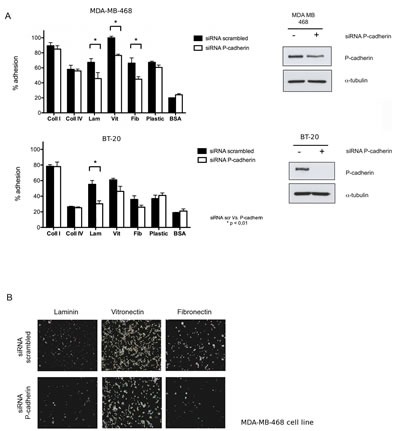
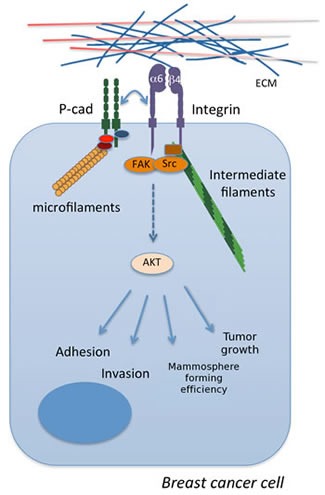
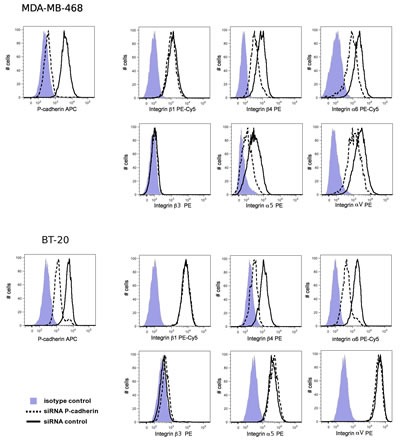
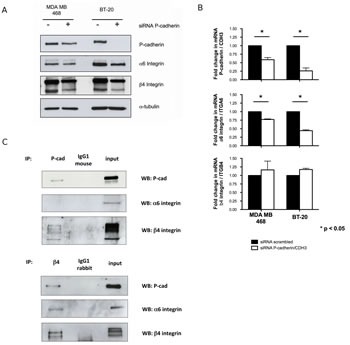
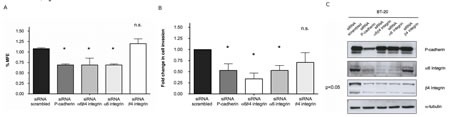
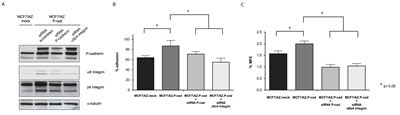
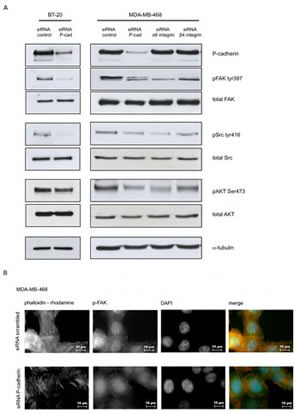
P-cadherin is a classical cell-cell adhesion molecule that, in contrast to E-cadherin, has a positive role in breast cancer progression, being considered a poor prognostic factor in this disease. In previous reports, we have shown that this protein induces cancer stem cell and invasive properties to basal-like breast cancer cells. Here, we clarify the downstream signaling pathways that are triggered by P-cadherin to mediate these effects. We demonstrated that P-cadherin inhibition led to a significant decreased adhesion of cancer cells to the basement membrane substrate laminin, as well as to a major reduction in the expression of the laminin receptor α6β4 integrin. Remarkably, the expression of this heterodimer was required for the invasive capacity and increased mammosphere forming efficiency induced by P-cadherin expression. Moreover, we showed that P-cadherin transcriptionally up-regulates the α6 integrin subunit expression and directly interacts with the β4 integrin subunit. We still showed that P-cadherin downstream signaling, in response to laminin, involves the activation of focal adhesion (FAK), Src and AKT kinases. The association between the expression of P-cadherin, α6β4 heterodimer and the active FAK and Src phosphorylated forms was validated in vivo. Our data establish that there is a crosstalk between P-cadherin and the laminin receptor α6β4 integrin signaling pathway, which link has never been previously described. The activation of this heterodimer explains the stem cell and invasive properties induced by P-cadherin to breast cancer cells, pointing to a new molecular mechanism that may be targeted to counteract the effects induced by this adhesion molecule.
P-钙黏蛋白是一种经典的细胞间黏附分子,与E-钙黏蛋白不同,它在乳腺癌进展中起积极作用,被认为是该疾病的不良预后因素。在先前的报道中,我们已经表明这种蛋白可诱导基底样乳腺癌细胞具有癌干细胞特性和侵袭性。在此,我们阐明了由P-钙黏蛋白触发以介导这些效应的下游信号通路。我们证明,抑制P-钙黏蛋白会导致癌细胞与基底膜底物层粘连蛋白的黏附显著降低,同时层粘连蛋白受体α6β4整合素的表达也大幅减少。值得注意的是,这种异二聚体的表达是P-钙黏蛋白表达所诱导的侵袭能力和乳腺球形成效率增加所必需的。此外,我们表明P-钙黏蛋白在转录水平上上调α6整合素亚基的表达,并直接与β4整合素亚基相互作用。我们还表明,P-钙黏蛋白下游信号响应层粘连蛋白涉及粘着斑激酶(FAK)、Src和AKT激酶的激活。P-钙黏蛋白表达、α6β4异二聚体与活性FAK和Src磷酸化形式之间存在关联,这一点在体内得到了验证。我们的数据表明,P-钙黏蛋白与层粘连蛋白受体α6β4整合素信号通路之间存在相互作用,而此前从未描述过这种联系。这种异二聚体的激活解释了P-钙黏蛋白诱导乳腺癌细胞产生的干细胞特性和侵袭性,指出了一种可能成为靶点以对抗这种黏附分子所诱导效应的新分子机制。