Uda Akihiko, Sekizuka Tsuyoshi, Tanabayashi Kiyoshi, Fujita Osamu, Kuroda Makoto, Hotta Akitoyo, Sugiura Naoko, Sharma Neekun, Morikawa Shigeru, Yamada Akio
Department of Veterinary Science, National Institute of Infectious Diseases, Shinjuku, Tokyo, Japan.
Pathogen Genomics Center, National Institute of Infectious Diseases, Shinjuku, Tokyo, Japan.
PLoS One. 2014 Feb 18;9(2):e89075. doi: 10.1371/journal.pone.0089075. eCollection 2014.
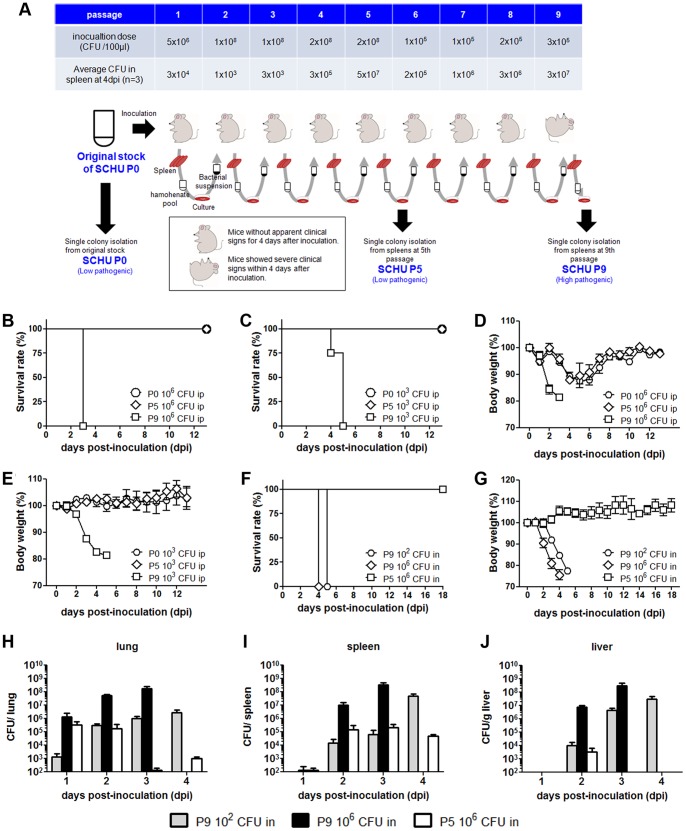
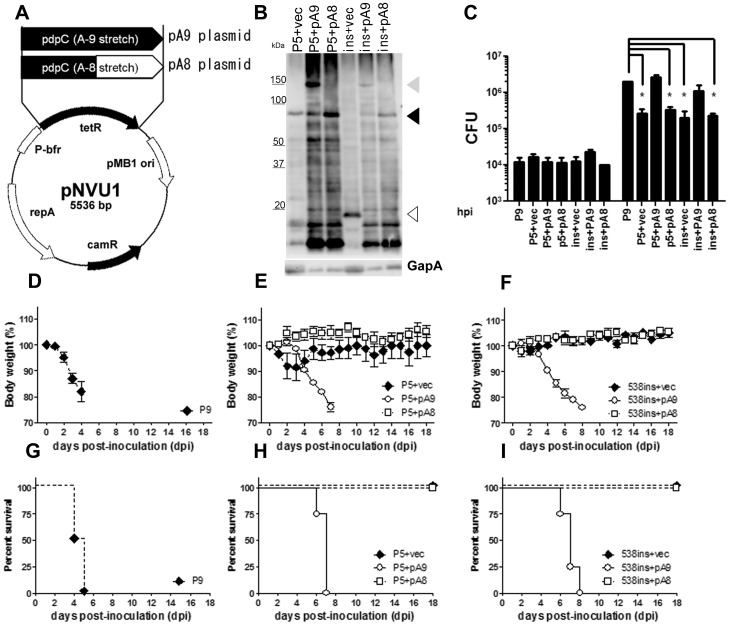
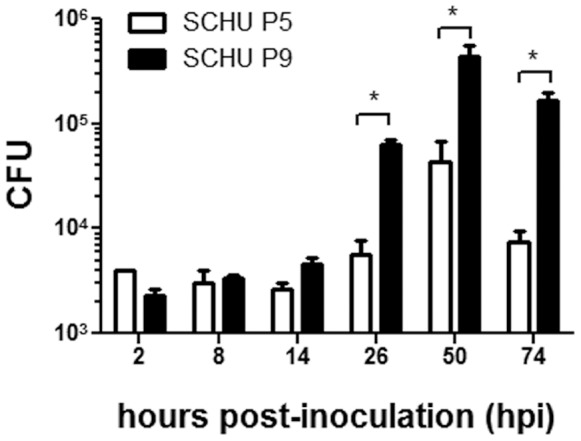
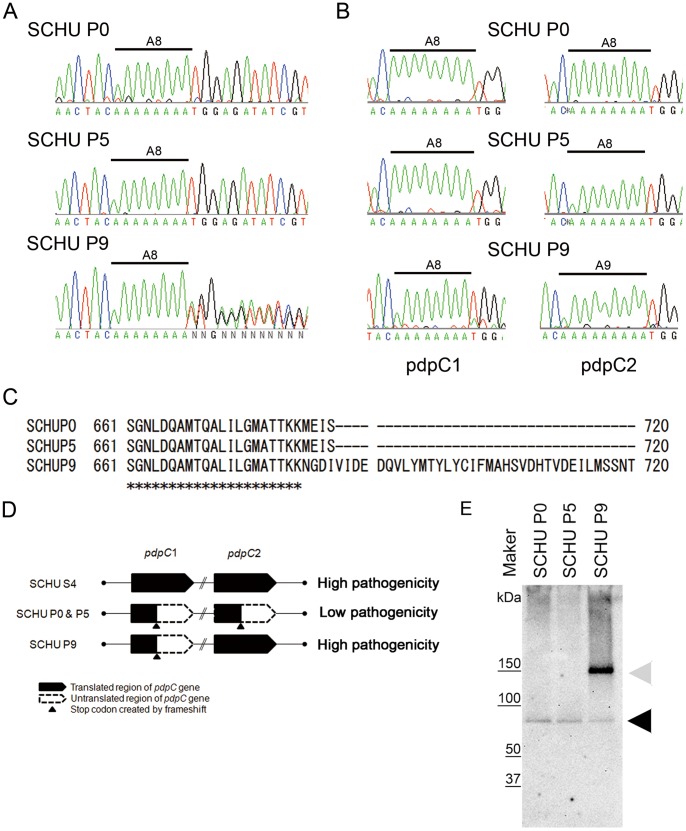
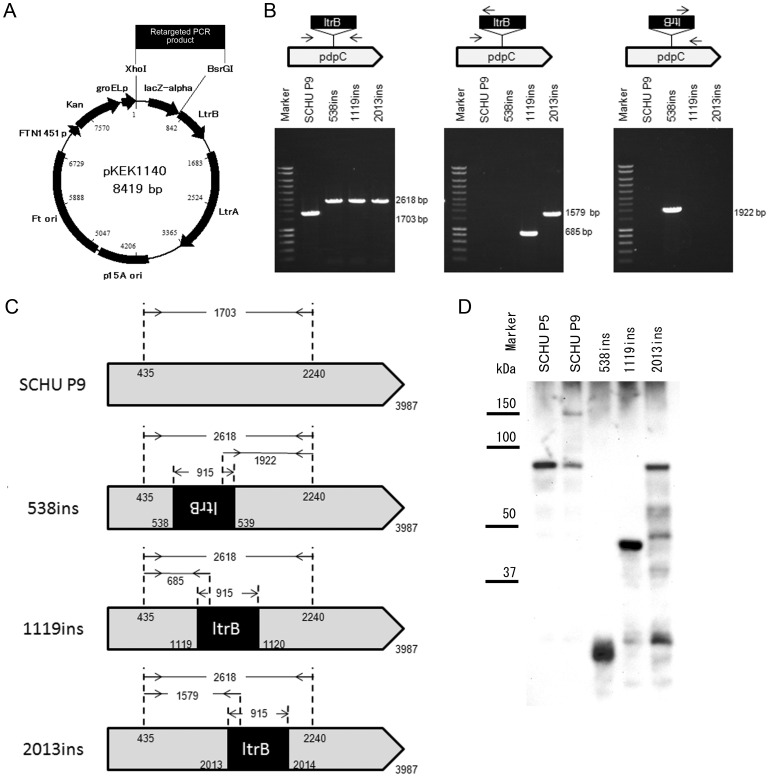
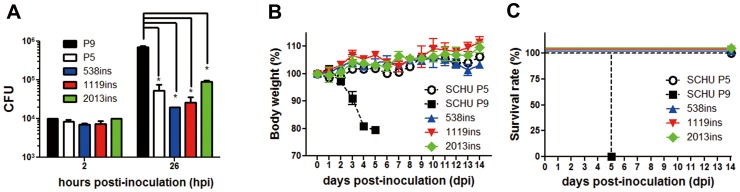
Francisella tularensis subspecies tularensis, the etiological agent of tularemia, is highly pathogenic to humans and animals. However, the SCHU strain of F. tularensis SCHU P0 maintained by passaging in artificial media has been found to be attenuated. To better understand the molecular mechanisms behind the pathogenicity of F. tularensis SCHU, we attempted to isolate virulent bacteria by serial passages in mice. SCHU P5 obtained after 5th passages in mice remained avirulent, while SCHU P9 obtained after 9th passages was completely virulent in mice. Moreover, SCHU P9 grew more efficiently in J774.1 murine macrophages compared with that in the less pathogenic SCHU P0 and P5. Comparison of the nucleotide sequences of the whole genomes of SCHU P0, P5, and P9 revealed only 1 nucleotide difference among P0, P5 and P9 in 1 of the 2 copies of pathogenicity determinant protein C (pdpC) gene. An adenine residue deletion was observed in the pdpC1 gene of SCHU P0, P5, and P9 and in the pdpC2 gene of SCHU P0, and P5, while P9 was characterized by the wild type pdpC2 gene. Thus, SCHU P0 and P5 expressed only truncated forms of PdpC protein, while SCHU P9 expressed both wild type and truncated versions. To validate the pathogenicity of PdpC, both copies of the pdpC gene in SCHU P9 have been inactivated by Targetron mutagenesis. SCHU P9 mutants with inactivated pdpC gene showed low intracellular growth in J774.1 cells and did not induce severe disease in experimentally infected mice, while virulence of the mutants was restored by complementation with expression of the intact PdpC. These results demonstrate that PdpC is crucial in determining the virulence of F. tularensis SCHU.
土拉热弗朗西斯菌土拉热亚种是兔热病的病原体,对人类和动物具有高度致病性。然而,通过在人工培养基中传代保存的土拉热弗朗西斯菌SCHU P0菌株已被发现毒力减弱。为了更好地理解土拉热弗朗西斯菌SCHU致病性背后的分子机制,我们试图通过在小鼠中连续传代来分离有毒力的细菌。在小鼠中传代5次后获得的SCHU P5仍然无毒,而传代9次后获得的SCHU P9在小鼠中完全有毒力。此外,与致病性较弱的SCHU P0和P5相比,SCHU P9在J774.1小鼠巨噬细胞中生长更高效。对SCHU P0、P5和P9全基因组的核苷酸序列进行比较发现,在2个拷贝的致病性决定蛋白C(pdpC)基因中的1个基因中,P0、P5和P9之间仅存在1个核苷酸差异。在SCHU P0、P5和P9的pdpC1基因以及SCHU P0和P5的pdpC2基因中观察到腺嘌呤残基缺失,而P9的特征是具有野生型pdpC2基因。因此,SCHU P0和P5仅表达截短形式的PdpC蛋白,而SCHU P9表达野生型和截短型两种形式。为了验证PdpC的致病性,通过靶基因诱变使SCHU P9中的两个拷贝的pdpC基因均失活。pdpC基因失活的SCHU P9突变体在J774.1细胞中细胞内生长缓慢,并且在实验感染的小鼠中未引发严重疾病,而通过完整PdpC的表达互补可恢复突变体的毒力。这些结果表明,PdpC对于确定土拉热弗朗西斯菌SCHU的毒力至关重要。