Global Health Programme, Graduate Institute of International and Development Studies, Geneva, Switzerland.
Mailman School of Public Health, Columbia University, New York, NY, USA.
Glob Health Action. 2014 Feb 13;7:23507. doi: 10.3402/gha.v7.23507. eCollection 2014.
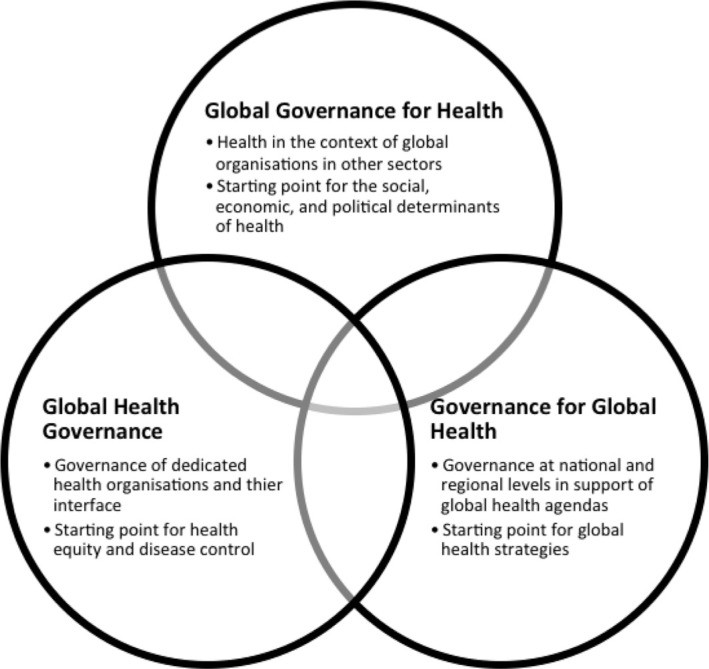
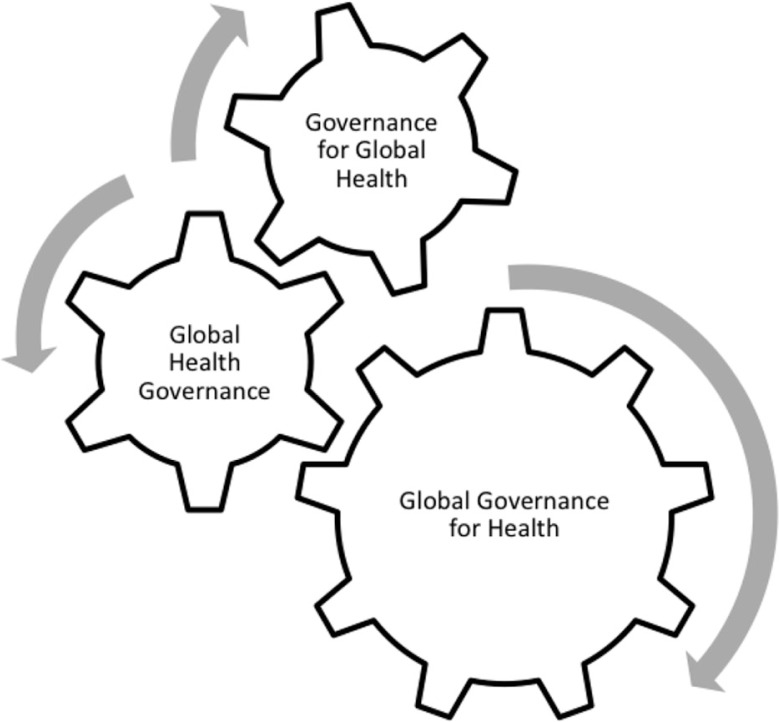
Global health refers to 'those health issues which transcend national boundaries and governments and call for actions on the global forces and global flows that determine the health of people'. (Kickbusch 2006) Governance in this trans-national and cross-cutting arena can be analyzed along three political spaces: global health governance, global governance for health, and governance for global health. It is argued that the management of the interface between these three political spaces of governance in the global public health domain is becoming increasingly important in order to move the global health agenda forward. Global health governance refers mainly to those institutions and processes of governance which are related to an explicit health mandate, such as the World Health Organization; global governance for health refers mainly to those institutions and processes of global governance which have a direct and indirect health impact, such as the United Nations, World Trade Organization or the Human Rights Council; governance for global health refers to the institutions and mechanisms established at the national and regional level to contribute to global health governance and/or to governance for global health--such as national global health strategies or regional strategies for global health. It can also refer to club strategies, such as agreements by a group of countries such as the BRICS. In all three political spaces, the involvement of a multitude of state and non-state actors has become the norm--that is why issues of legitimacy, accountability and transparency have moved to the fore. The transnational nature of global health will require the engagement of all actors to produce global public goods for health (GPGH) and to ensure a rules-based and reliably financed global public health domain.
全球卫生是指“那些超越国界和政府的健康问题,需要针对决定人民健康的全球力量和全球流动采取行动”。(Kickbusch 2006)在这个跨国和跨领域的领域中,治理可以沿着三个政治空间进行分析:全球卫生治理、全球卫生治理、全球卫生治理。有人认为,为了推动全球卫生议程向前发展,越来越有必要管理全球公共卫生领域这三个治理政治空间之间的接口。全球卫生治理主要是指与明确的卫生任务相关的治理机构和进程,例如世界卫生组织;全球卫生治理主要是指对直接和间接产生卫生影响的全球治理机构和进程,例如联合国、世界贸易组织或人权理事会;全球卫生治理是指在国家和区域一级建立的机构和机制,以促进全球卫生治理和/或全球卫生治理,例如国家全球卫生战略或区域全球卫生战略。它也可以指俱乐部战略,例如金砖国家等一组国家的协议。在这三个政治空间中,越来越多的国家和非国家行为体的参与已成为常态——这就是为什么合法性、问责制和透明度等问题成为焦点。全球卫生的跨国性质将需要所有行为体的参与,以生产全球卫生公共产品(GPGH),并确保基于规则和可靠融资的全球公共卫生领域。