Universidade Federal do Rio Grande do Sul (UFRGS), Faculdade de Medicina, Programa de Pós-graduação em Ciências Médicas, Rua Ramiro Barcelos 2400, Porto Alegre, RS, Brazil.
Virol J. 2014 Feb 24;11:36. doi: 10.1186/1743-422X-11-36.
Respiratory syncytial virus (RSV) is the main cause of lower respiratory tract illness in children worldwide. Molecular analyses show two distinct RSV groups (A and B) that comprise different genotypes. This variability contributes to the capacity of RSV to cause yearly outbreaks. These RSV genotypes circulate within the community and within hospital wards. RSV is currently the leading cause of nosocomial respiratory tract infections in pediatric populations. The aim of this study was to evaluate the G protein gene diversity of RSV amplicons.
Nasopharyngeal aspirate samples were collected from children with nosocomial or community-acquired infections. Sixty-three RSV samples (21 nosocomial and 42 community-acquired) were evaluated and classified as RSV-A or RSV-B by real-time PCR. Sequencing of the second variable region of the G protein gene was performed to establish RSV phylogenetics.
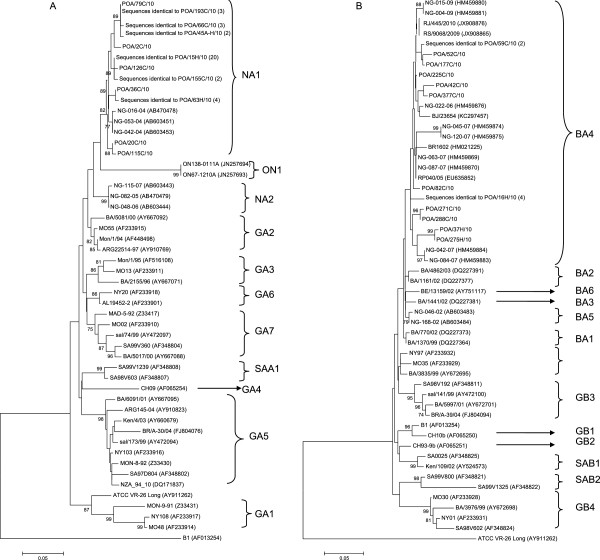
We observed co-circulation of RSV-A and RSV-B, with RSV-A as the predominant group. All nosocomial and community-acquired RSV-A samples were from the same phylogenetic group, comprising the NA1 genotype, and all RSV-B samples (nosocomial and community-acquired) were of the BA4 genotype. Therefore, in both RSV groups (nosocomial and community-acquired), the isolates belonged to only one genotype in circulation.
This is the first study to describe circulation of the NA1 RSV genotype in Brazil. Furthermore, this study showed that the BA4 genotype remains in circulation. Deciphering worldwide RSV genetic variability will aid vaccine design and development.
呼吸道合胞病毒(RSV)是全球儿童下呼吸道疾病的主要病因。分子分析显示,RSV 有两个截然不同的组(A 和 B),由不同的基因型组成。这种变异性使得 RSV 能够每年引起暴发。这些 RSV 基因型在社区和医院病房内传播。RSV 目前是儿科人群中医院获得性呼吸道感染的主要原因。本研究旨在评估 RSV 扩增子的 G 蛋白基因多样性。
采集患有医院获得性或社区获得性感染的儿童的鼻咽抽吸物样本。对 63 个 RSV 样本(21 个医院获得性和 42 个社区获得性)进行评估,并通过实时 PCR 将其分类为 RSV-A 或 RSV-B。对 G 蛋白基因第二可变区进行测序,以建立 RSV 系统发育。
我们观察到 RSV-A 和 RSV-B 的共同传播,其中 RSV-A 是主要组。所有医院获得性和社区获得性 RSV-A 样本均来自同一系统发育组,包含 NA1 基因型,所有 RSV-B 样本(医院获得性和社区获得性)均为 BA4 基因型。因此,在这两个 RSV 组(医院获得性和社区获得性)中,分离株仅属于流行的一种基因型。
这是首次描述巴西流行的 NA1 RSV 基因型。此外,本研究表明 BA4 基因型仍在流行。解析全球 RSV 遗传变异性将有助于疫苗的设计和开发。