Stem Cell Res Ther. 2013;4 Suppl 1(Suppl 1):S11. doi: 10.1186/scrt372. Epub 2013 Dec 20.
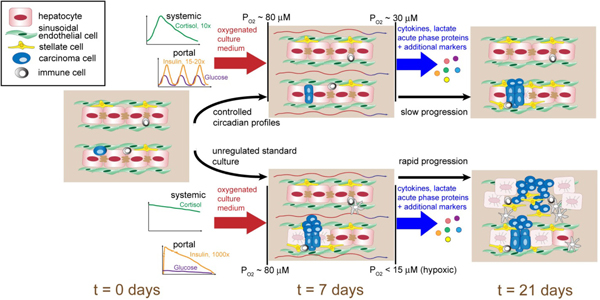
The vast majority of cancer mortalities result from distant metastases. The metastatic microenvironment provides unique protection to ectopic tumors as the primary tumors often respond to specific agents. Although significant interventional progress has been made on primary tumors, the lack of relevant accessible model in vitro systems in which to study metastases has plagued metastatic therapeutic development--particularly among micrometastases. A real-time, all-human model of metastatic seeding and cancer cells that recapitulate metastatic growth and can be probed in real time by a variety of measures and challenges would provide a critical window into the pathophysiology of metastasis and pharmacology of metastatic tumor resistance. To achieve this we are advancing our microscale bioreactor that incorporates human hepatocytes, human nonparenchymal liver cells, and human breast cancer cells to mimic the hepatic niche in three dimensions with functional tissue. This bioreactor is instrumented with oxygen sensors, micropumps capable of generating diurnally varying profiles of nutrients and hormones, while enabling real-time sampling. Since the liver is a major metastatic site for a wide variety of carcinomas and other tumors, this bioreactor uniquely allows us to more accurately recreate the human metastatic microenvironment and probe the paracrine effects between the liver parenchyma and metastatic cells. Further, as the liver is the principal site of xenobiotic metabolism, this reactor will help us investigate the chemotherapeutic response within a metabolically challenged liver microenvironment. This model is anticipated to yield markers of metastatic behavior and pharmacologic metabolism that will enable better clinical monitoring, and will guide the design of clinical studies to understand drug efficacy and safety in cancer therapeutics. This highly instrumented bioreactor format, hosting a growing tumor within a microenvironment and monitoring its responses, is readily transferable to other organs, giving this work impact beyond the liver.
绝大多数癌症死亡是由远处转移导致的。转移的微环境为异位肿瘤提供了独特的保护,因为原发性肿瘤通常对特定药物有反应。尽管对原发性肿瘤已经取得了重大的干预进展,但缺乏相关的可用于研究转移的体外模型,这一直困扰着转移性治疗的发展,尤其是对于微转移。一个实时的、全人类的转移播种和癌细胞模型,可以实时通过各种测量和挑战来探测转移生长,将为转移的病理生理学和转移性肿瘤耐药性的药理学提供一个关键窗口。为了实现这一目标,我们正在推进我们的微尺度生物反应器,该生物反应器结合了人类肝细胞、人类非实质肝细胞和人类乳腺癌细胞,以三维方式模拟肝脏小生境,并具有功能性组织。该生物反应器配备了氧传感器、能够产生昼夜变化的营养物质和激素的微泵,同时能够实时采样。由于肝脏是多种癌和其他肿瘤的主要转移部位,这种生物反应器独特地使我们能够更准确地再现人类转移性微环境,并探测肝脏实质和转移性细胞之间的旁分泌效应。此外,由于肝脏是外源性代谢物的主要代谢部位,该反应器将帮助我们研究代谢性挑战的肝脏微环境中的化疗反应。该模型预计将产生转移性行为和药物代谢的标志物,从而能够更好地进行临床监测,并指导临床研究的设计,以了解癌症治疗中的药物疗效和安全性。这种高度仪器化的生物反应器格式,在微环境中培养不断生长的肿瘤并监测其反应,很容易转移到其他器官,使这项工作的影响超出了肝脏。