Wang Lisha, Williamson Sean R, Wang Mingsheng, Davidson Darrell D, Zhang Shaobo, Baldridge Lee Ann, Du Xiang, Cheng Liang
Department of Pathology, Fudan University Shanghai Cancer Center, Shanghai, China.
Mol Cancer. 2014 Feb 26;13:39. doi: 10.1186/1476-4598-13-39.
Renal cell carcinoma (RCC) is known for its ability to metastasize synchronously or metachronously to various anatomic sites. Distinguishing histologic subtypes of metastatic RCC has become increasingly important, as prognosis and therapy can differ dramatically between subtypes. We propose a combination of immunohistochemistry (IHC) and molecular cytogenetics for subtyping metastatic RCC in light of these potential therapeutic implications.
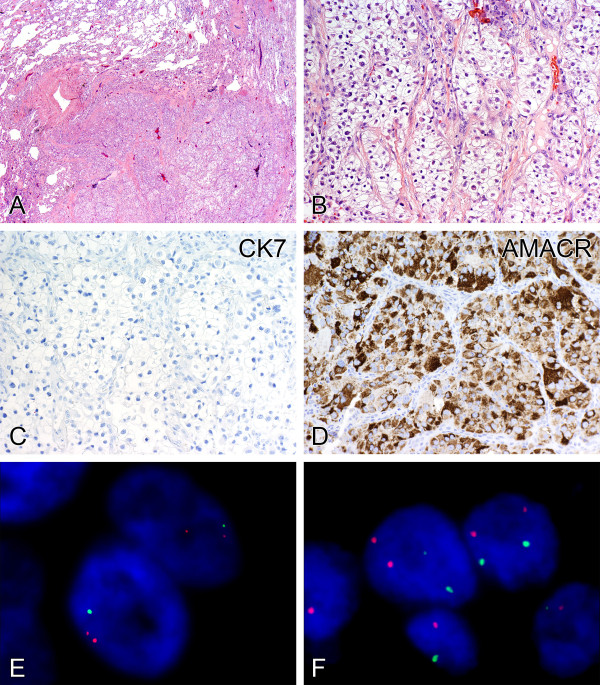
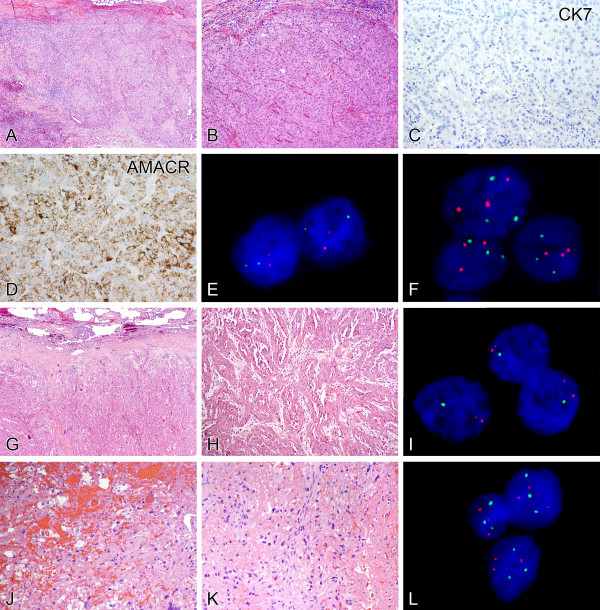
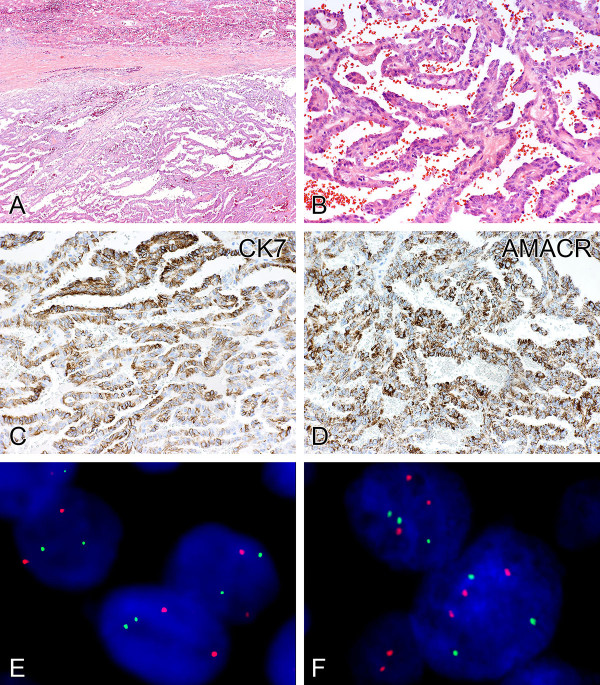
Specimens from 103 cases of metastatic RCC were retrieved, including 32 cases originally diagnosed as metastatic clear cell renal cell carcinoma (CCRCC), 8 as metastatic papillary renal cell carcinoma (PRCC), and 63 metastatic RCC without a specific subtype. Immunohistochemistry was performed with antibodies against cytokeratin 7 (CK7) and alpha-methylacyl-CoA racemase (AMACR). Dual color interphase fluorescence in situ hybridization was utilized to assess for deletion of chromosome 3p and trisomy of chromosomes 7 and 17 in all tumors. Chromosome 3p deletion was detected in 41% of all metastatic RCC specimens, and trisomy of chromosomes 7 and/or 17 was detected in 16%. Of metastatic CCRCC, chromosome 3p deletion was detected in 63%. Of metastatic PRCC, 75% showed trisomy of chromosomes 7 and/or 17. Of the tumors not previously classified, 6% were positive for CK7, and 64% were positive for AMACR; 35% showed chromosome 3p deletion, and 16% showed trisomy of chromosomes 7 and/or 17. Combined analysis of immunohistochemistry and cytogenetics enabled reclassification of 52% of these metastatic tumors not previously classified.
Our findings support the utility of immunohistochemistry and cytogenetics for subtyping metastatic RCC.
肾细胞癌(RCC)以能够同步或异时转移至各种解剖部位而闻名。区分转移性RCC的组织学亚型变得越来越重要,因为不同亚型的预后和治疗可能有显著差异。鉴于这些潜在的治疗意义,我们提出将免疫组织化学(IHC)和分子细胞遗传学结合用于转移性RCC的亚型分类。
检索了103例转移性RCC的标本,包括32例最初诊断为转移性透明细胞肾细胞癌(CCRCC)、8例转移性乳头状肾细胞癌(PRCC)和63例无特定亚型的转移性RCC。用抗细胞角蛋白7(CK7)和α-甲基酰基辅酶A消旋酶(AMACR)的抗体进行免疫组织化学检测。利用双色间期荧光原位杂交评估所有肿瘤中3号染色体短臂缺失以及7号和17号染色体三体情况。在所有转移性RCC标本中,41%检测到3号染色体短臂缺失,16%检测到7号和/或17号染色体三体。在转移性CCRCC中,63%检测到3号染色体短臂缺失。在转移性PRCC中,75%显示7号和/或17号染色体三体。在先前未分类的肿瘤中,6%的CK7呈阳性,64%的AMACR呈阳性;35%显示3号染色体短臂缺失,16%显示7号和/或17号染色体三体。免疫组织化学和细胞遗传学的联合分析能够对52%的先前未分类的转移性肿瘤进行重新分类。
我们的研究结果支持免疫组织化学和细胞遗传学在转移性RCC亚型分类中的应用。