Biological Physics Group, School of Physics & Astronomy, University of Manchester, Manchester M13 9PL, UK.
Europace. 2014 Mar;16(3):416-23. doi: 10.1093/europace/eut349.
Atrial fibrillation (AF), the commonest cardiac arrhythmia, has been strongly linked with arrhythmogenic sources near the pulmonary veins (PVs), but underlying mechanisms are not fully understood. We aim to study the generation and sustenance of wave sources in a model of the PV tissue.
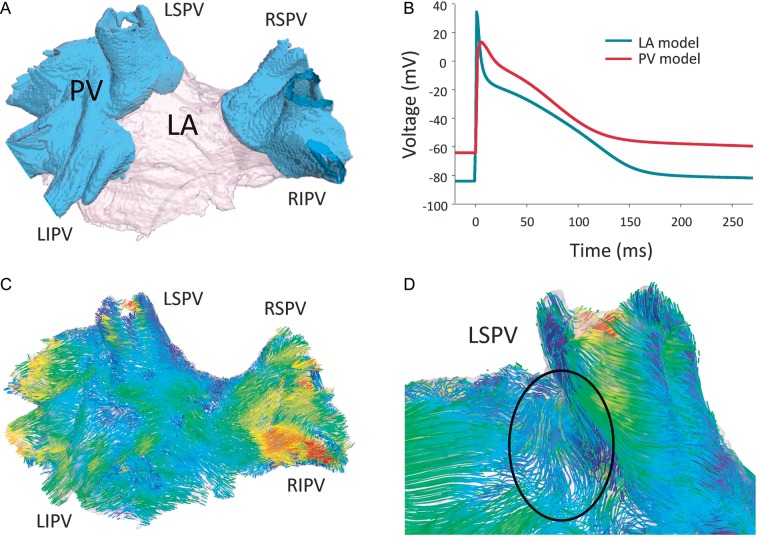
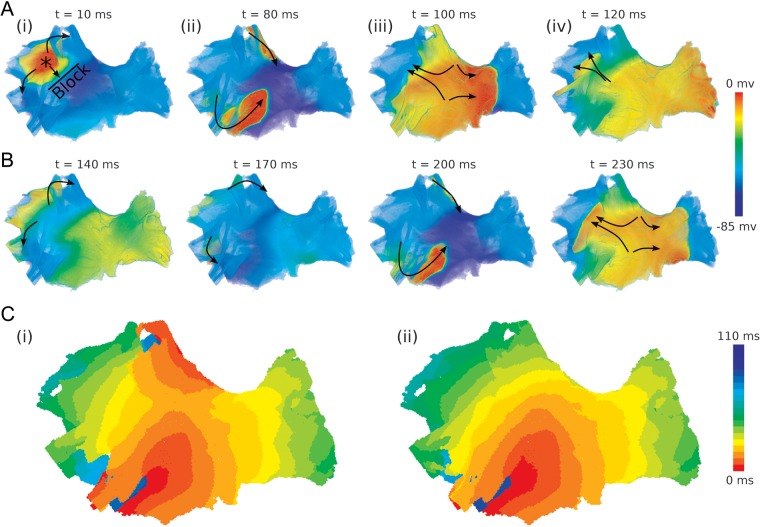
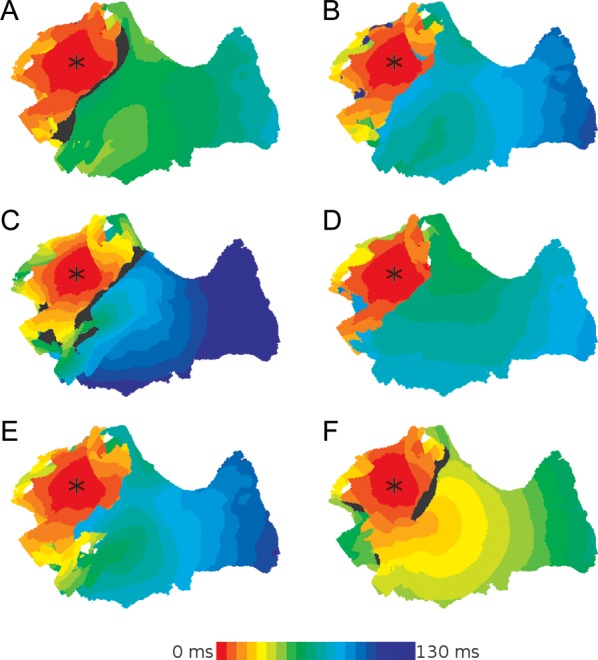
A previously developed biophysically detailed three-dimensional canine atrial model is applied. Effects of AF-induced electrical remodelling are introduced based on published experimental data, as changes of ion channel currents (ICaL, IK1, Ito, and IKur), the action potential (AP) and cell-to-cell coupling levels. Pharmacological effects are introduced by blocking specific ion channel currents. A combination of electrical heterogeneity (AP tissue gradients of 5-12 ms) and anisotropy (conduction velocities of 0.75-1.25 and 0.21-0.31 m/s along and transverse to atrial fibres) can results in the generation of wave breaks in the PV region. However, a long wavelength (171 mm) prevents the wave breaks from developing into re-entry. Electrical remodelling leads to decreases in the AP duration, conduction velocity and wavelength (to 49 mm), such that re-entry becomes sustained. Pharmacological effects on the tissue heterogeneity and vulnerability (to wave breaks and re-entry) are quantified to show that drugs that increase the wavelength and stop re-entry (IK1 and IKur blockers) can also increase the heterogeneity (AP gradients of 26-27 ms) and the likelihood of wave breaks.
Biophysical modelling reveals large conduction block areas near the PVs, which are due to discontinuous fibre arrangement enhanced by electrical heterogeneity. Vulnerability to re-entry in such areas can be modulated by pharmacological interventions.
心房颤动(AF)是最常见的心律失常,与肺静脉(PVs)附近的致心律失常源密切相关,但潜在机制尚不完全清楚。我们旨在研究 PV 组织模型中波源的产生和维持。
应用先前开发的具有详细生物物理特性的犬心房三维模型。根据已发表的实验数据,引入 AF 诱导的电重构效应,包括离子通道电流(ICaL、IK1、Ito 和 IKur)、动作电位(AP)和细胞间耦合水平的变化。通过阻断特定的离子通道电流引入药物作用。电异质性(AP 组织梯度为 5-12ms)和各向异性(沿和垂直于心房纤维的传导速度为 0.75-1.25 和 0.21-0.31m/s)的组合可导致在 PV 区域产生波破裂。然而,长波长(171mm)阻止波破裂发展为折返。电重构导致 AP 持续时间、传导速度和波长(降至 49mm)的降低,从而使折返得以维持。对组织异质性和易损性(波破裂和折返)的药物作用进行量化,以表明增加波长并阻止折返的药物(IK1 和 IKur 阻滞剂)也可以增加异质性(AP 梯度为 26-27ms)和波破裂的可能性。
生物物理模型揭示了 PV 附近存在大的传导阻滞区,这是由于电异质性增强的不连续纤维排列所致。这些区域对折返的易感性可以通过药物干预来调节。