Giorgi Rossi Paolo, Baldacchini Flavia, Ronco Guglielmo
Servizio Interaziendale di Epidemiologia, Azienda Unità Sanitaria Locale di Reggio Emilia , Reggio Emilia , Italy.
Unit of Cancer Epidemiology II, Center for Cancer Epidemiology and Prevention (CPO) , Turin , Italy.
Front Oncol. 2014 Feb 10;4:20. doi: 10.3389/fonc.2014.00020. eCollection 2014.
Screening with HPV is more effective than Pap test in preventing cervical cancer. HPV as primary test will imply longer intervals and a triage test for HPV positive women. It will also permit the development of self-sampling devices. These innovations may affect population coverage, participation, and compliance to protocols, and likely in a different way for less educated, poorer, and disadvantaged women.
To describe the impact on inequalities, actual or presumed, of the introduction of HPV-based screening.
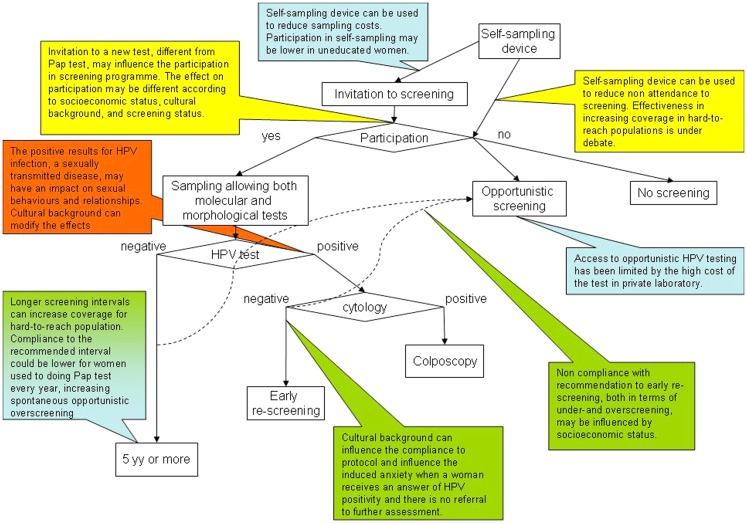
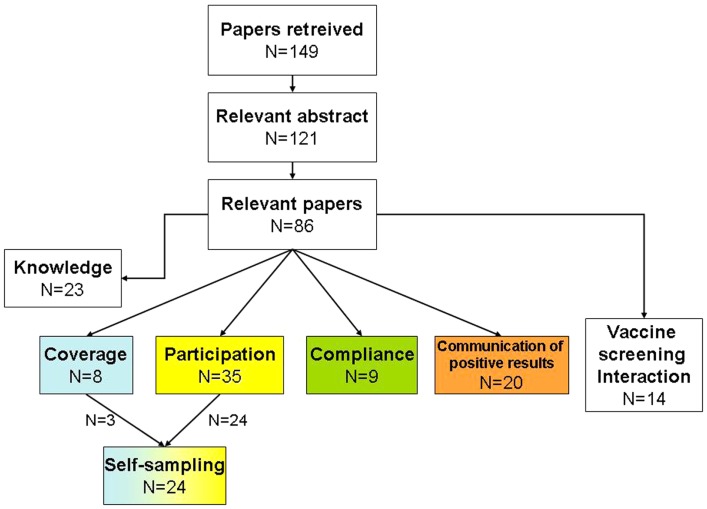
The putative HPV-based screening algorithm has been analyzed to identify critical points for inequalities. A systematic review of the literature has been conducted searching PubMed on HPV screening coverage, participation, and compliance. RESULTS were summarized in a narrative synthesis.
Knowledge about HPV and cervical cancer was lower in women with low socio-economic status and in disadvantaged groups. A correct communication can reduce differences. Longer intervals will make it easier to achieve high-population coverage, but higher cost of the test in private providers could reduce the use of opportunistic screening by disadvantaged women. There are some evidences that inviting for HPV test instead of Pap increases participation, but there are no data on social differences. Self-sampling devices are effective in increasing participation and coverage. Some studies showed that the acceptability of self-sampling is higher in more educated women, but there is also an effect on hard-to-reach women. Communication of HPV positivity may increase anxiety and impact on sexual behaviors, the effect is stronger in low educated and disadvantaged women. Finally, many studies found indirect evidence that unvaccinated women are or will be more probably under-screened.
The introduction of HPV test may increase population coverage, but non-compliance to protocols and interaction with opportunistic screening can increase the existing inequalities.
人乳头瘤病毒(HPV)筛查在预防宫颈癌方面比巴氏试验更有效。将HPV作为主要检测手段意味着检测间隔时间更长,且需对HPV阳性女性进行分流检测。这也将促进自检设备的发展。这些创新可能会影响人群覆盖率、参与度以及对检测方案的依从性,而且对受教育程度较低、贫困和弱势女性的影响可能有所不同。
描述引入基于HPV的筛查对实际或假定的不平等现象的影响。
分析了假定的基于HPV的筛查算法,以确定不平等现象的关键点。通过在PubMed上检索关于HPV筛查覆盖率、参与度和依从性的文献,进行了系统综述。结果以叙述性综述的形式进行了总结。
社会经济地位较低的女性和弱势群体对HPV和宫颈癌的了解较少。正确的沟通可以减少差异。更长的检测间隔将更容易实现高人群覆盖率,但私立医疗机构检测费用较高可能会减少弱势女性进行机会性筛查的次数。有证据表明,邀请进行HPV检测而非巴氏试验可提高参与度,但尚无关于社会差异的数据。自检设备在提高参与度和覆盖率方面有效。一些研究表明,受教育程度较高的女性对自检的接受度更高,但对难以接触到的女性也有影响。HPV阳性结果的告知可能会增加焦虑并影响性行为,在受教育程度低和弱势女性中这种影响更强。最后,许多研究发现间接证据表明未接种疫苗的女性现在或将来更有可能筛查不足。
引入HPV检测可能会提高人群覆盖率,但不遵守检测方案以及与机会性筛查的相互作用可能会加剧现有的不平等现象。