Sport Science Department, Myorobie Association Montvalezan, France.
Front Physiol. 2014 Feb 27;5:73. doi: 10.3389/fphys.2014.00073. eCollection 2014.
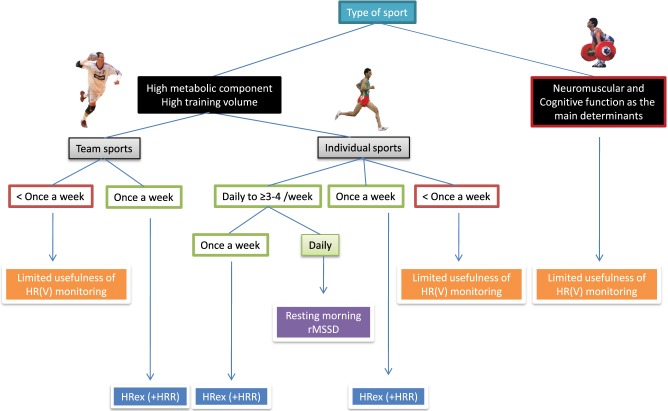
Measures of resting, exercise, and recovery heart rate are receiving increasing interest for monitoring fatigue, fitness and endurance performance responses, which has direct implications for adjusting training load (1) daily during specific training blocks and (2) throughout the competitive season. However, these measures are still not widely implemented to monitor athletes' responses to training load, probably because of apparent contradictory findings in the literature. In this review I contend that most of the contradictory findings are related to methodological inconsistencies and/or misinterpretation of the data rather than to limitations of heart rate measures to accurately inform on training status. I also provide evidence that measures derived from 5-min (almost daily) recordings of resting (indices capturing beat-to-beat changes in heart rate, reflecting cardiac parasympathetic activity) and submaximal exercise (30- to 60-s average) heart rate are likely the most useful monitoring tools. For appropriate interpretation at the individual level, changes in a given measure should be interpreted by taking into account the error of measurement and the smallest important change of the measure, as well as the training context (training phase, load, and intensity distribution). The decision to use a given measure should be based upon the level of information that is required by the athlete, the marker's sensitivity to changes in training status and the practical constrains required for the measurements. However, measures of heart rate cannot inform on all aspects of wellness, fatigue, and performance, so their use in combination with daily training logs, psychometric questionnaires and non-invasive, cost-effective performance tests such as a countermovement jump may offer a complete solution to monitor training status in athletes participating in aerobic-oriented sports.
静息心率、运动心率和恢复心率的测量值越来越受到关注,因为它们可以监测疲劳、体能和耐力表现的反应,这直接影响到在特定训练阶段和整个比赛季节调整训练负荷(1)的日常训练量和(2)。然而,这些测量值在监测运动员对训练负荷的反应方面还没有得到广泛应用,可能是因为文献中存在明显的矛盾发现。在这篇综述中,我认为大多数矛盾的发现与方法上的不一致和/或对数据的误解有关,而不是心率测量值在准确反映训练状态方面的局限性。我还提供了证据表明,从 5 分钟(几乎每天)的静息心率(反映心脏副交感神经活动的心率逐拍变化的指标)和亚最大运动心率(30 至 60 秒的平均心率)记录中得出的测量值可能是最有用的监测工具。为了在个体水平上进行适当的解释,给定指标的变化应该通过考虑测量误差和该指标的最小重要变化以及训练背景(训练阶段、负荷和强度分布)来解释。使用给定指标的决定应该基于运动员所需的信息水平、标志物对训练状态变化的敏感性以及测量所需的实际限制。然而,心率测量值不能提供所有关于健康、疲劳和表现的信息,因此,将其与每日训练日志、心理计量问卷以及非侵入性、经济实惠的性能测试(如反向跳跃)结合使用,可能是监测参与有氧运动的运动员训练状态的完整解决方案。