The University of Texas Health Science Center at Houston, United States.
Harvard School of Dental Medicine, United States.
Int J Med Inform. 2014 May;83(5):361-7. doi: 10.1016/j.ijmedinf.2014.01.010. Epub 2014 Feb 3.
To comparatively evaluate the effectiveness of three different methods involving end-users for detecting usability problems in an EHR: user testing, semi-structured interviews and surveys.
Data were collected at two major urban dental schools from faculty, residents and dental students to assess the usability of a dental EHR for developing a treatment plan. These included user testing (N=32), semi-structured interviews (N=36), and surveys (N=35).
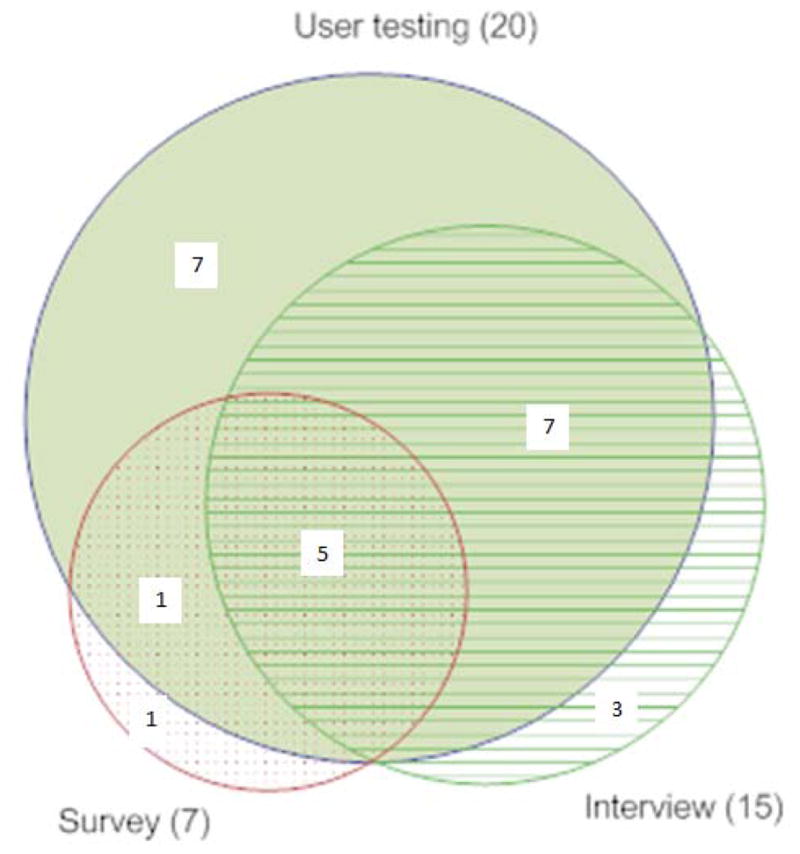
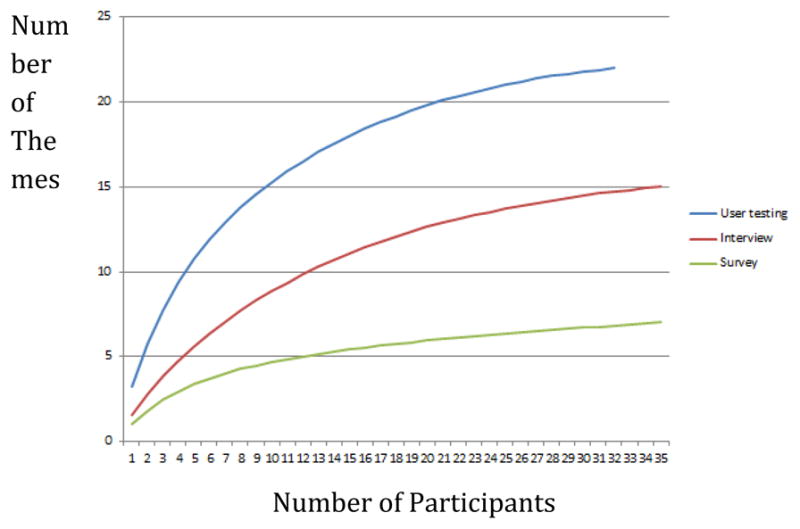
The three methods together identified a total of 187 usability violations: 54% via user testing, 28% via the semi-structured interview and 18% from the survey method, with modest overlap. These usability problems were classified into 24 problem themes in 3 broad categories. User testing covered the broadest range of themes (83%), followed by the interview (63%) and survey (29%) methods.
Multiple evaluation methods provide a comprehensive approach to identifying EHR usability challenges and specific problems. The three methods were found to be complementary, and thus each can provide unique insights for software enhancement. Interview and survey methods were found not to be sufficient by themselves, but when used in conjunction with the user testing method, they provided a comprehensive evaluation of the EHR.
We recommend using a multi-method approach when testing the usability of health information technology because it provides a more comprehensive picture of usability challenges.
比较评估三种不同的涉及终端用户的方法在检测电子健康记录(EHR)中的可用性问题方面的效果:用户测试、半结构化访谈和调查。
从两所主要城市的牙科学校收集了教职员工、住院医师和牙科学生的数据,以评估用于制定治疗计划的牙科 EHR 的可用性。这些方法包括用户测试(N=32)、半结构化访谈(N=36)和调查(N=35)。
这三种方法共发现了 187 个可用性违规行为:54%通过用户测试,28%通过半结构化访谈,18%通过调查方法,存在适度的重叠。这些可用性问题分为 3 个广泛类别的 24 个问题主题。用户测试涵盖了最广泛的主题(83%),其次是访谈(63%)和调查(29%)方法。
多种评估方法提供了一种全面的方法来识别 EHR 的可用性挑战和具体问题。发现这三种方法是互补的,因此每种方法都可以为软件增强提供独特的见解。访谈和调查方法本身被发现是不够的,但当与用户测试方法结合使用时,它们可以对 EHR 进行全面评估。
我们建议在测试健康信息技术的可用性时采用多方法方法,因为它可以更全面地了解可用性挑战。