Cressman Ross, Křivan Vlastimil, Brown Joel S, Garay József
Department of Mathematics, Wilfrid Laurier University, Waterloo, Ontario, Canada.
Institute of Entomology, Biology Centre, Academy of Sciences of the Czech Republic, and Faculty of Science, University of South Bohemia, České Budějovice, Czech Republic.
PLoS One. 2014 Feb 28;9(2):e88773. doi: 10.1371/journal.pone.0088773. eCollection 2014.
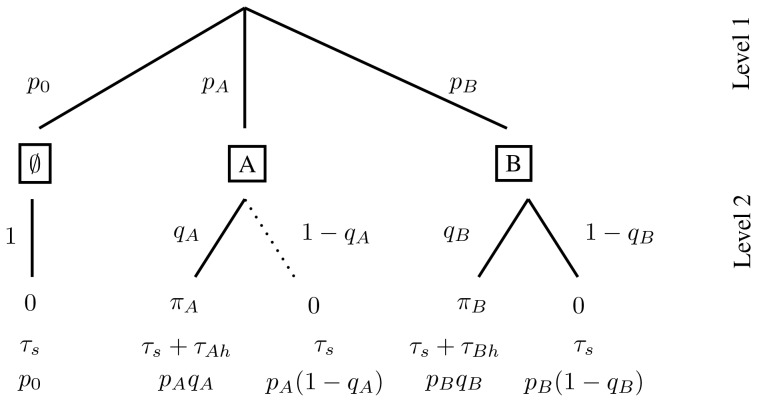
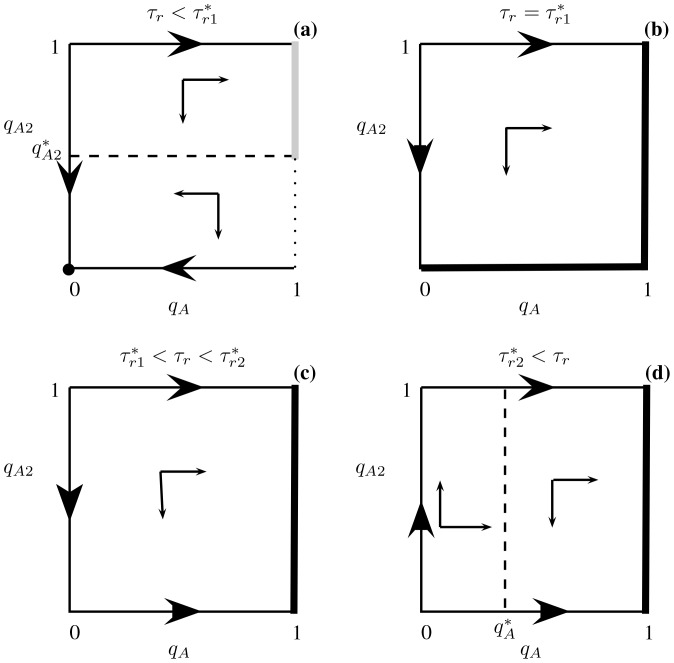
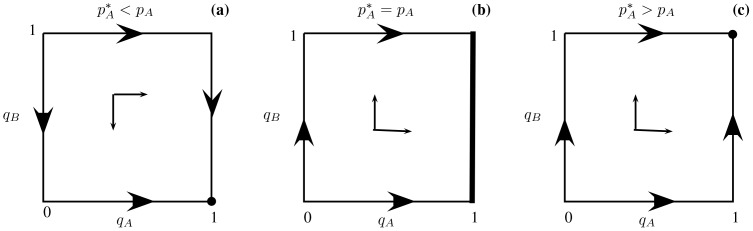
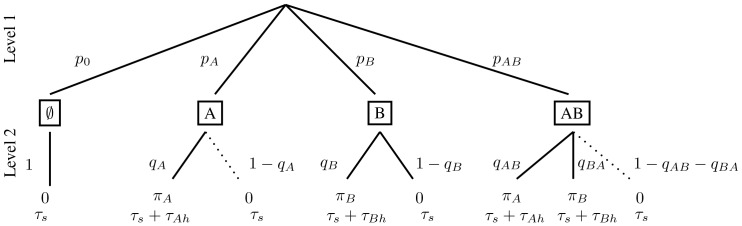
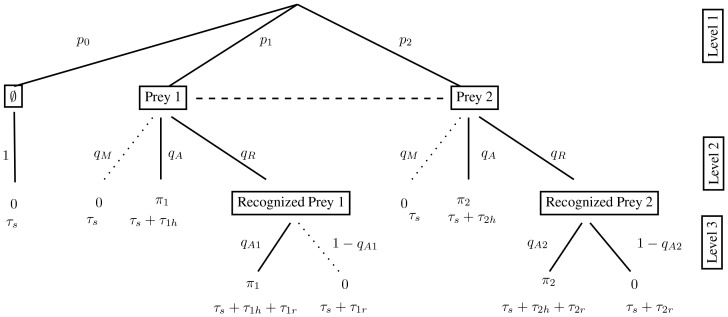
We develop a decision tree based game-theoretical approach for constructing functional responses in multi-prey/multi-patch environments and for finding the corresponding optimal foraging strategies. Decision trees provide a way to describe details of predator foraging behavior, based on the predator's sequence of choices at different decision points, that facilitates writing down the corresponding functional response. It is shown that the optimal foraging behavior that maximizes predator energy intake per unit time is a Nash equilibrium of the underlying optimal foraging game. We apply these game-theoretical methods to three scenarios: the classical diet choice model with two types of prey and sequential prey encounters, the diet choice model with simultaneous prey encounters, and a model in which the predator requires a positive recognition time to identify the type of prey encountered. For both diet choice models, it is shown that every Nash equilibrium yields optimal foraging behavior. Although suboptimal Nash equilibrium outcomes may exist when prey recognition time is included, only optimal foraging behavior is stable under evolutionary learning processes.
我们开发了一种基于决策树的博弈论方法,用于在多猎物/多斑块环境中构建功能反应,并找到相应的最优觅食策略。决策树提供了一种基于捕食者在不同决策点的选择序列来描述捕食者觅食行为细节的方法,这有助于写出相应的功能反应。结果表明,使捕食者单位时间能量摄入最大化的最优觅食行为是潜在最优觅食博弈的纳什均衡。我们将这些博弈论方法应用于三种情况:具有两种猎物类型和连续猎物遭遇的经典饮食选择模型、同时遭遇猎物的饮食选择模型,以及捕食者需要一段正识别时间来识别所遇猎物类型的模型。对于这两种饮食选择模型,结果表明每个纳什均衡都产生最优觅食行为。虽然当包括猎物识别时间时可能存在次优的纳什均衡结果,但在进化学习过程中只有最优觅食行为是稳定的。