Lin Li, Tang Chuyi, Xu Jianfeng, Ye Yong, Weng Liqing, Wei Wei, Ge Junbo, Liu Xuebo, Zou Yunzeng
Department of Cardiovascular Medicine, East Hospital, Tongji University School of Medicine, Shanghai, China.
Shanghai Institute of Cardiovascular Diseases, Zhongshan Hospital and Institute of Biomedical Science, Fudan University, Shanghai, China.
PLoS One. 2014 Feb 21;9(2):e89629. doi: 10.1371/journal.pone.0089629. eCollection 2014.
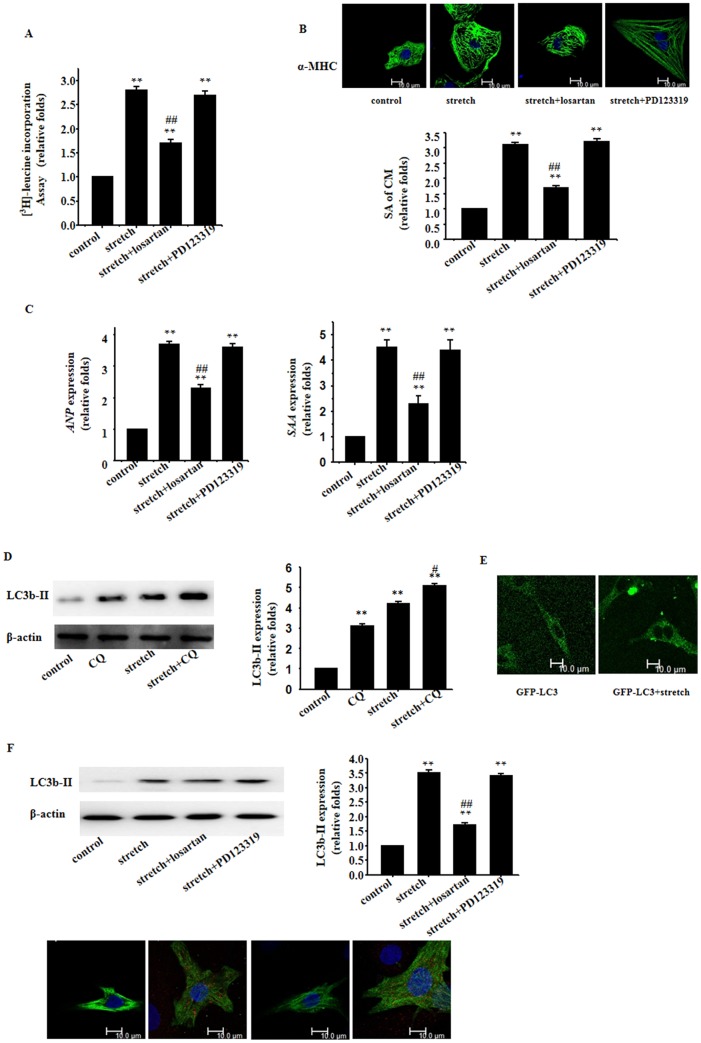
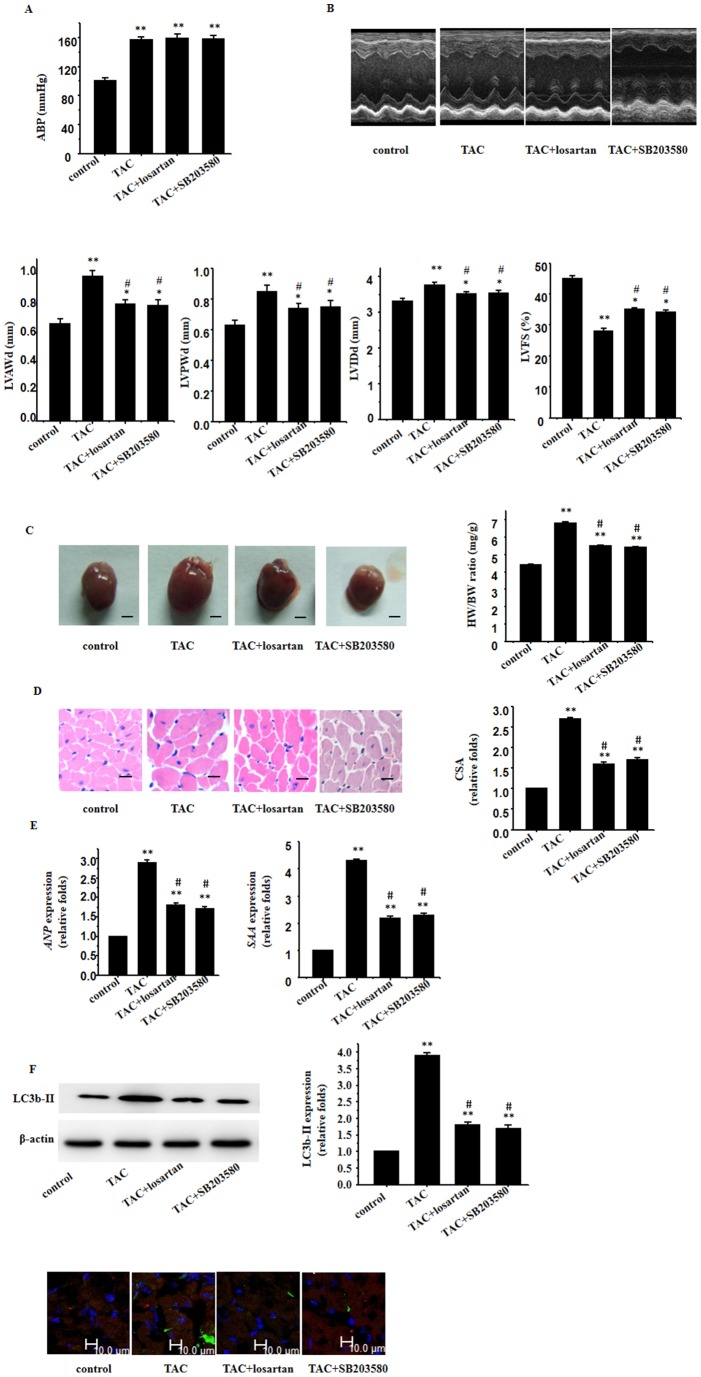
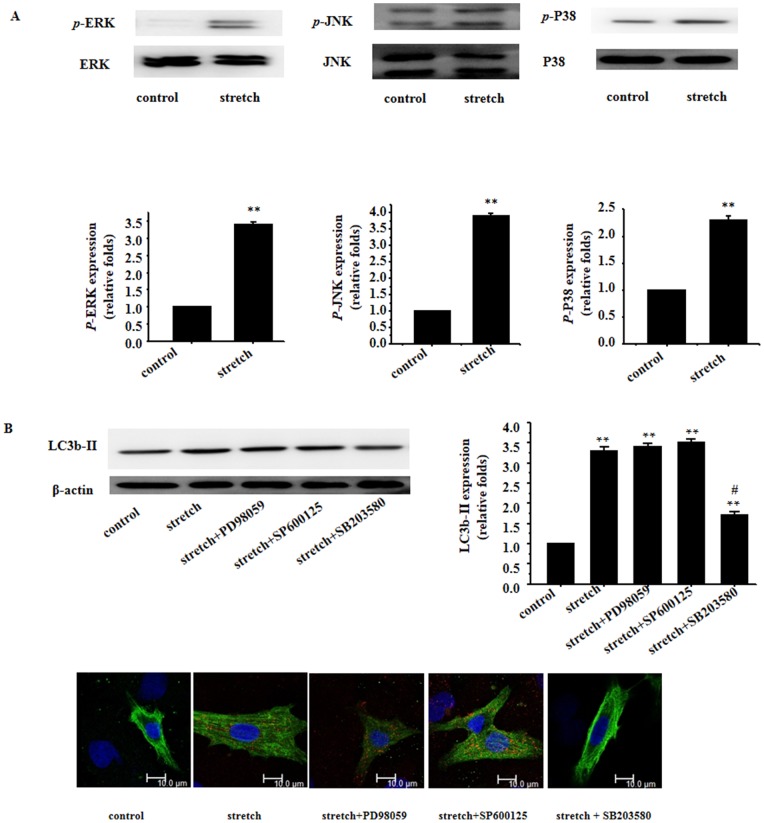
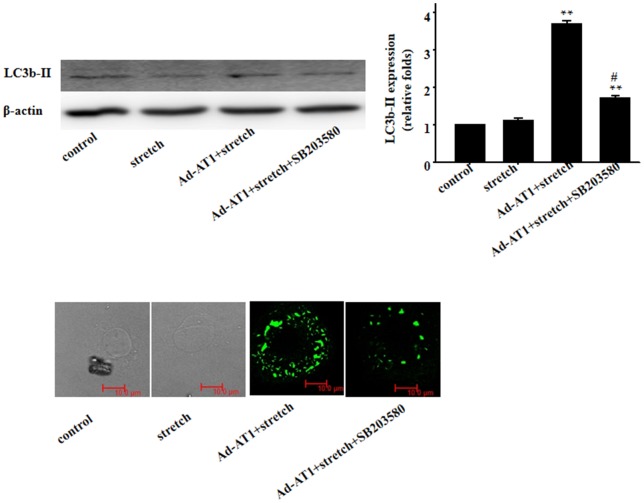
Angiotensin II (Ang II) type 1 (AT1) receptor is known to mediate a variety of physiological actions of Ang II including autophagy. However, the role of AT1 receptor in cardiomyocyte autophagy triggered by mechanical stress still remains elusive. The aim of this study was therefore to examine whether and how AT1 receptor participates in cardiomyocyte autophagy induced by mechanical stresses. A 48-hour mechanical stretch and a 4-week transverse aorta constriction (TAC) were imposed to cultured cardiomyocytes of neonatal rats and adult male C57B/L6 mice, respectively, to induce cardiomyocyte hypertrophy prior to the assessment of cardiomyocyte autophagy using LC3b-II. Losartan, an AT1 receptor blocker, but not PD123319, the AT2 inhibitor, was found to significantly reduce mechanical stretch-induced LC3b-II upregulation. Moreover, inhibition of p38MAP kinase attenuated not only mechanical stretch-induced cardiomyocyte hypertrophy but also autophagy. To the contrary, inhibition of ERK and JNK suppressed cardiac hypertrophy but not autophagy. Intriguingly, mechanical stretch-induced autophagy was significantly inhibited by Losartan in the absence of Ang II. Taken together, our results indicate that mechanical stress triggers cardiomyocyte autophagy through AT1 receptor-mediated activation of p38MAP kinase independently of Ang II.
已知血管紧张素II(Ang II)1型(AT1)受体介导Ang II的多种生理作用,包括自噬。然而,AT1受体在机械应激触发的心肌细胞自噬中的作用仍不清楚。因此,本研究的目的是探讨AT1受体是否以及如何参与机械应激诱导的心肌细胞自噬。分别对新生大鼠和成年雄性C57B/L6小鼠的培养心肌细胞施加48小时的机械拉伸和4周的主动脉缩窄(TAC),以诱导心肌细胞肥大,然后使用LC3b-II评估心肌细胞自噬。发现AT1受体阻滞剂氯沙坦可显著降低机械拉伸诱导的LC3b-II上调,而AT2抑制剂PD123319则无此作用。此外,抑制p38MAP激酶不仅可减轻机械拉伸诱导的心肌细胞肥大,还可减轻自噬。相反,抑制ERK和JNK可抑制心脏肥大,但不能抑制自噬。有趣的是,在没有Ang II的情况下,氯沙坦可显著抑制机械拉伸诱导的自噬。综上所述,我们的结果表明,机械应激通过AT1受体介导的p38MAP激酶激活触发心肌细胞自噬,且不依赖于Ang II。