Department of Neuro- and Sensory Physiology, University Medical Center Göttingen European Neuroscience Institute, Göttingen, Germany.
EMBO J. 2014 Apr 16;33(8):788-822. doi: 10.1002/embj.201386357. Epub 2014 Mar 3.
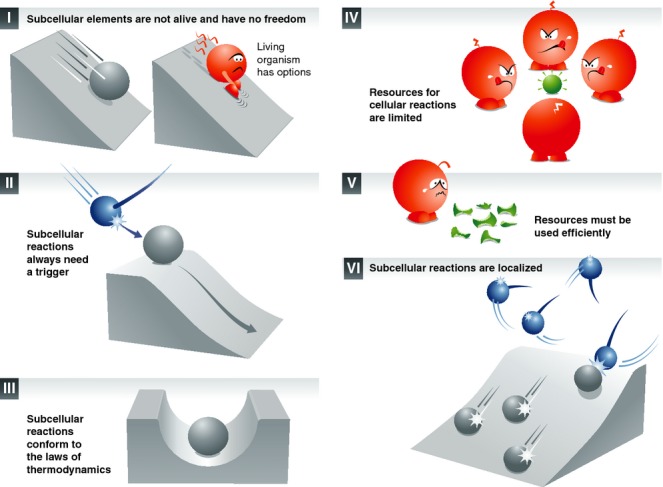
Synaptic vesicle recycling is one of the best-studied cellular pathways. Many of the proteins involved are known, and their interactions are becoming increasingly clear. However, as for many other pathways, it is still difficult to understand synaptic vesicle recycling as a whole. While it is generally possible to point out how synaptic reactions take place, it is not always easy to understand what triggers or controls them. Also, it is often difficult to understand how the availability of the reaction partners is controlled: how the reaction partners manage to find each other in the right place, at the right time. I present here an overview of synaptic vesicle recycling, discussing the mechanisms that trigger different reactions, and those that ensure the availability of reaction partners. A central argument is that synaptic vesicles bind soluble cofactor proteins, with low affinity, and thus control their availability in the synapse, forming a buffer for cofactor proteins. The availability of cofactor proteins, in turn, regulates the different synaptic reactions. Similar mechanisms, in which one of the reaction partners buffers another, may apply to many other processes, from the biogenesis to the degradation of the synaptic vesicle.
突触囊泡循环是研究得最好的细胞途径之一。许多涉及的蛋白质已经被了解,它们的相互作用也越来越清楚。然而,对于许多其他途径来说,仍然很难将突触囊泡循环作为一个整体来理解。虽然通常可以指出突触反应是如何发生的,但并不总是容易理解是什么触发或控制了它们。此外,通常也很难理解反应伴侣的可用性是如何被控制的:反应伴侣如何设法在正确的时间和地点找到彼此。我在这里介绍了突触囊泡循环的概述,讨论了触发不同反应的机制,以及确保反应伴侣可用性的机制。一个核心观点是,突触囊泡以低亲和力结合可溶性辅助因子蛋白,从而控制其在突触中的可用性,形成辅助因子蛋白的缓冲液。辅助因子蛋白的可用性反过来又调节不同的突触反应。类似的机制,其中一个反应伴侣缓冲另一个,可能适用于许多其他过程,从突触囊泡的生物发生到降解。