Müller-Redetzky Holger C, Suttorp Norbert, Witzenrath Martin
Department of Infectious Diseases and Pulmonary Medicine, Charité-Universitätsmedizin, Charitéplatz 1, 10117, Berlin, Germany.
Cell Tissue Res. 2014 Mar;355(3):657-73. doi: 10.1007/s00441-014-1821-0. Epub 2014 Mar 6.
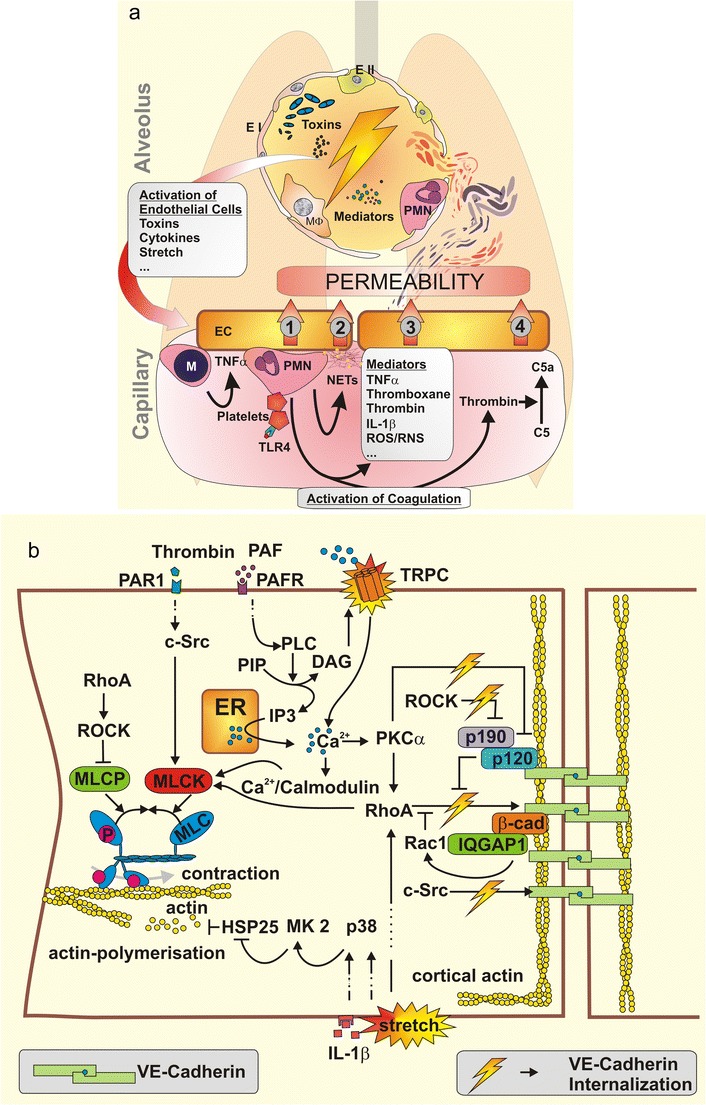
The lungs provide a large inner surface to guarantee respiration. In lung alveoli, a delicate membrane formed by endo- and epithelial cells with their fused basal lamina ensures rapid and effective gas exchange between alveolar and vascular compartments while concurrently forming a robust barrier against inhaled particles and microbes. However, upon infectious or sterile inflammatory stimulation, tightly regulated endothelial barrier leakiness is required for leukocyte transmigration. Further, endothelial barrier disruption may result in uncontrolled extravasation of protein-rich fluids. This brief review summarizes some important mechanisms of pulmonary endothelial barrier regulation and disruption, focusing on the role of specific cell populations, coagulation and complement cascades and mediators including angiopoietins, specific sphingolipids, adrenomedullin and reactive oxygen and nitrogen species for the regulation of pulmonary endothelial barrier function. Further, current therapeutic perspectives against development of lung injury are discussed.
肺提供了一个大的内表面以保证呼吸。在肺泡中,由内皮细胞和上皮细胞及其融合的基膜形成的一层薄而精致的膜,确保了肺泡和血管腔之间快速而有效的气体交换,同时形成了一道强大的屏障,抵御吸入的颗粒和微生物。然而,在感染性或无菌性炎症刺激下,白细胞迁移需要严格调控内皮屏障的通透性。此外,内皮屏障破坏可能导致富含蛋白质的液体不受控制地外渗。本综述总结了肺内皮屏障调节和破坏的一些重要机制,重点关注特定细胞群体、凝血和补体级联反应以及包括血管生成素、特定鞘脂、肾上腺髓质素和活性氧及氮物种在内的介质在调节肺内皮屏障功能中的作用。此外,还讨论了针对肺损伤发展的当前治疗前景。