Park Chanhyun, Kim Gilwan, Patel Isha, Chang Jongwha, Tan Xi
College of Pharmacy, University of Texas at Austin, Austin, TX, USA.
College of Pharmacy, University of Michigan, Ann Arbor, MI, USA.
Clin Cosmet Investig Dermatol. 2014 Feb 18;7:65-72. doi: 10.2147/CCID.S46051. eCollection 2014.
To examine recent studies on the effect of mobile and electronic (ME)-health technology on adherence to acne treatment.
With emerging use of ME-health technology, there is a growing interest in evaluating the effectiveness of the tools on medication adherence. Examples of ME-health technology-based tools include text message-based pill reminders and Web-based patient education.
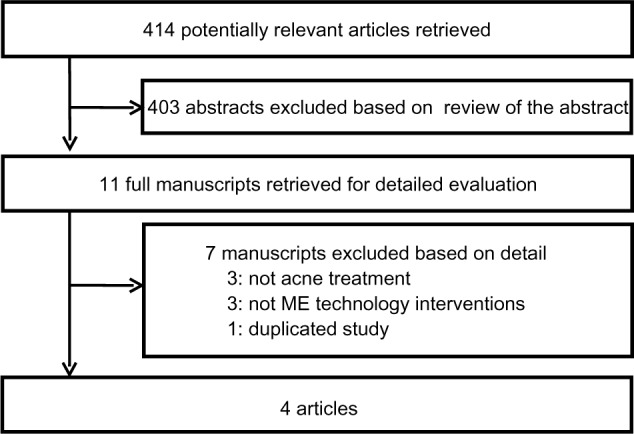
MEDLINE, Cochrane Library, and Web of Science were searched for articles on adherence to acne treatment published through November 2013. A combination of search terms such as "acne" and "adherence" or "compliance" were used.
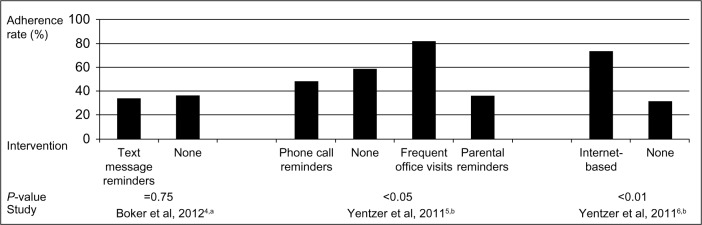
Adherence to oral acne medication was higher than for topical acne medication. The frequency of office visits was also an influencing factor for acne treatment adherence. The telephone-based reminders on a daily basis did not improve acne patients' medication adherence, whereas the Web-based educational tools on a weekly basis had a positive effect on medication adherence in acne treatment.
In using ME-health interventions, factors such as medication dosage forms, frequency of intervention, and patients' preferences should be taken into consideration. Developing disease-specific text message reminders may be helpful to increase adherence rates. In addition, a combination of text message reminders with another type of intervention may improve medication adherence.
探讨近期关于移动和电子(ME)健康技术对痤疮治疗依从性影响的研究。
随着ME健康技术的日益普及,人们对评估这些工具在药物依从性方面的有效性越来越感兴趣。基于ME健康技术的工具示例包括基于短信的服药提醒和基于网络的患者教育。
检索MEDLINE、Cochrane图书馆和科学网,查找截至2013年11月发表的关于痤疮治疗依从性的文章。使用了“痤疮”和“依从性”或“顺应性”等搜索词的组合。
口服痤疮药物的依从性高于外用痤疮药物。就诊频率也是影响痤疮治疗依从性的一个因素。每日的电话提醒并未提高痤疮患者的药物依从性,而每周的基于网络的教育工具对痤疮治疗的药物依从性有积极影响。
在使用ME健康干预措施时,应考虑药物剂型、干预频率和患者偏好等因素。开发针对特定疾病的短信提醒可能有助于提高依从率。此外,将短信提醒与另一种干预措施相结合可能会改善药物依从性。