Hershfield Michael S, Ganson Nancy J, Kelly Susan J, Scarlett Edna L, Jaggers Denise A, Sundy John S
Arthritis Res Ther. 2014 Mar 7;16(2):R63. doi: 10.1186/ar4500.
Pegloticase, a PEGylated recombinant porcine uricase, is approved for treating refractory gout at a dose of 8 mg intravenous (IV) every 2 weeks. However, during phase 1 testing, pharmacokinetics supported less frequent dosing. Also, single doses of pegloticase unexpectedly induced antibodies (Ab) that bound to polyethylene glycol (PEG). We have conducted a phase 2 trial to evaluate every 3-week dosing, and to further define the Ab response to pegloticase. Organ transplant recipients were included, as they are prone to severe gout that is difficult to manage, and because treatment to prevent graft rejection might influence the immune response to pegloticase.
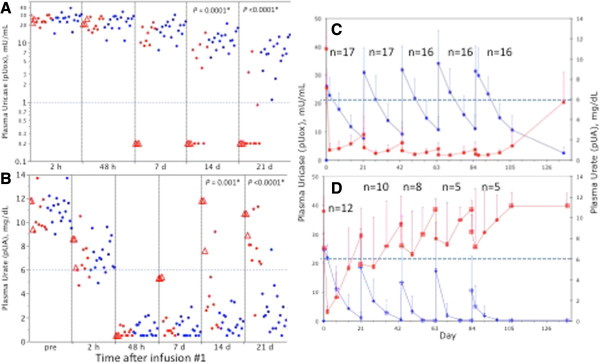
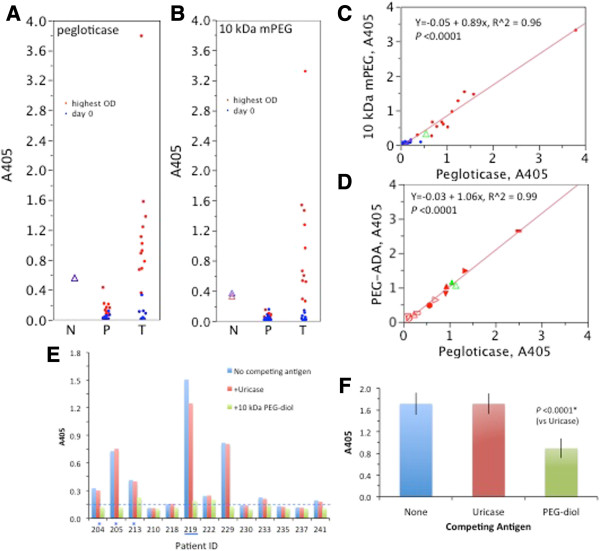
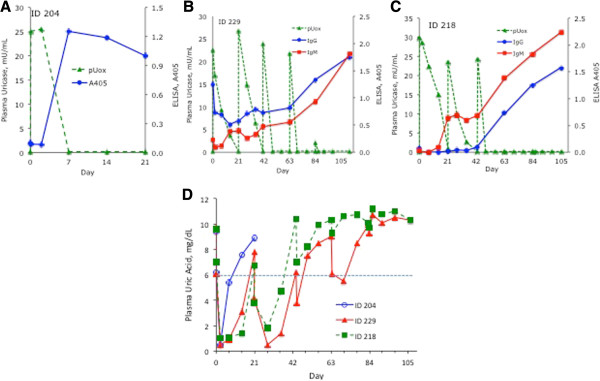
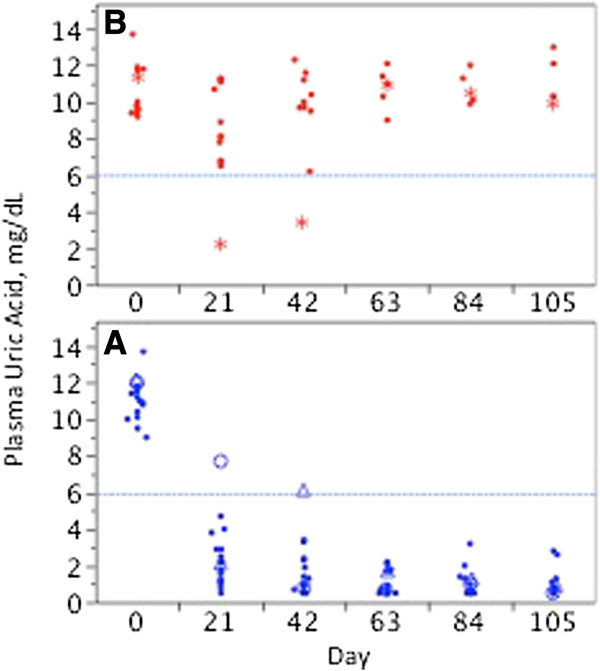
Plasma uricase activity (pUox), urate concentration (pUA), and clinical response were monitored during up to 5 infusions in 30 patients, including 7 organ transplant recipients. Depending on whether pUA <6 mg/dL was achieved and maintained, patients were classified as non (NR), persistent (PR), or transient (TR) responders. Ab to pegloticase and 10 kDa mPEG were monitored by enzyme linked immunosorbent assay and specificity was further defined.
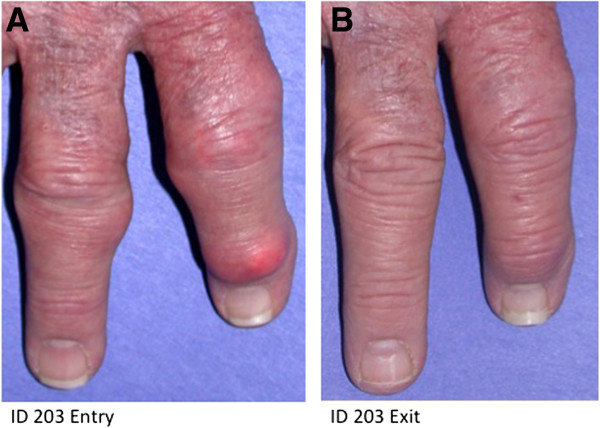
We observed 17 PR, 12 TR, and 1 NR; 21 patients (16 PR, 5 TR) received all 5 infusions. Over the 15-week trial, pUA in PR averaged 1.0 ± 0.4 mg/dL; T½ for pUox was approximately 13 days, and area under the curve after dose 5 was approximately 30% higher than after dose 1. PR showed clinical benefit and in some, tophi resolved. In 11 of 12 TR, pUox fell rapidly and hyperuricemia recurred before dose 2. In all TR and NR, loss of response to pegloticase was accompanied by Ab to PEG, which was pre-existing in half of those who had no prior exposure to pegloticase. No PR, and 1 one out of 7 organ transplant recipients, had a sustained Ab response to pegloticase.
Every 3-week dosing is effective and may enhance the utility of pegloticase for treating refractory gout. Ab to PEG, which were pre-existing or induced by treatment, caused rapid loss of efficacy and increased the risk of infusion reactions. Organ transplant recipients can benefit from pegloticase, and may be less prone than non-recipients to developing anti-PEG Ab. Investigation of immunosuppressive strategies to minimize anti-PEG Ab is warranted.
ClincalTrials.gov identifier: NCT00111657.
聚乙二醇化重组猪尿酸酶培戈洛酶已获批用于治疗难治性痛风,剂量为每2周静脉注射8毫克。然而,在1期试验期间,药代动力学支持更低频率的给药方案。此外,单剂量培戈洛酶意外诱导产生了与聚乙二醇(PEG)结合的抗体(Ab)。我们进行了一项2期试验,以评估每3周给药方案,并进一步明确对培戈洛酶的抗体反应。纳入了器官移植受者,因为他们易患难以控制的严重痛风,且预防移植排斥的治疗可能会影响对培戈洛酶的免疫反应。
在30例患者(包括7例器官移植受者)中进行了多达5次输注,期间监测血浆尿酸酶活性(pUox)、尿酸盐浓度(pUA)和临床反应。根据是否达到并维持pUA<6毫克/分升,将患者分为无反应者(NR)、持续反应者(PR)或短暂反应者(TR)。通过酶联免疫吸附测定法监测对培戈洛酶和10 kDa甲氧基聚乙二醇(mPEG)的抗体,并进一步明确其特异性。
我们观察到17例PR、12例TR和1例NR;其中21例患者(16例PR,5例TR)接受了全部5次输注。在为期15周的试验中,PR患者的pUA平均为1.0±0.4毫克/分升;pUox的半衰期约为13天,第5次给药后的曲线下面积比第1次给药后约高30%。PR患者显示出临床获益,部分患者的痛风石消退。在12例TR患者中的11例中,pUox迅速下降,高尿酸血症在第2次给药前复发。在所有TR和NR患者中,对培戈洛酶反应丧失均伴有对PEG的抗体,在未接触过培戈洛酶的患者中,一半患者的该抗体为预先存在。没有PR患者,7例器官移植受者中只有1例对培戈洛酶有持续抗体反应。
每3周给药方案有效,可能会提高培戈洛酶治疗难治性痛风的效用。预先存在或由治疗诱导产生的对PEG的抗体导致疗效迅速丧失,并增加了输注反应的风险。器官移植受者可从培戈洛酶中获益,且可能比非受者更不易产生抗PEG抗体。有必要研究免疫抑制策略以尽量减少抗PEG抗体的产生。
ClinicalTrials.gov标识符:NCT00111657。