Kim Youl-Ri, Kim Chan-Hyung, Park Jin Hong, Pyo Jimin, Treasure Janet
Department of Neuropsychiatry, Seoul Paik Hospital, Inje University, Seoul, Republic of Korea.
Department of Psychiatry, Severance Mental Hospital, Yonsei University College of Medicine, Gyeonggi Do, South Korea.
PLoS One. 2014 Mar 6;9(6):e90721. doi: 10.1371/journal.pone.0090721. eCollection 2014.
Social factors may be of importance causally and act as maintenance factors in patients with anorexia nervosa. Oxytocin is a neuromodulatory hormone involved in social emotional processing associated with attentional processes. This study aimed to examine the impact of oxytocin on attentional processes to social faces representing anger, disgust, and happiness in patients with anorexia nervosa.
A double-blind, placebo-controlled within-subject crossover design was used. Intranasal oxytocin or placebo followed by a visual probe detection task with faces depicting anger, disgust, and happiness was administered to 64 female subjects: 31 patients with anorexia nervosa and 33 control students.
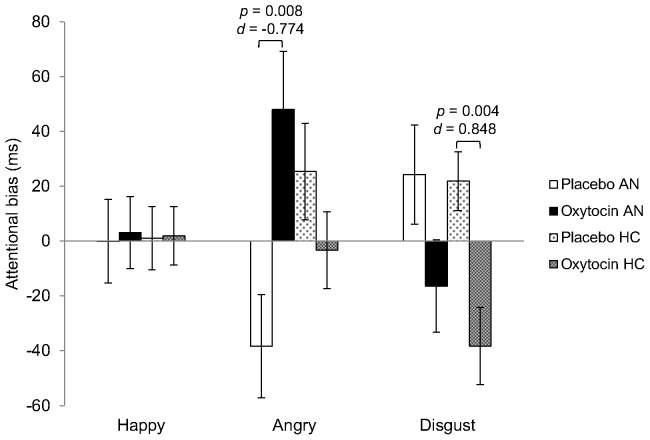
Attentional bias to the disgust stimuli was observed in both groups under the placebo condition. The attentional bias to disgust was reduced under the oxytocin condition (a moderate effect in the patient group). Avoidance of angry faces was observed in the patient group under the placebo condition and vigilance was observed in the healthy comparison group; both of these information processing responses were moderated by oxytocin producing an increase in vigilance in the patients. Happy/smiling faces did not elicit an attentional response in controls or the patients under either the placebo or oxytocin conditions.
Oxytocin attenuated attentional vigilance to disgust in patients with anorexia nervosa and healthy controls. On the other hand, oxytocin changed the response to angry faces from avoidance to vigilance in patients but reduced vigilance to anger in healthy controls. We conclude that patients with anorexia nervosa appear to use different strategies/circuits to emotionally process anger from their healthy counterparts.
社会因素在神经性厌食症患者中可能具有因果关系且起到维持因素的作用。催产素是一种神经调节激素,参与与注意力过程相关的社会情感加工。本研究旨在探讨催产素对神经性厌食症患者对代表愤怒、厌恶和快乐的社会面孔的注意力过程的影响。
采用双盲、安慰剂对照的受试者内交叉设计。对64名女性受试者(31名神经性厌食症患者和33名对照学生)给予鼻内催产素或安慰剂,随后进行带有描绘愤怒、厌恶和快乐的面孔的视觉探测任务。
在安慰剂条件下,两组均观察到对厌恶刺激的注意力偏向。在催产素条件下,对厌恶的注意力偏向降低(患者组有中等效应)。在安慰剂条件下,患者组观察到对愤怒面孔的回避,而健康对照组观察到警觉性;这两种信息加工反应均受到催产素的调节,使患者的警觉性增加。在安慰剂或催产素条件下,快乐/微笑的面孔在对照组或患者中均未引发注意力反应。
催产素减弱了神经性厌食症患者和健康对照者对厌恶的注意力警觉性。另一方面,催产素使患者对愤怒面孔的反应从回避变为警觉,但降低了健康对照者对愤怒的警觉性。我们得出结论,神经性厌食症患者在对愤怒进行情绪加工时似乎使用了与健康对照者不同的策略/神经回路。