Wang Peter L, Bao Yun, Yee Muh-Ching, Barrett Steven P, Hogan Gregory J, Olsen Mari N, Dinneny José R, Brown Patrick O, Salzman Julia
Department of Biochemistry, Stanford University School of Medicine, Stanford, California, United States of America; Stanford Cancer Institute, Stanford University School of Medicine, Stanford, California, United States of America.
Department of Plant Biology, Carnegie Institution for Science, Stanford, California, United States of America; Temasek Lifesciences Laboratory, National University of Singapore, Singapore, Singapore; Department of Biological Sciences, National University of Singapore, Singapore, Singapore.
PLoS One. 2014 Mar 7;9(6):e90859. doi: 10.1371/journal.pone.0090859. eCollection 2014.
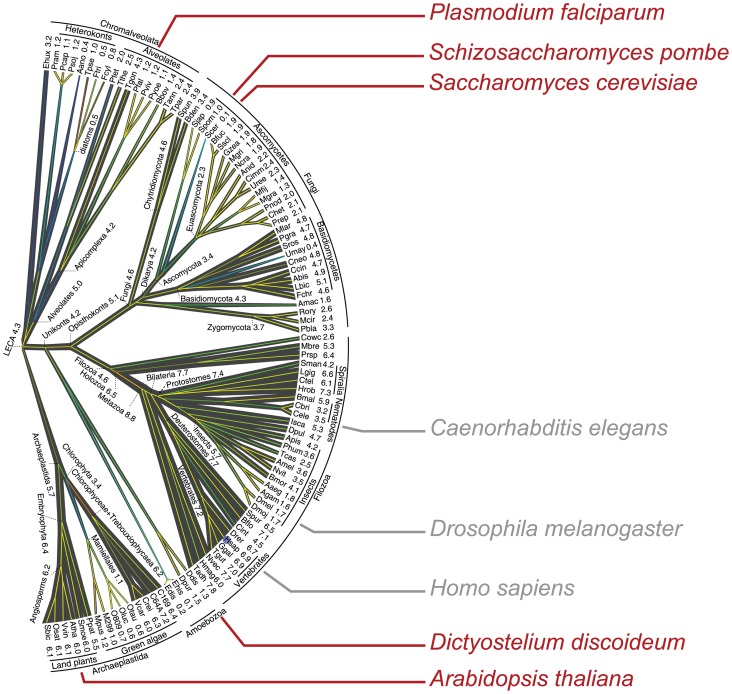
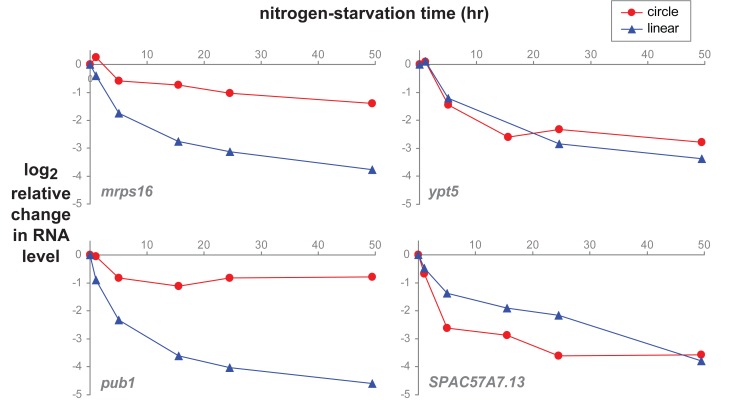
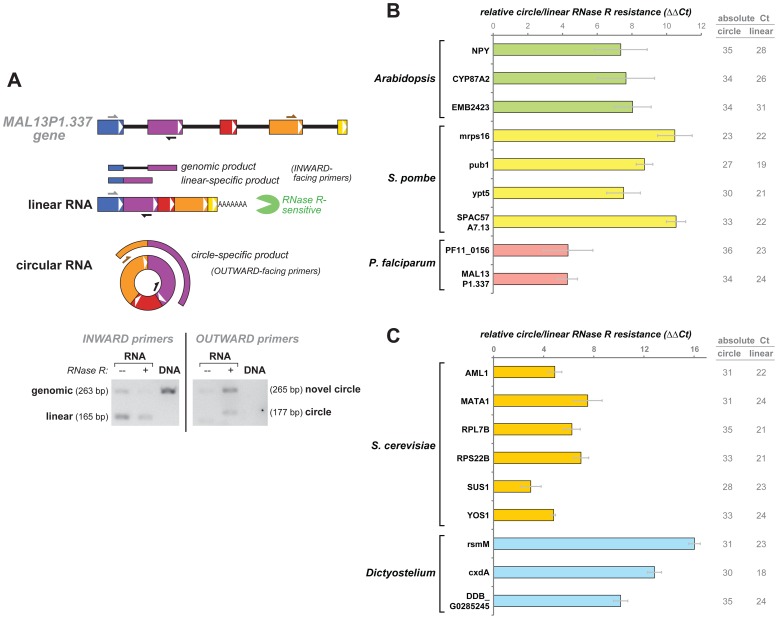
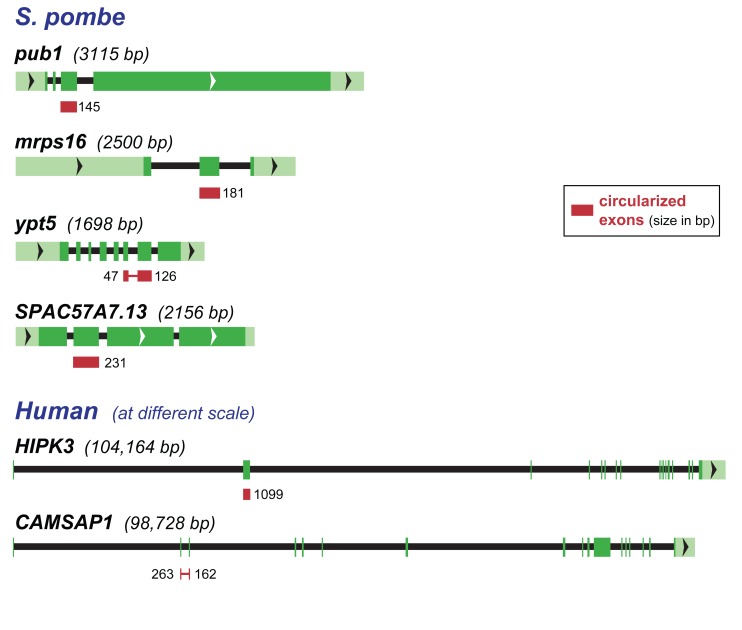
An unexpectedly large fraction of genes in metazoans (human, mouse, zebrafish, worm, fruit fly) express high levels of circularized RNAs containing canonical exons. Here we report that circular RNA isoforms are found in diverse species whose most recent common ancestor existed more than one billion years ago: fungi (Schizosaccharomyces pombe and Saccharomyces cerevisiae), a plant (Arabidopsis thaliana), and protists (Plasmodium falciparum and Dictyostelium discoideum). For all species studied to date, including those in this report, only a small fraction of the theoretically possible circular RNA isoforms from a given gene are actually observed. Unlike metazoans, Arabidopsis, D. discoideum, P. falciparum, S. cerevisiae, and S. pombe have very short introns (∼ 100 nucleotides or shorter), yet they still produce circular RNAs. A minority of genes in S. pombe and P. falciparum have documented examples of canonical alternative splicing, making it unlikely that all circular RNAs are by-products of alternative splicing or 'piggyback' on signals used in alternative RNA processing. In S. pombe, the relative abundance of circular to linear transcript isoforms changed in a gene-specific pattern during nitrogen starvation. Circular RNA may be an ancient, conserved feature of eukaryotic gene expression programs.
后生动物(人类、小鼠、斑马鱼、线虫、果蝇)中,出乎意料的是,很大一部分基因会高水平表达含有典型外显子的环状RNA。在此我们报告,在最近的共同祖先生活在十亿多年前的多种物种中发现了环状RNA异构体:真菌(粟酒裂殖酵母和酿酒酵母)、一种植物(拟南芥)以及原生生物(恶性疟原虫和盘基网柄菌)。对于迄今研究的所有物种,包括本报告中的物种,给定基因理论上可能的环状RNA异构体中只有一小部分实际被观察到。与后生动物不同,拟南芥、盘基网柄菌、恶性疟原虫、酿酒酵母和粟酒裂殖酵母的内含子非常短(约100个核苷酸或更短),但它们仍能产生环状RNA。粟酒裂殖酵母和恶性疟原虫中少数基因有典型可变剪接的记录实例,这使得并非所有环状RNA都是可变剪接的副产物或“搭便车”于可变RNA加工中使用的信号这一点不太可能成立。在粟酒裂殖酵母中,在氮饥饿期间,环状与线性转录本异构体的相对丰度以基因特异性模式发生变化。环状RNA可能是真核基因表达程序中一个古老且保守的特征。