Laboratoire Interuniversitaire de Psychologie (LIP), University of Grenoble 2 Grenoble, France ; Department of Psychology, University of Louvain Louvain-la-Neuve, Belgium.
Laboratoire Interuniversitaire de Psychologie (LIP), University of Grenoble 2 Grenoble, France.
Front Hum Neurosci. 2014 Feb 28;8:97. doi: 10.3389/fnhum.2014.00097. eCollection 2014.
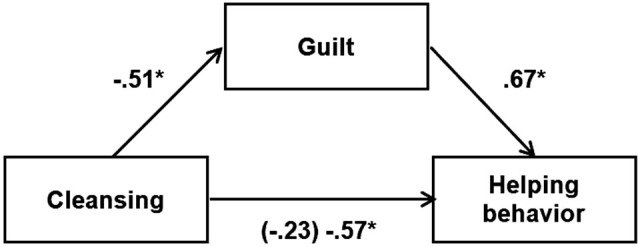
For centuries people have washed away their guilt by washing their hands. Do people need to wash their own hands, or is it enough to watch other people wash their hands? To induce guilt, we had participants write about a past wrong they had committed. Next, they washed their hands, watched a washing-hands video, or watched a typing-hands video. After the study was over, participants could help a Ph.D. student complete her dissertation by taking some questionnaires home and returning them within 3 weeks. Results showed that guilt and helping behavior were lowest among participants who washed their hands, followed by participants who watched a washing-hands video, followed by participants who watched a typing-hands video. Guilt mediated the effects of cleansing on helping. These findings suggest that washing one's own hands, or even watching someone else wash their hands, can wash away one's guilt and lead to less helpful behavior.
几个世纪以来,人们通过洗手来洗清自己的罪恶感。人们需要自己洗手,还是仅仅观看别人洗手就足够了?为了诱发罪恶感,我们让参与者写下过去他们犯下的一个错误。接下来,他们洗手、观看洗手视频或观看打字视频。研究结束后,参与者可以帮助一名博士生完成她的论文,将一些问卷带回家并在 3 周内交回。结果表明,在参与者中,洗手的人罪恶感和帮助行为最低,其次是观看洗手视频的人,其次是观看打字视频的人。罪恶感在清洁对帮助的影响中起中介作用。这些发现表明,洗手,甚至观看别人洗手,都可以洗清一个人的罪恶感,导致更少的帮助行为。