mBio. 2014 Mar 11;5(2):e00899-14. doi: 10.1128/mBio.00899-14.
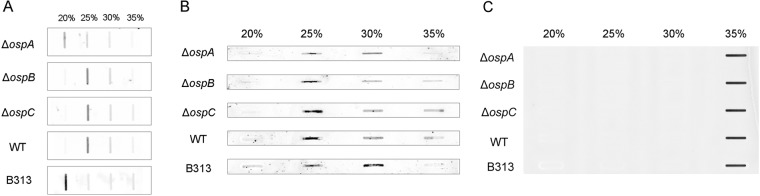
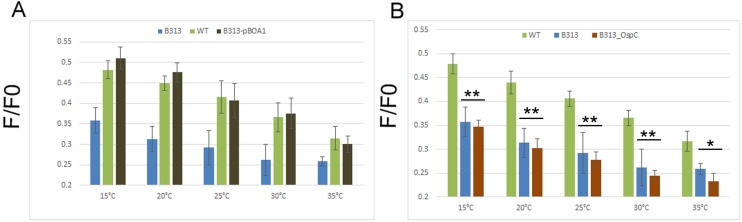
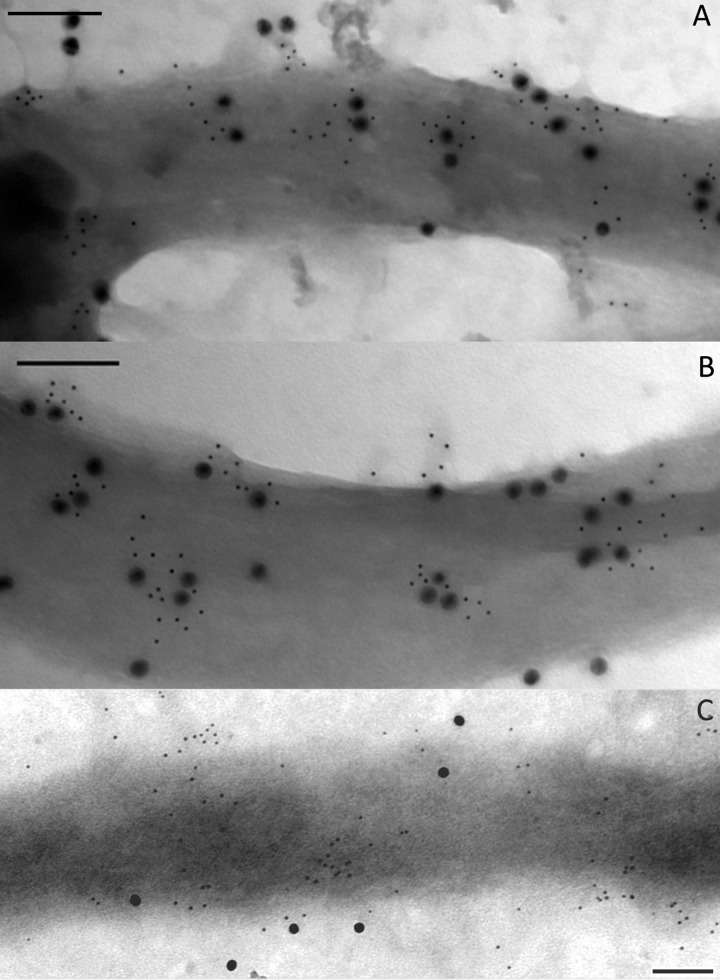
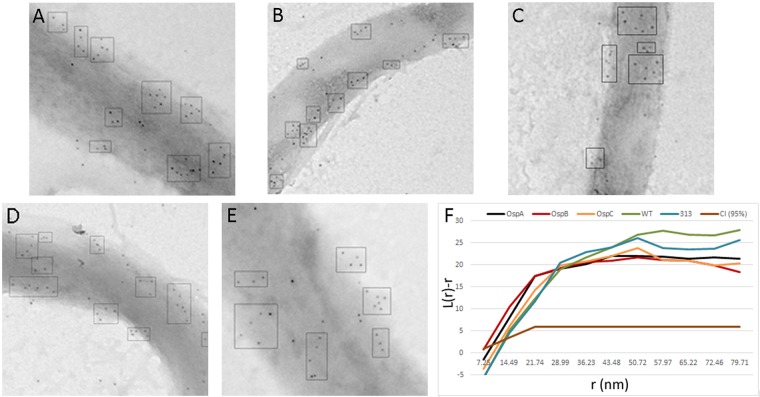
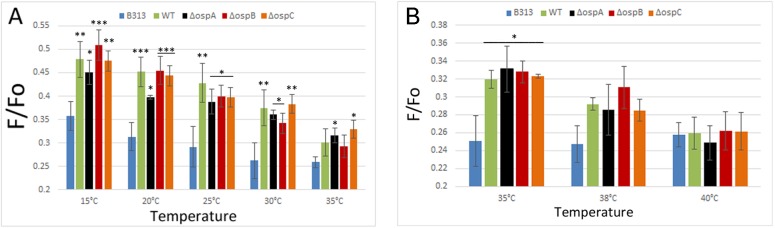
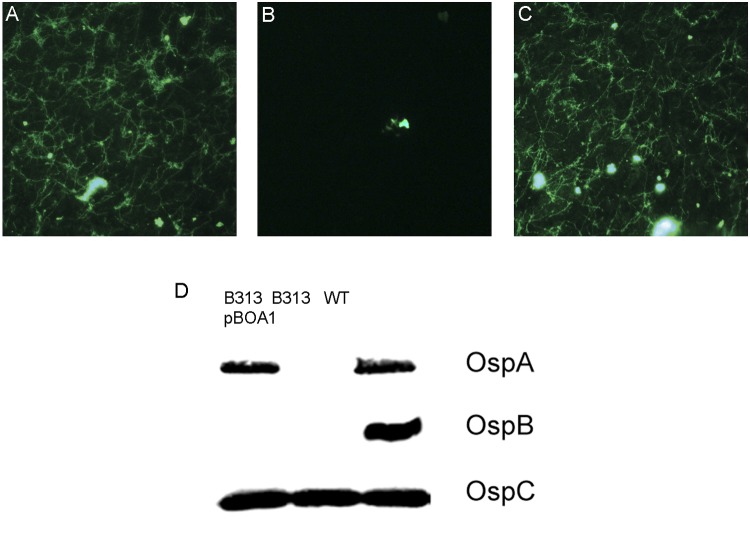
Borrelia burgdorferi contains unique cholesterol-glycolipid-rich lipid rafts that are associated with lipoproteins. These complexes suggest the existence of macromolecular structures that have not been reported for prokaryotes. Outer surface lipoproteins OspA, OspB, and OspC were studied for their participation in the formation of lipid rafts. Single-gene deletion mutants with deletions of ospA, ospB, and ospC and a spontaneous gene mutant, strain B313, which does not express OspA and OspB, were used to establish their structural roles in the lipid rafts. All mutant strains used in this study produced detergent-resistant membranes, a common characteristic of lipid rafts, and had similar lipid and protein slot blot profiles. Lipoproteins OspA and OspB but not OspC were shown to be associated with lipid rafts by transmission electron microscopy. When the ability to form lipid rafts in live B. burgdorferi spirochetes was measured by fluorescence resonance energy transfer (FRET), strain B313 showed a statistically significant lower level of segregation into ordered and disordered membrane domains than did the wild-type and the other single-deletion mutants. The transformation of a B313 strain with a shuttle plasmid containing ospA restored the phenotype shared by the wild type and the single-deletion mutants, demonstrating that OspA and OspB have redundant functions. In contrast, a transformed B313 overexpressing OspC neither rescued the FRET nor colocalized with the lipid rafts. Because these lipoproteins are expressed at different stages of the life cycle of B. burgdorferi, their selective association is likely to have an important role in the structure of prokaryotic lipid rafts and in the organism's adaptation to changing environments. IMPORTANCE Lipid rafts are cholesterol-rich clusters within the membranes of cells. Lipid rafts contain proteins that have functions in sensing the cell environment and transmitting signals. Although selective proteins are present in lipid rafts, little is known about their structural contribution to these domains. Borrelia burgdorferi, the agent of Lyme disease, has lipid rafts, which are novel structures in bacteria. Here, we have shown that the raft-associated lipoproteins OspA and OspB selectively contribute to lipid rafts. A similar but non-raft-associated lipoprotein, OspC, cannot substitute for the role of OspA and OspB. In this study, we have demonstrated that lipoprotein association with lipid rafts is selective, further suggesting a functional adaptation to different stages of the spirochete life cycle. The results of this study are of broader importance and can serve as a model for other bacteria that also possess cholesterol in their membranes and, therefore, may share lipid raft traits with Borrelia.
伯氏疏螺旋体含有独特的富含胆固醇的糖脂丰富的脂筏,与脂蛋白有关。这些复合物表明存在尚未报道的原核生物的大分子结构。研究了外表面脂蛋白 OspA、OspB 和 OspC 参与脂筏的形成。使用单基因缺失突变体缺失 ospA、ospB 和 ospC 以及一个自发基因突变体菌株 B313(不表达 OspA 和 OspB)来确定它们在脂筏中的结构作用。本研究中使用的所有突变株都产生了去污剂抗性膜,这是脂筏的共同特征,并且具有相似的脂质和蛋白质斑点印迹图谱。透射电子显微镜显示,脂蛋白 OspA 和 OspB 但不是 OspC 与脂筏有关。当通过荧光共振能量转移 (FRET) 测量活伯氏疏螺旋体螺旋体形成脂筏的能力时,与野生型和其他单缺失突变体相比,B313 菌株显示出统计学上显著较低的有序和无序膜域分离水平。含有 ospA 的穿梭质粒转化 B313 菌株恢复了野生型和单缺失突变体共有的表型,表明 OspA 和 OspB 具有冗余功能。相比之下,过度表达 OspC 的转化 B313 既不能挽救 FRET,也不能与脂筏共定位。由于这些脂蛋白在伯氏疏螺旋体生命周期的不同阶段表达,它们的选择性关联可能在原核脂筏的结构和生物体对环境变化的适应中发挥重要作用。重要性 脂筏是细胞膜内富含胆固醇的簇。脂筏包含在感知细胞环境和传递信号中具有功能的蛋白质。尽管存在选择性蛋白质,但对它们对这些结构域的结构贡献知之甚少。伯氏疏螺旋体,莱姆病的病原体,具有脂筏,这是细菌中的新结构。在这里,我们表明,与脂筏相关的脂蛋白 OspA 和 OspB 选择性地参与脂筏。一种类似但非脂筏相关的脂蛋白 OspC 不能替代 OspA 和 OspB 的作用。在这项研究中,我们已经证明了脂蛋白与脂筏的关联是选择性的,这进一步表明了对螺旋体生命周期不同阶段的功能适应。这项研究的结果具有更广泛的重要性,可以作为其他也在其膜中含有胆固醇的细菌的模型,因此可能与伯氏疏螺旋体共享脂筏特征。